Poetic Rendering

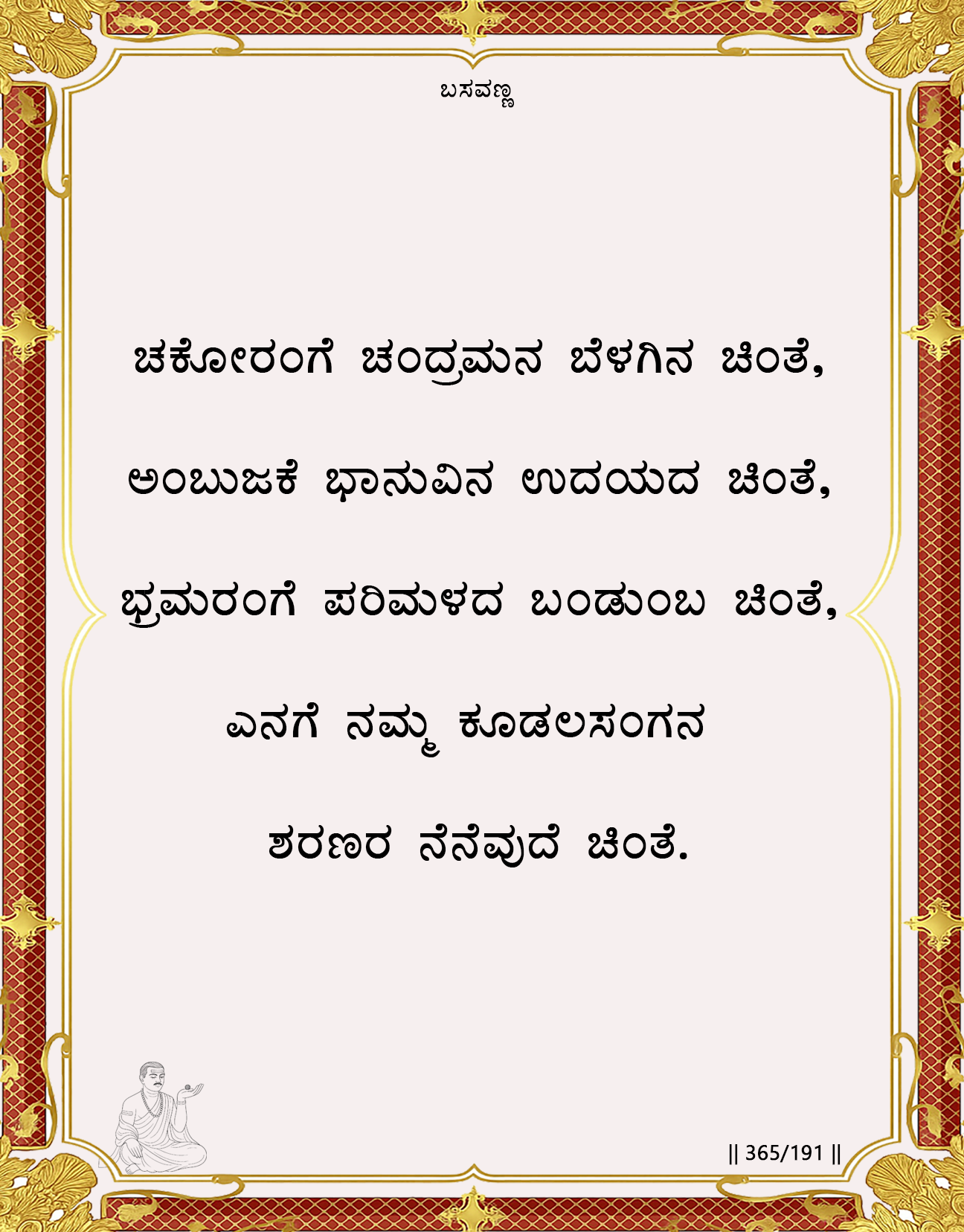
The radiant bird pines for moonlight
without its glow, its colors fall into darkness.
The lotus waits with folded palms
for dawn to open its hidden splendor.
The bee trembles in longing
for the sweet breath of flowers.
And I
my joy, my ache, my every pulse
turns only toward the remembrance
of the sharanas of Koodalasangama.
In this vachana, Basavanna reveals that true devotion arises not from effort but from the soul’s natural orientation toward its source, just as a bird longs for moonlight, a lotus yearns for the sun, and a bee seeks nectar. These images show that longing is intrinsic to life itself. Basavanna confesses that his own consciousness has found its rightful direction in the living radiance of the sharanas of Koodalasangama; they are the light, warmth, and nourishment of his inner being. Devotion here becomes not a practice, but the very nature of an awakened heart.
Spiritual Context
Core Spiritual Principle: Devotion (bhakti) as the soul’s innate dharma. The longing for God is not an acquired sentiment but the fundamental operating principle of consciousness, as natural as a flower turning toward the sun. When this longing is awakened, spiritual practice ceases to be an effort and becomes as effortless and essential as breathing.
Cosmic Reality Perspective: This vachana beautifully captures the pull of Shakti toward Shiva. The bird, lotus, and bee are all metaphors for Shakti the individual unit of consciousness and energy. Their longing for moonlight, sun, and nectar is Shakti’s inherent desire to return to and be illumined by its source, Shiva. The sharanas are those in whom this union is so complete that they themselves become beacons of this divine light, attracting other seeking souls.
Historical Reality (Anubhava Mantapa Context): This vachana describes the mature, self-sustaining spirituality of the Lingayoga community. It moves beyond the initial stages of discipline and effort to depict the state of a seasoned sharana for whom devotion has become as natural as life itself. It validates the community’s focus on satsang (holy company), showing that realized beings become the “moonlight” and “nectar” for other seekers.
Interpretation
“The radiant bird pines for moonlightwithout its glow, its colors fall into darkness.” The soul’s (“bird’s”) innate radiance is dependent on divine illumination (“moonlight”). Without this connection, its true nature remains unmanifest and unseen, lost in the “darkness” of ignorance.
“The lotus waits with folded palms for dawn to open its hidden splendor.” The heart is the “lotus,” which remains closed (“folded palms”) until the grace of the divine “dawn” allows it to open and reveal its inherent beauty and offering. This signifies the state of receptive waiting.
“The bee trembles in longing for the sweet breath of flowers.” This conveys the intensity and sweetness of the longing. The “trembling” is the vibration of intense love (mahabhava), and the “sweet breath” is the subtle, intoxicating essence of the Divine.
“And Imy joy, my ache, my every pulse turns only toward the remembrance of the sharanas…” This is the culmination. The seeker’s entire beingboth joy and sorrowhas been re-calibrated. Its fundamental frequency is now attuned to the presence of those who embody the Divine. They have become the proximate, accessible source of the moonlight, sun, and nectar.
Practical Implications: The practitioner is encouraged to nurture this natural longing rather than suppress it. Allow the heart to ache for God. Seek out the company of those who inspire this feeling, for they help to awaken and direct this innate pull of the soul.
The Cosmic Reality
Anga (Human Dimension): The Anga is the longing itself. It is not a flaw but a feature the soul’s homing device. Its purpose is to feel this ache and to orient the entire being toward its source.
Linga (Divine Principle): The Linga is the ultimate fulfillment of the longing the moonlight, the sun, the nectar. It is the silent attractor that pulls all life toward itself.
Jangama (Dynamic Interaction): The Jangama is the confluence where the longing of the Anga meets the grace of the Linga. The true sharanas are this living confluence. To be in their company (satsang) is to stand at the point where the pull is strongest, making the longing most intense and its fulfillment most tangible.
Shata Sthala
Primary Sthala: Pranalingi (One for whom Linga is Life-Breath) The state described is that of the Pranalingi. For such a person, the remembrance of the Divine (through the sharanas) is not an activity but as natural and essential as the breath itselfit is the very “pulse” of their being.
Supporting Sthala: Aikya (Union) The vachana points toward Aikya. The longing is so complete that the distinction between the seeker (the bird) and the sought (the moonlight) begins to dissolve. The remembrance is not of something separate, but of one’s own deepest nature.
Practical Integration
Arivu (Awareness Practices): Contemplate the natural metaphors in this vachana. Sit quietly and feel yourself as the bird longing for light, the lotus waiting to open, the bee seeking nectar. Do not resist the feeling of longing; embrace it as your soul’s true direction.
Achara (Personal Discipline): Let your discipline be to protect and nurture this longing. Avoid environments and influences that numb this sacred ache. Curate your life to stay in the “moonlight” of inspiring company and teachings.
Kayaka (Sacred Action): Let your work be an expression of this longing. Pour the love you feel into your service, making your labor an offering that itself becomes a form of remembrance.
Dasoha (Communal Offering): Become a source of “moonlight” for others. In your community, strive to be a presence that inspires and nurtures the divine longing in your fellow seekers, creating a collective field of aspiration.
Modern Application
We are taught to seek fulfillment in external achievements, possessions, and relationships. When these inevitably fail to satisfy our deepest longing, we pathologize the feeling as depression, anxiety, or emptiness, and seek to numb it with distraction, consumption, or medication.
This vachana re-frames our deepest ache as our greatest blessing. It liberates us from the futile search for fulfillment in the transient and directs us toward the only source of lasting peace. It teaches us to honor our spiritual hunger as a divine compass, guiding us home to our true nature.
Essence
The bird for moon, the flower for sun,
The bee for blooms, till day is done.
So too my heart, with restless beat,
Finds its true end, its joy complete,
In but the thought of those who stand
One with my Lord, in heart and hand.
The Deeper Pattern: This vachana describes the fundamental principle of spiritual gravitation. Just as physical bodies are governed by gravity, conscious beings are governed by a “love force” that pulls them toward the source of consciousness itself. The bird, lotus, and bee are all obeying this law in their own realm. Basavanna has simply become conscious of this law operating within him, and has identified the “massive objects” (the sharanas) that create the strongest gravitational pull in his spiritual universe.
In Simple Terms: It is like a compass needle that has found its north. The needle doesn’t try to point north; it is its nature to do so when it is free to move. Basavanna’s heart is that compass, and the sharanas are his “magnetic north.” All agitation ceases once the alignment is found; the needle rests, pointing truly, and in that pointing, it fulfills its purpose.
The Human Truth: We all have a deep, often unnamable longing. We spend our lives trying to satisfy it with a thousand different things. The timeless truth here is that this longing has a single, correct address. When we finally direct it toward the Divine often through the living example of those who have done soour life finds its true axis, and our restless seeking transforms into peaceful, purposeful abiding.

Views: 0