
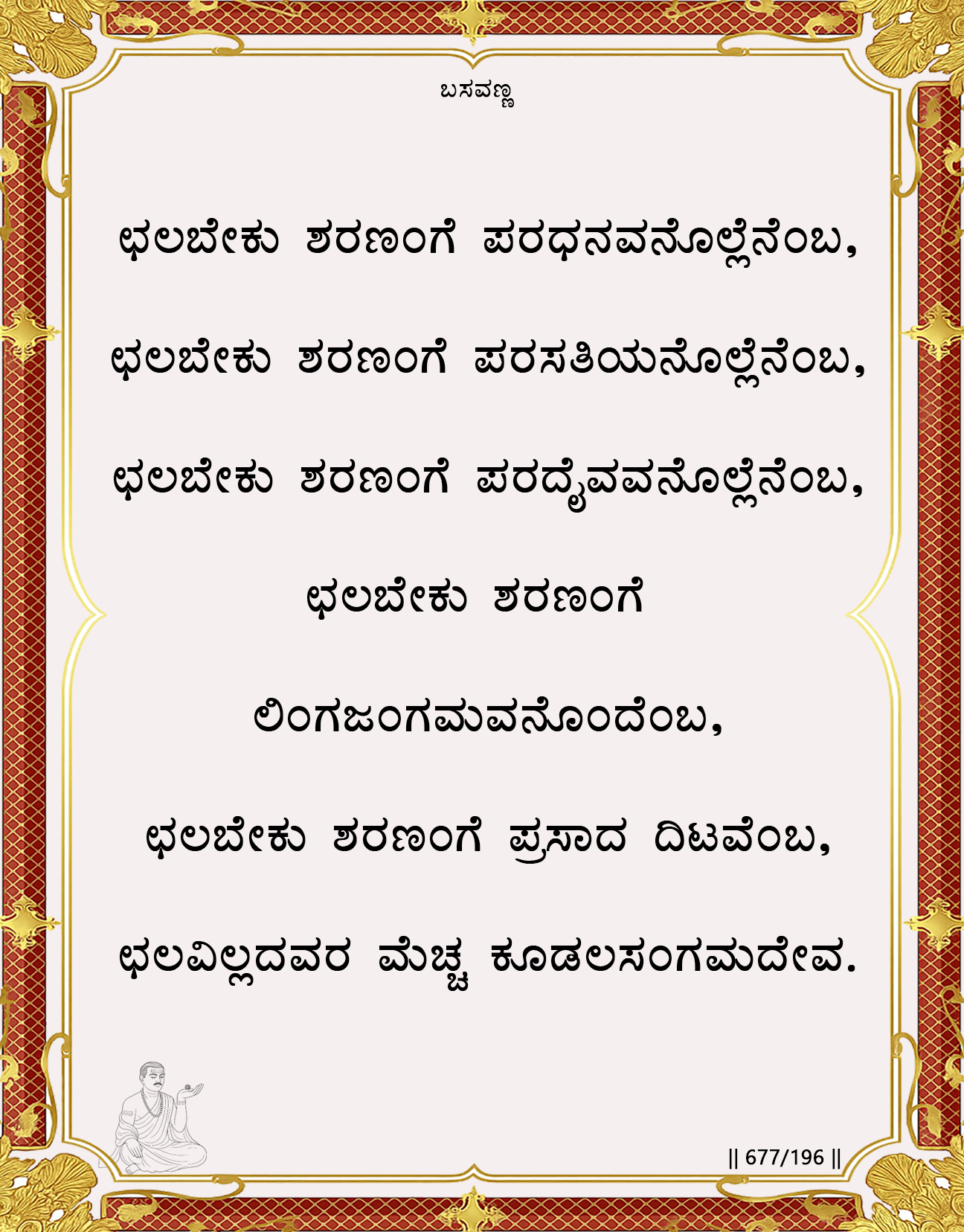
Poetic Rendering

A Sharana must hold fast to vows:
never desire another’s wealth,
never touch another’s wife,
never bow to another’s god,
never forsake Linga and Jangama,
never doubt the sanctity of Prasada.
Without this steadfastness, O Koodalasangama,
faith is hollow.
This vachana establishes the foundational ethics of the Sharana pathnot as external rules but as the essential architecture of awakened consciousness. Basavanna presents five non-negotiable commitments that protect the integrity of spiritual life from the subtle corruptions that undermine devotion. These are not mere moral injunctions but the natural expressions of a consciousness that has recognized the divine unity in all aspects of existence.
Spiritual Context
Core Spiritual Principle: Ethical purity as the structural foundation of spiritual realization. Consciousness cannot expand into higher states if it is compromised by fundamental ethical fractures. These five vows protect the seeker from the primary energies that scatter consciousness: greed, lust, spiritual distraction, apostasy, and ingratitude.
Cosmic Reality Perspective: This vachana describes the process of purifying and focusing Shakti. The vows are designed to channel the seeker’s energy (Shakti) single-pointedly toward Shiva (the Linga). Coveting wealth scatters energy outwardly; lust binds energy to sensory illusion; worshiping other gods divides devotional energy; forsaking the Linga and Jangama severs the connection to the source and its living channel; doubting Prasada rejects the flow of grace. Together, they ensure a coherent, undivided movement of Shakti toward its goal.
Historical Reality (Anubhava Mantapa Context): This vachana served as the constitutional code for the Lingayoga community. In a diverse social landscape, it created a clear, unified identity for the Sharanas, distinguishing them from other sects. It ensured the community’s internal trust and moral integrity, as members were bound by this shared, rigorous ethical standard. It was a practical safeguard against the hypocrisy and moral laxity that Basavanna critiqued in the established religious orders.
Interpretation
“never desire another’s wealth” (Non-covetousness): This vow attacks the root of lobha (greed) and the illusion of separation fostered by materialism. It cultivates contentment (santosha) and recognizes that all wealth ultimately belongs to the Divine.
“never touch another’s wife” (Chastity): This is the control of kama (lust). It sanctifies human relationships and protects the social fabric. It signifies mastering the most powerful biological impulse, redirecting that energy (brahmacharya) toward spiritual pursuit.
“never bow to another’s god” (Exclusive devotion): This is the culmination of ishvara pranidhana (surrender to God). It represents the non-dual realization that there is only One Reality. Bowing to another god is a cognitive error that reinforces duality.
“never forsake Linga and Jangama” (Steadfast refuge): This is the practical application of taking refuge. The Linga is the static symbol of the Divine, and the Jangama is its dynamic expression in the world. Forsaking them means abandoning the path itself.
“never doubt the sanctity of Prasada” (Faith in grace): Prasada is the tangible flow of grace. To doubt it is to reject God’s gift. This vow cultivates gratitude and the perception of the divine in the mundane, seeing every morsel of food as a blessing from Koodalasangamadeva.
Practical Implications: The practitioner must embrace these vows as the bedrock of their spiritual life. Regular self-examination is required to ensure one is not compromising on these five fronts. They are the fence that protects the tender sapling of devotion.
The Cosmic Reality
Anga (Human Dimension): The Anga is the field where these vows are practiced. Each vow purifies a different aspect: desire, sensory attachment, intellectual belief, volitional commitment, and emotional receptivity.
Linga (Divine Principle): The Linga is the focal point that makes these vows meaningful. They all serve to orient the Anga entirely toward the Linga, eliminating all other competing loyalties.
Jangama (Dynamic Interaction): The Jangama is the lived experience of these vows in community. It is the active refusal to covet, the respectful interaction with others, the steadfast worship, and the joyful sharing of Prasada.
Shata Sthala
Primary Sthala: Bhakta (Devotee) This vachana is the essential guide for the Bhakta. It outlines the disciplined foundation upon which true, steady devotion can be built. A devotee must first establish this ethical integrity.
Supporting Sthala: Sharana (Total Refuge) The five vows are the explicit expression of what it means to be a Sharana. Taking refuge is not a vague feeling but this concrete, fivefold commitment of one’s energy, relationships, worship, and faith.
Practical Integration
Arivu (Awareness Practices): Use the five vows as a daily examination of conscience. At the end of each day, review: Was my mind free from covetousness? Did I uphold purity in thought and deed? Was my devotion singular? Did I strengthen my connection to the Linga and Sangha? Did I receive my sustenance as Prasada?
Achara (Personal Discipline): Formalize these vows as your core personal discipline. Let them be the non-negotiable boundaries of your conduct.
Kayaka (Sacred Action): Let your work be an arena to practice non-covetousness (fair dealing) and to see its fruits as Prasada to be shared.
Dasoha (Communal Offering): These vows create the trust necessary for Dasoha. A community where members adhere to this code can share wealth and resources without fear of theft or misuse, and can share Prasada in the certainty of shared faith.
Modern Application
Contemporary life is often characterized by ethical relativism, consumerist greed, sexual commodification, spiritual eclecticism (hopping between traditions without depth), and a general lack of commitment and gratitude. This leads to fragmented identities and shallow spiritual seeking.
This vachana offers a powerful antidote to modern fragmentation. It provides a clear, rigorous framework for building a life of integrity and single-pointed purpose. It liberates us from the confusion of endless choice and the anxiety of moral ambiguity by offering a definitive path rooted in timeless principles. It builds character and focus, which are prerequisites for any profound spiritual attainment.
Essence
Not others’ gold, nor others’ spouse,
No other god in any house.
Hold fast to Linga, Jangama near,
And Prasada with holy fear.
These five strong pillars, deep and true,
Are what a Sharana must ever do.
The Deeper Pattern: This vachana describes the installation of a secure spiritual operating system with a built-in firewall. The five vows are the core security protocols that prevent malware from infecting the system. Covetousness is a virus of desire, lust is a Trojan horse of attachment, other gods are phishing attacks that steal devotional data, forsaking the path is a system shutdown, and doubting grace is a denial-of-service attack on the flow of input. A system running these protocols is secure, stable, and capable of running the high-level applications of meditation and realization.
In Simple Terms: It is like building a fortress. The vow of non-covetousness secures the treasury. The vow of chastity guards the inner chambers. The vow of exclusive devotion mans the main gate, allowing only one king entry. The vow to the Linga and Jangama is the oath of allegiance to the kingdom and its messengers. The vow regarding Prasada is the trust in the kingdom’s supply lines. Without these five defenses, the fortress (the soul) is easily overrun.
The Human Truth: We desire a profound spiritual life but are often unwilling to create the conditions for it. We want the flower without planting the seed and tending the fence. The timeless truth here is that freedom (moksha) is not a state of license but of supreme order. These five vows are not restrictions that bind us; they are the disciplines that free us from the tyranny of our own lower nature, creating the inner space where the Divine can truly dwell.

Views: 0