Poetic Rendering

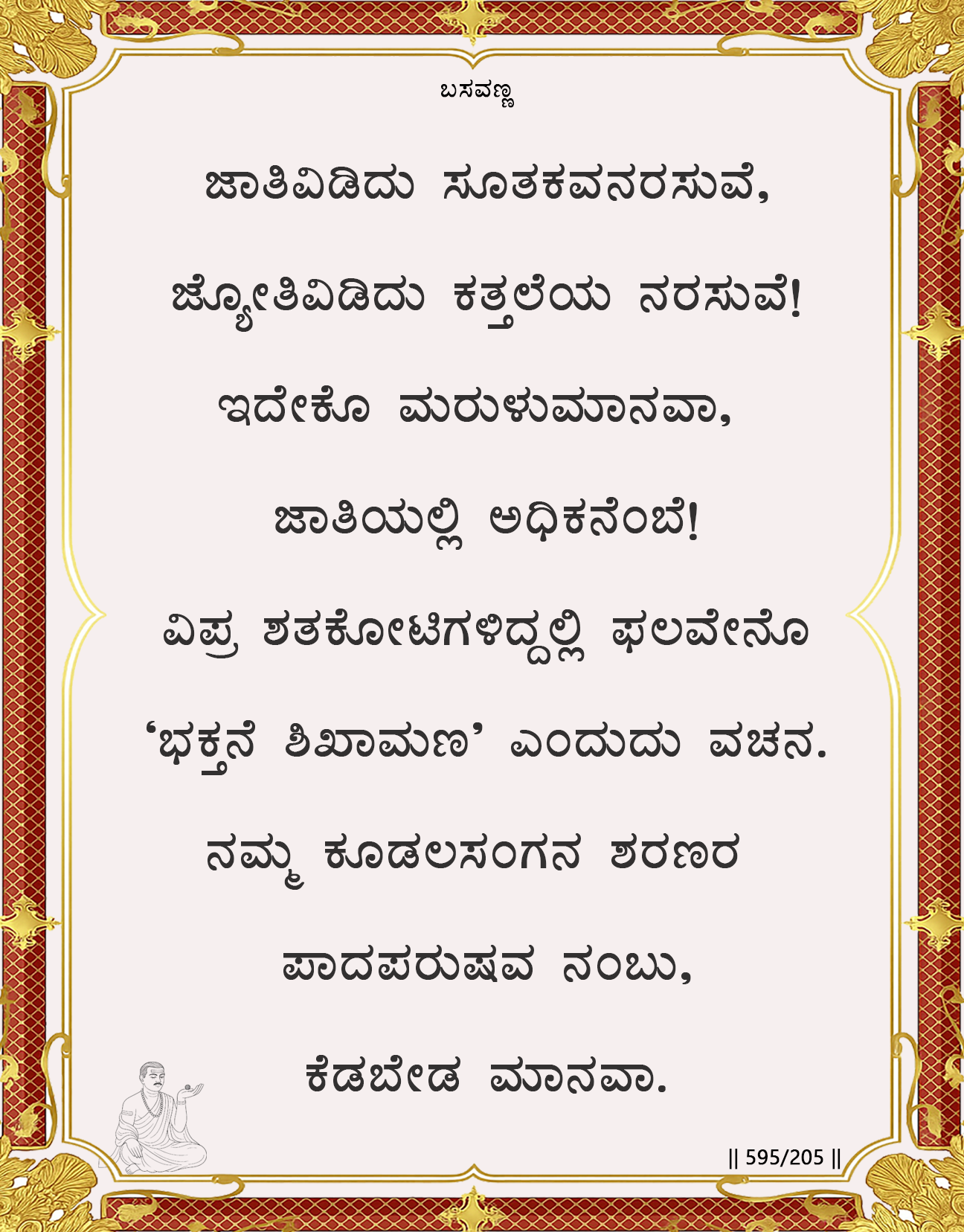
Can one shed birth, yet clutch to impurity?
Can one abandon light, yet embrace the dark?
Why this delusion of caste-pride, O man?
What use a hundred crore priests,
if devotion is absent?
Do not be misled
the scriptures themselves proclaim:
“The Bhakta is the crest jewel.”
Hold fast to the feet of Koodalasangama’s Sharanas,
and walk not astray.
This vachana is Basavanna’s revolutionary manifesto against the hierarchical caste system and empty ritualism. He exposes caste as a collective illusion that perpetuates division and spiritual ignorance. For Basavanna, true purity is not a matter of birth but of inner devotion (bhakti), and true impurity is not a physical state but the arrogance of considering oneself superior to another. He radically redefines nobility, stating that it is found not in lineage but in the humility and unwavering devotion of a Sharana a surrendered soul. This is a call to dismantle all man-made barriers and recognize the divine unity inherent in all.
Spiritual Context
Core Spiritual Principle: Reality is non-dual (Shiva alone is real). Any identity or structure built upon separation and hierarchy like caste is a fundamental spiritual falsehood (Maya). The only true identity is that of a Bhakta/Sharana, an individual whose being is defined by their relationship with the Divine, not by social convention.
Cosmic Reality Perspective: From the vantage point of Shiva-Shakti non-duality, all manifested forms are equal expressions of the same divine consciousness. To impose a hierarchy of “pure” and “impure” upon this unified field is a profound error that obscures the cosmic reality. Devotion is the force that realigns individual perception with this truth.
Historical Reality (Anubhava Mantapa Context): Basavanna was directly confronting the oppressive Brahminical orthodoxy of 12th-century Karnataka. This vachana is not a polite suggestion but a theological demolition of caste. It empowered the masses by declaring that spiritual authority comes from direct devotion and ethical living (Kayaka), not from birthright or ritual expertise, thus founding the social revolution of the Anubhava Mantapa.
Interpretation
“Can one shed birth, yet clutch to impurity?”: This exposes the metaphysical contradiction at the heart of caste. If the spirit is eternal and beyond physical birth (a core Indian spiritual premise), how can a temporary physical body confer a permanent spiritual status? The question reveals caste as a logical absurdity.
“What use a hundred crore priests, if devotion is absent?”: This severs the link between ritual scale and spiritual efficacy. It asserts that external action (Kriya) is inert without the internal consciousness of devotion (Bhakti). A million priests cannot compensate for a single heart devoid of love for God.
“The Bhakta is the crest jewel… Hold fast to the feet of… Sharanas”: This establishes a new spiritual lineage and authority structure. The “guru” is not the Brahmin by birth, but the Sharana by devotion. The path is found not in ancient texts alone, but in the living community of those who embody the truth of non-duality in their daily lives.
Practical Implications: The practice of Lingayoga necessitates a conscious and active rejection of all identities that foster separation. It is a commitment to see the Linga (Divine) in every Jangama (moving being) and to build a society (Sangha) based on this realized truth, not on inherited fiction.
The Cosmic Reality
Anga (Human Dimension): The individual conditioned by societal labels (high caste/low caste) and ritualistic piety. This is the state of identifying with a false, limited self, which is the root of spiritual ignorance.
Linga (Divine Principle): The untainted, universal, and undivided Consciousness that is the true substance of every Anga. The Linga is the truth that makes a mockery of the caste system’s claims of inherent purity and impurity.
Jangama (Dynamic Interaction): The process of enlightenment and social transformation. It is the act of using the sword of discernment (viveka) to cut through the illusion of caste, and the subsequent movement toward the fellowship of Sharanas, where one’s true identity as a devotee is lived and reinforced.
Shata Sthala
Primary Sthala: Sharana This stage is characterized by taking refuge and dissolving individual ego into the collective body of the enlightened community. This vachana is the very definition of that transition abandoning the false refuge of caste and taking the true refuge among Sharanas.
Supporting Sthala: Bhakta The power that fuels this transition is Bhakti. Without the intense, personal devotion of the Bhakta, the step to becoming a Sharana which requires immense courage to break social norms would be impossible. Devotion provides the revolutionary fervor.
Practical Integration
Arivu (Awareness): Cultivate constant awareness of the times you unconsciously categorize people based on social, economic, or educational status. See these categorizations as the modern equivalent of caste illusions that create separation.
Achara (Personal Discipline): Make a personal vow to never claim superiority or accept inferiority based on external markers. Actively seek out and learn from those who embody sincere devotion, regardless of their social background.
Kayaka (Sacred Action): Ensure your work and interactions actively dismantle hierarchies. In your workplace or community, champion meritocracy and devotion to purpose over titles and pedigree. Let your work be an offering that honors the divine in all collaborators.
Dasoha (Communal Offering): The community (Sangha) must be a living example of this principle. It should be a space where all forms of privilege based on birth, wealth, or gender are subordinated to the shared pursuit of spiritual awakening, creating a true aristocracy of devotion.
Modern Application
Contemporary society is rife with new “castes”: the elitism of wealth, the hierarchy of academic credentials, the branding of social influencers, and the deep-seated biases of race, class, and nationality. These are modern illusions of nobility that create the same spiritual wounds as the traditional caste system.
Basavanna’s teaching invites us to perform a “reality check” on all our identities. Are you a “VP,” an “Ivy League grad,” a “celebrity”? This vachana declares these are as illusory as caste. True worth is measured by the quality of one’s consciousness, the integrity of one’s work, and the depth of one’s compassion and devotion. It liberates us to define ourselves and others by the only metric that is real in a non-dual universe: the presence of the Divine.
Essence
The body’s lineage is a story told in dust.
The heart’s devotion is the only royal blood.
Abandon the haunted house of caste,
And take shelter in the living temple of the devotees.
Caste is a classic example of a “consensus hallucination” a complex pattern of information that a society agrees to treat as real, despite having no basis in fundamental reality (the Linga/Quantum field). Devotion (Bhakti) is the force that collapses this wavefunction of separation, forcing the system (the individual) to decohere from the societal illusion and recohere into alignment with the non-dual ground state.
Imagine society is a game of Monopoly where everyone is fighting over fake money and properties. Basavanna stands up and says, “This money is worthless paper! Your true wealth is the kindness in your heart and your connection to the Divine. Stop fighting over Boardwalk and Park Place, and come join the real economy of the soul.”
The universal human craving is for authentic identity and genuine respect. We often seek it in external, fragile labels that society offers (caste, job title, brand). This vachana points to the only identity that is unshakeable and true: the identity of being a loving devotee, a child of the Divine. This is the true nobility that no one can give you and no one can take away.

Views: 0