Poetic Rendering
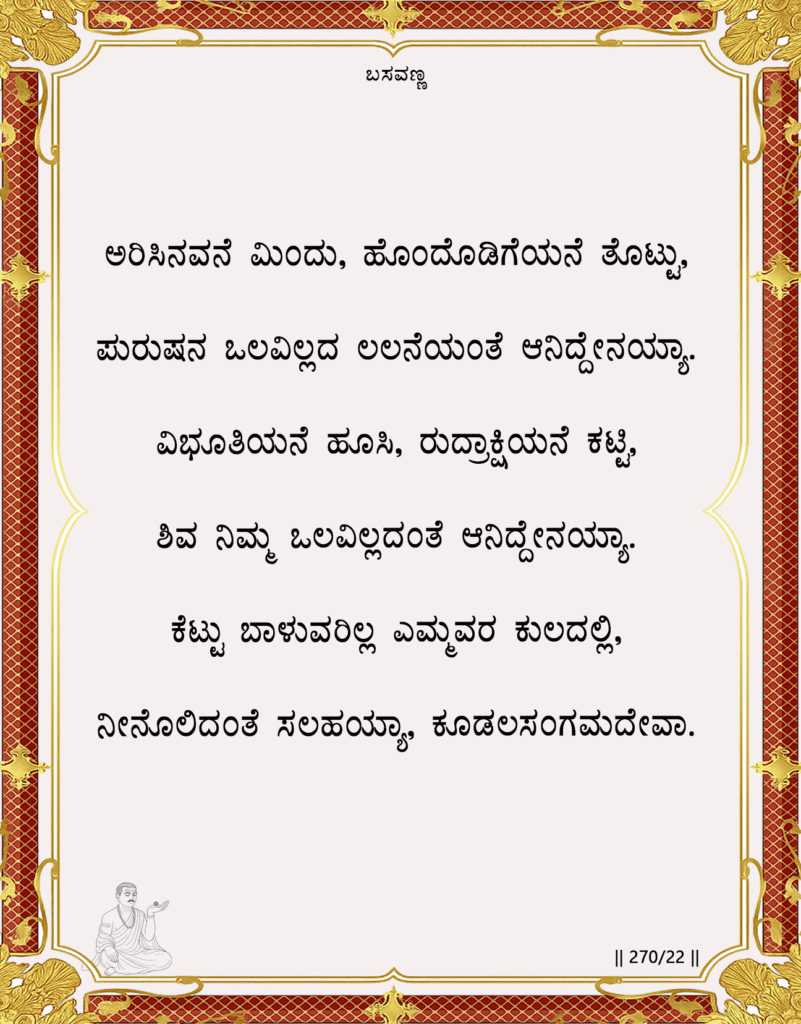
A wife may wear silk,
adorn herself with gold and ornaments
yet without her husband’s love,
she is joyless, her life hollow.
So too, one may smear vibhuti,
string rudraksha beads,
and display the signs of piety
but without Your grace, O Lord,
all is emptiness.
In our lineage, false living has no place.
Grant me, Koodalasangama,
the favor of truth lived in love.
The poet compares a wife adorned in silk and jewels but lacking her husband’s love to a devotee who wears the external marks of piety (ash, rudraksha) but lacks the inner grace of the Lord. Both lives are hollow. He prays that in his lineage, such falsehood finds no place, and asks Kudalasangama for the grace of a life where truth is lived in love.
Spiritual Context
Core Spiritual Principle: The essence of spirituality is the authentic, loving relationship between the soul and the Divine. External symbols and rituals are meaningless even hypocritical if they do not flow from and express this inner connection. Truth must be lived , not just performed.
Cosmic Reality Perspective: The Linga is the ultimate reality (Sat) and consciousness (Chit). To engage in empty ritual is to relate to a concept instead of the reality itself. True worship is the alignment of one’s entire being with this reality, which is an act of love and integration.
Historical Reality (Anubhava Mantapa context): This vachana is a direct critique of Brahminical ritualism, where external purity and Vedic rites were often divorced from inner morality and heartfelt devotion. It defines the Lingayat path as one of existential authenticity, where one’s daily life is the real test of one’s spirituality.
Interpretation
1. The Domestic Metaphor: The “wife” represents the individual soul (Jiva). The “silk and jewels” are external religious observances. The “husband’s love” is the divine grace (Prasada) and conscious connection. Without the latter, the former is a hollow performance.
2. The Spiritual Application: “Vibhuti” (sacred ash) and “rudraksha” beads are specific external markers of a Shaiva devotee. Basavanna uses the very symbols of his own tradition to make his point: even these are empty without the inner experience of God’s grace.
3. “In our lineage, false living has no place.” : This is a powerful declaration of the Sangha’s ethos. The “lineage” (Parampara) of the Sharanas is not one of ritual succession but of authentic experience. Hypocrisy is explicitly exiled from this spiritual community.
4. “Grant me… truth lived in love.” : This is the culminating prayer. He does not ask for better ritual skills or more knowledge, but for the grace to live the truth. “Truth lived in love” is the definition of integrated spirituality where one’s actions (Achara, Kayaka) are a direct and loving expression of one’s inner realization (Arivu).
Practical Implications: The seeker must constantly examine their motives. Are my practices creating a deeper, loving connection with the Divine, or are they just a spiritual costume? The focus must shift from performing rituals to cultivating a genuine inner relationship, allowing that relationship to naturally express itself in truthful and loving action.
The Cosmic Reality
Anga (Human Dimension): The human being in their external aspect the body performing rituals, wearing symbols, and engaging in social roles. This must be infused with substance from within.
Linga (Divine Principle): Kudalasangama Deva as the source of authentic being and grace. The Linga is the “love” that gives meaning to the “marriage” of the soul.
Jangama (Dynamic Interaction): The Jangama is “truth lived in love.” It is the dynamic process where the inner grace of the Linga transforms the outer life of the Anga, making every action a truthful expression of the divine relationship. The Jangama is the integrated life itself.
Shata Sthala
Primary Sthala: Bhakta. This vachana serves as a crucial test for the Bhakta, ensuring that their devotion moves beyond sentimental or ritualistic attachment to a deep, authentic longing for a real relationship.
Supporting Sthala: Sharana. The state of being a true Sharana is defined by this “truth lived in love.” It is the stage where there is no gap between inner belief and outer action.
Practical Integration
Arivu (Awareness): Practice self-inquiry regarding your spiritual actions. Ask: “Why am I doing this? Is it from habit, for show, or from a genuine place of love and connection?”
Achara (Personal Discipline): Let your personal discipline be the alignment of your inner state and outer behavior. Strive for complete honesty and integrity in your dealings, making your life a transparent reflection of your heart.
Kayaka (Sacred Action): Ensure your work is an authentic expression of your values. Do not engage in work that requires you to wear a “mask” or compromise your inner truth for external gain.
Dasoha (Communal Offering): Foster a community culture that values authenticity over piety. Call out hypocrisy gently but firmly, and celebrate those whose simple, truthful lives exemplify “truth lived in love.”
Modern Application
We live in a world of curated personas, especially online, where we perform “wellness,” “success,” and even “spirituality” for social validation. This creates a culture of hypocrisy, where the external image is polished, but the inner life is fraught with anxiety, loneliness, and inauthenticity.
This vachana liberates by calling for radical authenticity. It invites us to strip away the “silk and jewels” of our spiritual and social performances and to focus instead on cultivating a genuine inner life. The goal is not to appear loving and truthful, but to be loving and truthful, allowing our external lives to become a simple, natural expression of who we really are.
Essence
The finest silk, the sacred ash,
Are empty signs, a hollow dash,
Without the heart’s true, loving aim.
Let my life be Your sacred name.
Metaphysically, this vachana distinguishes between the essence (Svarupa) and the attribute (Tatastha Lakshana). The Linga is the Svarupa the essential nature of consciousness and bliss. The rituals and symbols are Tatastha Lakshana non-essential, incidental attributes. To mistake the attribute for the essence is the fundamental spiritual error. The prayer for “truth lived in love” is the prayer for the essence to fully permeate and express itself through the attributes of one’s life, resulting in a state of Sahaja Samadhi natural, effortless God-consciousness in action.
A life of integrity, where our actions are in perfect harmony with our deepest values and our capacity to love, is the highest spiritual achievement. All else, no matter how impressive or pious it may appear, is ultimately a shadow without substance. The most profound legacy is a life authentically lived.

Views: 4