Poetic Rendering
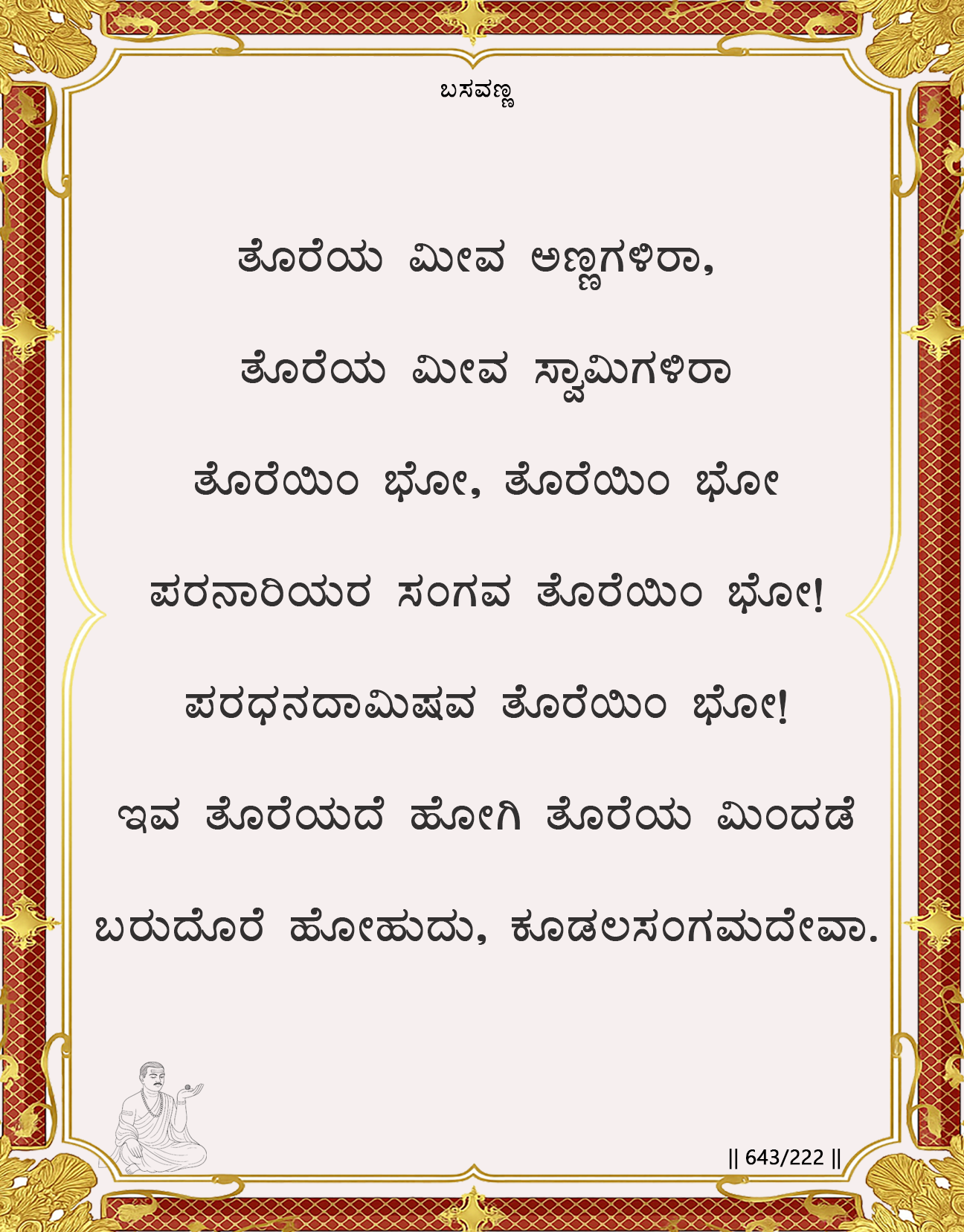
Bathe all you wish in the river like a fish
O brothers, O elders, O learned ones
still I say: renounce! renounce!
Renounce the touch that belongs to another,
renounce the wealth that is not yours.
If these are not abandoned first,
how can any spiritual rising begin?
Without this foundation,
even the foam upon the ocean
will vanish before yielding you grace,
O Kudalasangamadeva.
Basavanna teaches that true renunciation is not external austerity but the ethical cutting-off of what does not belong to us another’s body, another’s wealth, another’s rights. One may perform endless rituals, bathe continually like a fish in the river, and display outward piety, yet without this basic moral renunciation, spiritual progress is impossible. This is the first law of inner freedom: the mind must be free from the violence of taking what is not one’s own. Only then can consciousness expand toward the Divine; otherwise, all effort dries up like foam upon the shore.
Spiritual Context
Core Spiritual Principle: Spiritual evolution is built on the foundation of ethical living (Yama-Niyama). The most fundamental ethical precept is non-stealing (asteya), which extends beyond material objects to include another’s dignity, peace, and bodily autonomy. A mind that is an instrument of taking cannot simultaneously be an instrument of receiving divine grace.
Cosmic Reality Perspective: In the non-dual reality, all is the property of the Divine (Linga). To claim another’s body or wealth as one’s own is a double error: it violates the unity of all beings and arrogantly claims ownership of what belongs only to God. Such an action reinforces the illusion of separation, the very antithesis of spiritual realization.
Historical Reality (Anubhava Mantapa Context): This vachana grounds the Lingayoga revolution in concrete ethics. It was a direct challenge to a society where the powerful routinely appropriated the land, labor, and bodies of the lower castes. Basavanna declares that no amount of ritual bathing or learning can purify such a fundamental violation. This made social justice an integral part of spiritual practice.
Interpretation
“Bathe all you wish in the river like a fish…”: This critiques empty ritualism. The “fish” is perpetually in water but remains a fish; it is not transformed by the element. Similarly, one can be perpetually engaged in external purification rituals but remain unchanged internally if the heart is impure.
“renounce the touch that belongs to another, renounce the wealth that is not yours.”: This defines renunciation not as asceticism, but as respect for boundaries. “Touch” signifies all forms of violation, from sexual misconduct to any form of coercion. “Wealth” signifies all forms of material and social appropriation. This is the practical application of seeing the Divine in all you do not steal from God.
“If these are not abandoned first, how can any spiritual rising begin?”: This establishes a causal sequence. Ethical purity creates the stable, non-violent inner space necessary for the subtle energies of spiritual awakening to arise. A mind agitated by greed, lust, and guilt is too turbulent for the delicate presence of grace to settle.
“even the foam upon the ocean will vanish before yielding you grace”: The “foam” represents all spiritual efforts prayers, rituals, meditations that lack an ethical foundation. They appear substantial but are empty and transient, dissolving without a trace, leaving the seeker dry and unfulfilled.
Practical Implications: The first step in Lingayoga is a rigorous self-audit of one’s life to root out all forms of “taking” what is not freely given. This includes subtle forms of exploitation in relationships, work, and society. Without this, advanced practices are built on sand.
The Cosmic Reality
Anga (Human Dimension): The individual who must consciously restrain their senses and desires from appropriating what is not theirs, thereby purifying the vessel.
Linga (Divine Principle): The ultimate owner of all, the source of all abundance. Alignment with the Linga naturally manifests as respect for the divine property rights of all beings.
Jangama (Dynamic Interaction): The daily, moment-to-moment practice of ethical vigilance and renunciation. It is the active process of making one’s life a testament to the truth that “nothing is mine,” thereby preparing the ground for the Linga’s grace.
Shata Sthala
Primary Sthala: Bhakta The passionate, urgent call to “renounce!” is the voice of the Bhakta purifying their love. For the devotee, unethical conduct is a betrayal of the Beloved, who resides in the other.
Supporting Sthala: Maheshwara The understanding that spiritual law is inexorable that grace cannot flow into a corrupted vessel is the discerning wisdom of Maheshwara. It is the “great” law that governs the “great” path.
Practical Integration
Arivu (Awareness Practices): Cultivate mindfulness around ownership and entitlement. Observe thoughts like “I deserve that,” or “I want that,” and inquire: “By what right? Is it truly mine to take?”
Achara (Personal Discipline): Make a strict personal vow of asteya (non-stealing). This includes not taking office supplies, not wasting others’ time, not claiming credit for others’ work, and respecting physical and emotional boundaries.
Kayaka (Sacred Action): Ensure your work is a fair exchange. Do not exploit clients, customers, or employees. Earn your wealth through labor that honors the divine in all parties involved.
Dasoha (Communal Offering): Build a community based on mutual respect and fairness, where the resources of the Sangha are managed transparently and used for the collective good, not for individual appropriation.
Modern Application
We live in a culture of appropriation and entitlement cultural appropriation, digital piracy, exploitative business practices, and relationships devoid of true consent. We seek spiritual highs and mindfulness techniques while ignoring the fundamental ethical fractures in our lives.
This vachana provides the ultimate reality check for the modern seeker. It liberates us from the delusion that we can compartmentalize spirituality from ethics. It states unequivocally that freedom begins with respecting the freedom and property of others. It offers a clear, actionable starting point: audit your life, renounce what is not yours, and build your spiritual practice on the solid ground of integrity. This is the only foundation for a grace that does not “vanish like foam.”
Essence
You cannot build a temple with stolen bricks.
The first prayer is to return what was never yours.
Then, and only then,
will the ground be holy enough to hold your knees.
The consciousness that takes from others operates at a low, entropic frequency characterized by lack and separation. The influx of divine grace (Prasadi) is a high-integrity, coherent waveform. A system (the individual) configured for “taking” has an incompatible operating system; it cannot process the “signal” of grace, which is based on selfless giving and unity. The “foam” of spiritual effort vanishes because the system’s fundamental settings reject the download.
Imagine you are trying to fill a cup that has a hole in it. The hole is the habit of taking what is not yours it creates a leak of spiritual energy. You can pour in endless amounts of water (perform rituals, meditate), but the cup will never fill. Basavanna’s command to “renounce!” is the instruction to patch the hole first. Only a whole vessel can hold the water of grace.
We often seek spiritual solutions to problems created by our own unethical conduct. This vachana addresses the universal tendency to seek external fixes for internal moral conflicts. It reveals that the first and most profound spiritual practice is to clean up our own act, to live in right relationship with the world around us. The peace and freedom we seek externally are the natural consequences of this internal integrity.

Views: 0