Poetic Rendering

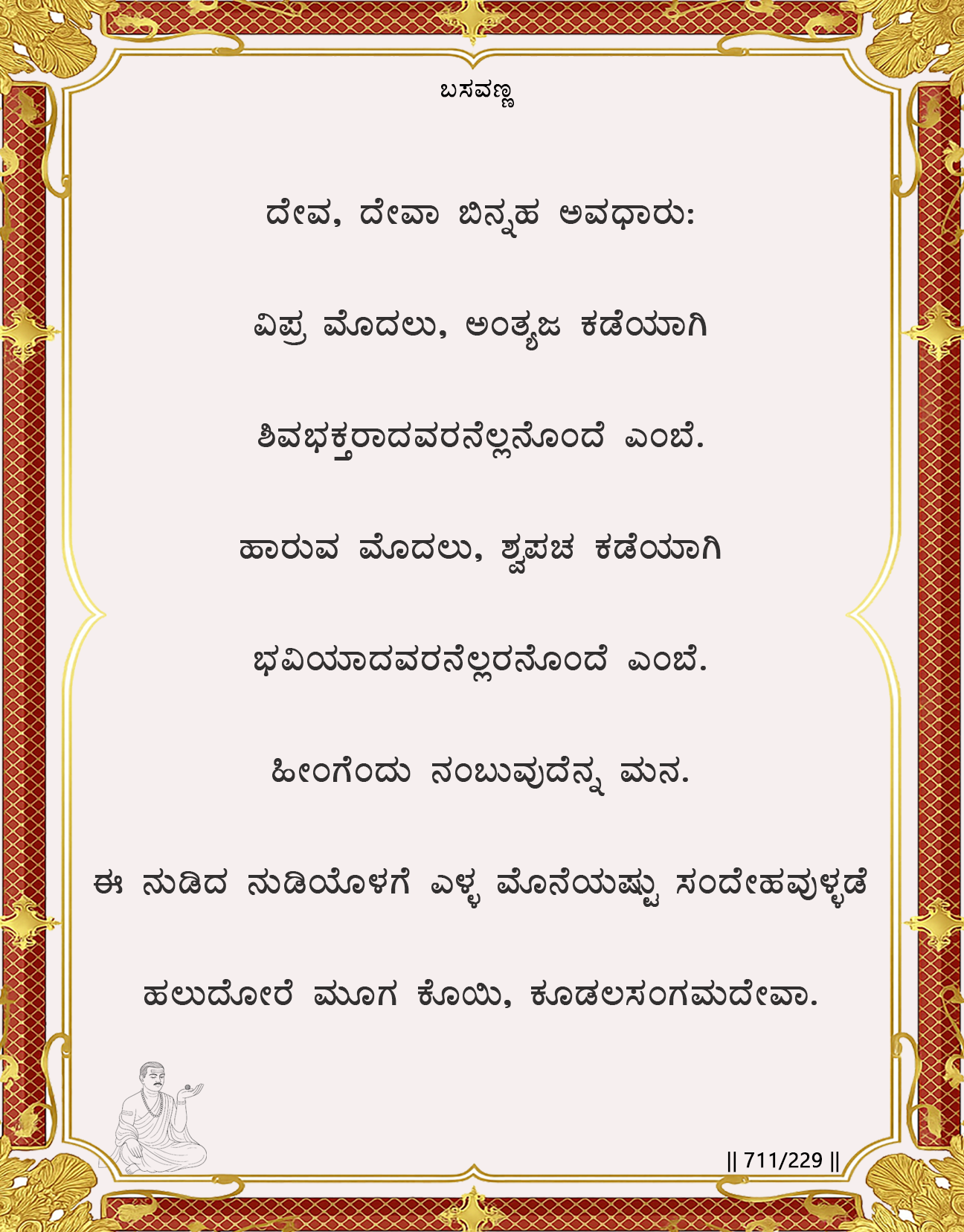
if ever I let division enter my sight,
if I see one as high-born and another as low-born,
then let it be known: I have strayed from Your truth.
Among those who are devoted to You,
there is no “first” and no “last.”
Never shall such thoughts arise in my heart;
never shall such words pass my lips.
If even for a moment
I allow these man-made hierarchies to cloud my mind,
that very delusion becomes my punishment,
O Kudalasangamadeva.
In this vachana, Basavanna takes a solemn inner vow to never perceive difference or hierarchy among human beings, for any division whether of caste, birth, status, or social identity is an affront to the oneness of Shiva who dwells equally in all. He declares that true bhaktas are one indivisible community, and any thought that places one person as “higher” and another as “lower” is a betrayal of the divine presence that permeates every being. The very arising of such a thought is, for him, a self-inflicted punishment, for it separates him from the truth of non-duality. Basavanna therefore prays that his speech, mind, and perception remain free of all forms of discrimination, so that he may live in unbroken harmony with Kudalasangama’s universal consciousness.
Spiritual Context
Core Spiritual Principle: The realization of non-duality (Advaita) is not merely a metaphysical insight but must be embodied as a continuous, unbroken perceptual and ethical stance. Any perception of hierarchy based on birth, caste, or status is a fundamental spiritual error a denial of the divine immanence. Therefore, maintaining a non-dual vision is an active, demanding discipline of consciousness.
Cosmic Reality Perspective: From the absolute standpoint, only the Linga exists. The phenomena of “high-born” and “low-born” are dramatic appearances within the one divine consciousness, having no ultimate reality. To assign truth to these appearances is to be deluded by Maya and to actively perpetuate the illusion of separation from the Divine.
Historical Reality (Anubhava Mantapa Context): This vachana is the foundational social contract of the Lingayoga community. It is a radical repudiation of the caste system, making the rejection of hierarchy a core tenet of faith. It internalizes the social revolution, making every Sharana personally responsible for eradicating casteism from their own mind, as a prerequisite for experiencing divine unity.
Interpretation
“if ever I let division enter my sight… I have strayed from Your truth.”: “Sight” here means spiritual perception. Basavanna defines spiritual error not as a moral lapse, but as a perceptual failure a failure to see the world as it truly is (satyadrishti). The moment one sees caste, one has lost sight of God.
“Among those who are devoted to You, there is no ‘first’ and no ‘last.'”: This establishes the new, divine hierarchy or rather, the absence of one. In the community of bhaktas, the only measure is the quality of one’s devotion, which is an internal state, not an external attribute like birth. This creates a true spiritual democracy.
“Never shall such thoughts arise in my heart; never shall such words pass my lips.”: The vow covers the entire spectrum of internal and external life: thought, word, and deed. It demands purity at the source (the heart/mind) to ensure purity in expression (speech/action).
“that very delusion becomes my punishment…”: This is a profound psychological and karmic insight. The punishment for the error of division is not an external penalty but the internal, self-inflicted suffering of the error itself. The state of being in delusion of feeling separate from the divine unity is its own hell.
Practical Implications: For a Lingayogi, the practice of non-discrimination is as essential as meditation. It requires constant self-auditing of one’s thoughts, reactions, and language to uproot any residual bias. The community must be a safe space where this unity is lived and enforced.
The Cosmic Reality
Anga (Human Dimension): The individual who must purify their perception to become a clear mirror reflecting only the one Linga, free from the distortions of societal conditioning.
Linga (Divine Principle): The absolute, non-dual truth that is equally reflected in every Anga, making all division illusory.
Jangama (Dynamic Interaction): The active, lifelong process of cleansing one’s perception. It is the practice of meeting every person and seeing past their worldly label to the divine core within, thereby honoring the Jangama as the moving Linga.
Shata Sthala
Primary Sthala: Aikya The perspective of this vow is that of one who abides in or strives relentlessly for the non-dual state of Aikya, where the perception of separation has been completely extinguished.
Supporting Sthala: Maheshwara The power to take such a vow and the discipline to maintain it stem from the “lordly” discernment and self-mastery of the Maheshwara stage, which governs the inner kingdom of the mind.
Practical Integration
Arivu (Awareness Practices): Practice “equality mindfulness.” In every interaction, consciously pause and affirm: “This person is the Linga. There is no high, no low.” When a judgmental thought arises, note it as “the cloud of division” and let it pass without engaging it.
Achara (Personal Discipline): Make a personal vow to never use language that reinforces social hierarchies. Actively challenge such language in others with compassion. Consciously engage with and learn from people of all social backgrounds.
Kayaka (Sacred Action): Ensure your workplace or field of action is free from discriminatory practices. Champion merit and devotion over pedigree and privilege.
Dasoha (Communal Offering): The community must be a living exemplar of this principle. Leadership should be based on spiritual maturity, not worldly status. All members must be treated with equal reverence, and any expression of casteist or hierarchical thinking must be addressed as a spiritual emergency.
Modern Application
While overt casteism may be outlawed, modern society is rife with new and old hierarchies: racism, classism, xenophobia, and the brutal ranking of human worth by wealth, education, and appearance. Our minds are conditioned to constantly compare and categorize, creating endless “us vs. them” divisions.
This vachana is a timeless vaccine against the poison of “othering.” It liberates us from the deeply ingrained habit of judgment and comparison. It provides a practical tool for creating a truly inclusive and harmonious society, by starting with the purification of our own perception. It calls us to build communities where every human being is seen and honored as a direct manifestation of the Divine.
Essence
In the eyes of God, there is no scale.
To see a hierarchy is to be blind.
My only vow: to see as God sees.
My only sin: to forget that I see God in all.
The perception of hierarchy is a “computational error” in the processing of sensory data by the egoic operating system. The system mistakenly assigns a value of “more divine” or “less divine” to different data packets (people), based on corrupted historical and cultural programming. The vow of non-duality is the installation of a new, root-level algorithm that processes all incoming data with the same fundamental instruction: “This = Linga.” The “punishment” is the system instability and error messages (suffering) generated when the old and new programs conflict.
Imagine your mind is a mirror. The vow of non-duality is the commitment to keep the mirror perfectly clean. Thoughts of “high and low” are like mud thrown on the mirror. The mud itself is the punishment, because it distorts the reflection and prevents you from seeing reality clearly. Basavanna’s practice is to continuously wipe the mirror clean, ensuring it only reflects the one, undivided light.
We have a deep-seated cognitive tendency to categorize and rank. This vachana addresses this primal instinct and redirects it toward the only ranking that is real: the absolute value of the divine presence in all. It reveals that our peace and our capacity for love are directly proportional to our ability to see the same fundamental worth in every face we meet. This is the foundation of true equality and universal brotherhood.

Views: 0