Poetic Rendering

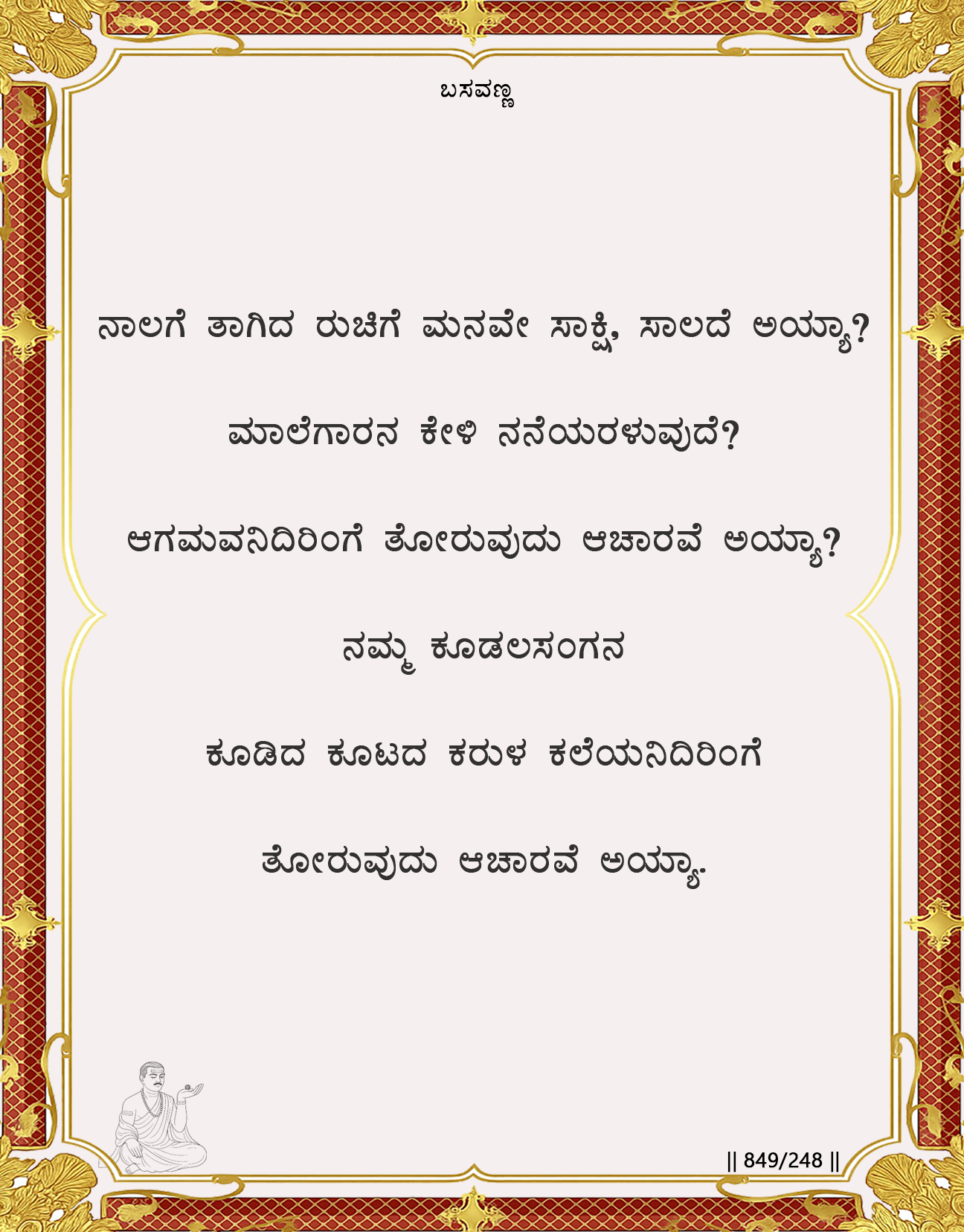
Does the tongue need instruction
to know the sweetness it touches?
Is not the tasting itself the knowing?
Does a blossom, filled with fragrance,
wait for the garland-maker’s command to bloom?
So then why chase scriptures, rites, and arguments,
when truth is already stirring within?
Without tasting, who can speak of nectar?
Without the company of the awakened
those graced ones who walk with Koodalasangamadeva
who can feel the living pulse of the Divine?
O Koodalasangamadeva,
truth is not proclaimed it is tasted.
Grace is not read it is lived.
Basavanna teaches that spiritual truth cannot be borrowed or inferred; it must be directly experienced, just as sweetness is known by tasting and fragrance by blooming. He questions reliance on external authorities scriptures, rituals, debates when the Divine reveals itself inwardly. Without the inner tasting and the guidance of the truly awakened, one cannot grasp the living reality of Shiva. Thus, the vachana affirms the Lingayata emphasis on immediate, experiential realization over secondhand knowledge or intellectual religion.
Spiritual Context
Core Spiritual Principle: Axiological Experientialism. Truth (satya) is not a proposition to be agreed with, but a reality (anubhava) to be lived and validated through one’s own being. The authority of experience supersedes the authority of text or tradition.
Cosmic Reality Perspective: This is a non-dual assertion where Shiva-Shakti is not a distant deity but the very fabric of consciousness and its dynamic energy of awareness (“the living pulse”). The “fragrance” is the inherent, self-luminous nature of Reality (Shiva), and the “blooming” is the spontaneous expression of that Reality through the individual (Shakti).
Historical Reality (Anubhava Mantapa Context): This vachana is a radical democratization of spiritual authority. It dismantles the Brahminical monopoly on truth defined by mastery of Sanskrit scriptures (shabda pramana). In the Anubhava Mantapa, a cobbler’s direct experience was as valid as a scholar’s, establishing a spiritual meritocracy based on anubhava.
Interpretation
“Does the tongue need instruction to know the sweetness?” The body (Anga) is not an obstacle but the primary instrument of realization. Consciousness is immanent and self-validating.
“Does a blossom… wait for the garland-maker’s command to bloom?” The Divine (Linga) unfolds according to its own inherent law (svabhava), not external command. Spiritual awakening is a natural, organic process, not an obedient performance.
“Without the company of the awakened… who can feel the living pulse?” The Jangama is essential as a catalytic presence. The awakened one does not impart information but ignites the seeker’s own capacity for direct perception.
Practical Implications: Spiritual practice shifts from external validation (performing rituals correctly, winning debates) to internal calibration (“Have I tasted it?”). The goal is not to accumulate knowledge but to refine one’s being into a more sensitive instrument for direct perception.
The Cosmic Reality
Anga (Human Dimension): The human is re-framed from a sinful soul needing salvation to a sentient field (kshetra) already containing the “seed” of truth. The seeker’s role is to create the conditions for it to bloom.
Linga (Divine Principle): The Linga is the immanent reality, the “sweetness” and “fragrance” itself. It is not a symbol of God; it is the divine presence, accessible here and now through the senses and consciousness.
Jangama (Dynamic Interaction): This is the sacred movement of life the act of “tasting,” the process of “blooming,” and the transformative influence of the enlightened community. It is the functional bridge that makes the union of Anga and Linga a lived reality, not a theological concept.
Shata Sthala
Primary Sthala: Bhakta. This vachana is the quintessential expression of the Bhakta stage. It is defined by a passionate, personal, and direct relationship with the divine, fueled by the immediate joy of “tasting” rather than abstract philosophy.
Supporting Sthala: Prasadi. The capacity for this direct tasting is not a personal achievement but a state of grace. The seeker who realizes this moves from the fervor of the Bhakta to the receptivity and profound gratitude of the Prasadi, who understands that even the seeking is a form of divine giving.
Practical Integration
Arivu (Awareness Practices): Practice mindful awareness in every moment truly “taste” your food, “smell” the air, “feel” an emotion. Use these as gates to perceive the underlying consciousness that is aware of the experience itself.
Achara (Personal Discipline): The discipline is to constantly question: “Am I relying on secondhand knowledge, or am I seeking my own direct experience?” Reject dogmatic answers in favor of personal inquiry.
Kayaka (Sacred Action): Let your work be an expression of your innate “fragrance.” Bloom where you are planted, performing your duty with the natural excellence and beauty of a flower, without waiting for external reward or command.
Dasoha (Communal Offering): Seek the company (satsang) of those who are genuinely “awakened” those whose presence reminds you to taste for yourself. In turn, become a presence that encourages direct experience in others, not dependency.
Modern Application
The “paralysis of analysis” and ideological consumption. We outsource our truth to gurus, influencers, scientific studies, and political ideologies, living in a world of curated opinions rather than grounded, personal experience. We read about life instead of living it.
This vachana is a call to a radical empiricism of the spirit. It empowers the individual to trust their own capacity for knowing. Whether in spirituality, art, or relationships, it advises: move from the comment section to the experience itself. Your lived reality is the final authority.
Essence
The blossom does not plead with the sun,
nor the tongue petition to know the sweet.
Why then do you beg from books
what only your awakening can meet?
Sit with the One who has tasted the source,
and let your own life become the proof.
This vachana describes a fundamental principle of epistemic metaphysics: that certain classes of knowledge (qualia) are irreducible and can only be accessed through first-person consciousness. Spiritual truth is the ultimate “qualia,” and any system that bypasses direct consciousness-event interaction will yield only a map, not the territory.
You can read a thousand reviews of a mango, study its botanical classification, and debate its cultural significance, but you will never know its taste until you bite into it. Basavanna says God is that mango.
We are wired for direct encounter. Our deepest fulfillment comes not from understanding the world conceptually, but from merging with it experientially through love, beauty, and profound connection. This vachana taps into the universal human yearning for authenticity and the frustration with the proxies that stand in for a life truly lived.

Views: 0