Poetic Rendering
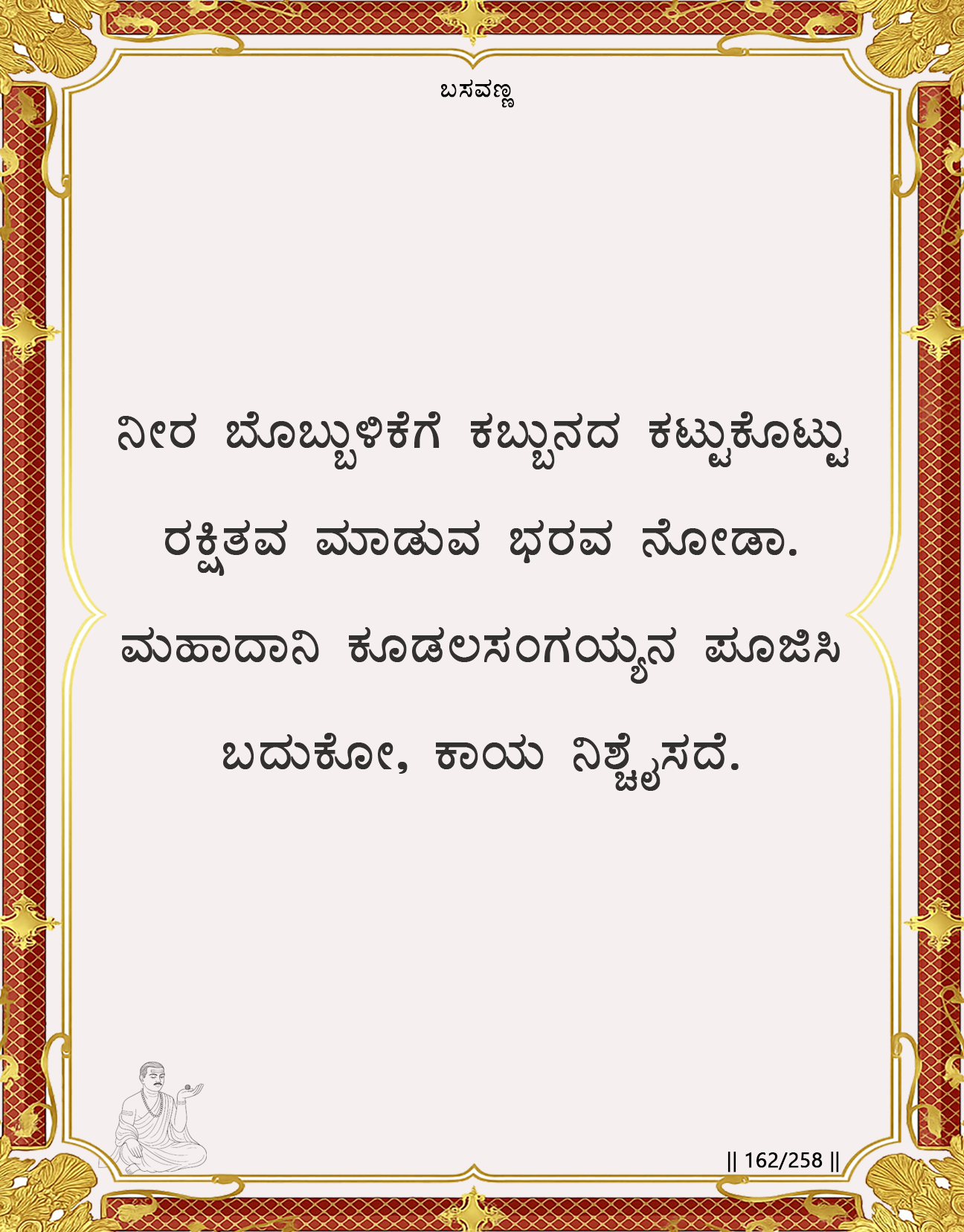
Trying to guard water-froth
with an iron shield
what folly is this, O man?
For this body too is but a bubble,
glittering for a breath in the sun,
vanishing the next moment
into the formless vastness.
Unless the living breath bows
to the Giver of all breath,
O Koodalasangamadeva,
this bustle of life and death
remains nothing more
than froth under a shield
bright for an instant,
empty forever.
Basavanna exposes the human tendency to protect and glorify what is inherently fragile and fleeting. Just as it is absurd to guard froth with an iron shield, it is equally misguided to anchor our identity in the temporary body, ego, and worldly structures. These, like bubbles, sparkle briefly and dissolve. The only meaningful orientation of life is to recognize and surrender to the inner, eternal source Koodalasangama. Without this inner turning, human life becomes a struggle to preserve what cannot be preserved, a drama both brilliant and hollow. This vachana calls the seeker to shift from illusion to essence, from temporary forms to the eternal Truth within.
Spiritual Context
Core Spiritual Principle: The Economics of Spiritual Energy. Human effort (purushartha) is finite and precious. To expend it on preserving what is doomed to perish (the froth) is the height of spiritual poverty. Wise investment is to use that same effort to achieve union with the Eternal, which is the only true security. This is the principle of yoga-kshema (to gain what should be gained and protect what should be protected).
Cosmic Reality Perspective: From the non-dual stance, the froth and the vast ocean are not-two. The froth is a temporary pattern of the ocean itself. The error is the froth identifying itself as separate and then constructing a “shield” (the ego) to defend its separateness. Realization is the froth recognizing it is the ocean, at which point the need for the shield dissolves. The “bowing” is this recognition.
Historical Reality (Anubhava Mantapa Context): This vachana challenged the orthodox preoccupation with bodily purity, ritual protection, and caste-based identity all “iron shields” constructed to guard the fragile “froth” of social and ritual status. For the Sharanas, who included manual laborers and those from “impure” castes, this teaching was liberating. It declared that their true work was not to gain social shields but to transcend identification with the froth entirely through surrender to Koodalasangamadeva.
Interpretation
“Iron shield…” The shield represents all egoic structures: wealth, status, dogma, intellectual pride, even rigid spiritual practices performed for gain. It is heavy, burdensome, and designed for a battle that is based on a misperception (that the froth can be saved).
“Glittering for a breath in the sun…” This captures the poignant beauty and tragedy of the unawakened life. The body and its achievements do sparkle with life and intelligence, but this glory is mistaken for substance. The recognition of its fleeting nature is not nihilism but the dawn of wisdom.
“Unless the living breath bows to the Giver of all breath…” This presents the solution. The breath (prana) is the link between the froth (body) and the ocean (Source). Conscious surrender of the breath in awareness (pranayama as offering) is the alchemical act that transforms identification from the bubble to the boundless air that gives it form.
Practical Implications: Spiritual practice is the gradual lowering of the shield. It involves watching where one spends energy defending a fragile self-image or possession, and consciously redirecting that energy into surrender and service.
The Cosmic Reality
Anga (Human Dimension): The Anga as perceived by the ego is the frotha temporary, beautiful, but utterly insubstantial formation. The entire project of the unenlightened life is building and polishing the shield around it.
Linga (Divine Principle): The Linga is the ocean of being, the “formless vastness,” and the “Giver of all breath.” It is the only substantial reality. It does not need protection; it is the very ground of existence.
Jangama (Dynamic Interaction): Jangama is the process of the bubble dissolving back into the ocean, or more precisely, recognizing it has never been separate. The “bowing” is the active, voluntary participation in this recognition, which is the end of the futile shielding and the beginning of true life.
Shata Sthala
Primary Sthala: Bhakta. The vachana addresses the Bhakta who is still caught in the drama of protecting their devotional identity, their purity, or their spiritual attainments. It is a shock therapy to expose the fragility of that upon which they are building.
Supporting Sthala: Prasadi. The state beyond this folly is Prasadi. The one who has received grace understands that both the froth and the shield are illusory. They live in a state of grateful, surrendered receiving, no longer burdened by the weight of self-protection, having bowed their individual will to the Divine.
Practical Integration
Arivu (Awareness Practices): Practice observing the “froth” of your thoughts, emotions, and bodily sensations without raising the “shield” of judgment, justification, or identification. Simply watch them arise, glitter, and dissolve.
Achara (Personal Discipline): The discipline is to consciously “bow” each breath. With each inhalation, acknowledge “This is given.” With each exhalation, surrender “This is returned.” Use this practice to deconstruct the sense of being an owner of life and rebuild the sense of being a conduit.
Kayaka (Sacred Action): Perform action without the shield of attachment to results. Do your work as an offering, like a bubble reflecting the sun for its brief moment, with no anxiety about its eventual dissolution.
Dasoha (Communal Offering): Help others see the burden of their shields. Create a community where vulnerability (the froth) is accepted as natural, reducing the compulsive need for defensive posturing, and where the collective practice is surrender to the greater Whole.
Modern Application
“The Armored Self.” Modern life encourages us to build massive shields: career armor, financial buffers, social media personas, ideological fortresses, and obsessive health regimesall to protect a fragile sense of self that feels perpetually under threat. This leads to burnout, anxiety, and profound existential emptiness.
This vachana is a call to lay down your arms. It offers a way out of the exhausting battle to maintain an image, secure a future, or defend a position. It invites a profound trust in the Source of life itself, suggesting that true freedom and peace come not from reinforcing the bubble, but from realizing your nature as the boundless ocean within which all bubbles play.
Essence
You forge a fortress, deep and wide,
to guard the dew-drop glistening inside.
You strain and sweat, a weary fight,
to keep a candle safe from night.
Lay down your arms, and you will see
the dew-drop is the boundless sea,
the candle-flame, the sun’s own light,
that needs no shield, and fears no night.
This vachana describes the Spiritual Law of Inverse Security. In conventional thinking, security increases with the strength of one’s defenses (the shield). In spiritual reality, security decreases in direct proportion to one’s investment in defense, because the defended object (the separate self) is an illusion. True security (abhaya) is found only in the total vulnerability of surrender to the Real, which involves dropping the shield and acknowledging one’s froth-like nature. It is the ultimate “soft power.”
Imagine spending your entire life’s savings to buy the world’s best insurance policy for a sandcastle you built at the beach. The policy is the shield; the sandcastle is your ego and possessions. Basavanna points out the tide (time, death) is inevitable. Wisdom is not in buying a better policy, but in enjoying the castle, knowing it is sand, and finding your identity in the beach and ocean themselves, which are eternal relative to the castle.
This speaks to our core existential anxiety the fear of dissolution, of being nothing. Our entire culture is built on constructing shields against this fear. Basavanna offers the counterintuitive but liberating truth: by embracing our nothingness (the froth), by bowing to the Source, we discover we are Everything. The fear of being empty froth is resolved by realizing you are the full ocean.

Views: 0