Poetic Rendering

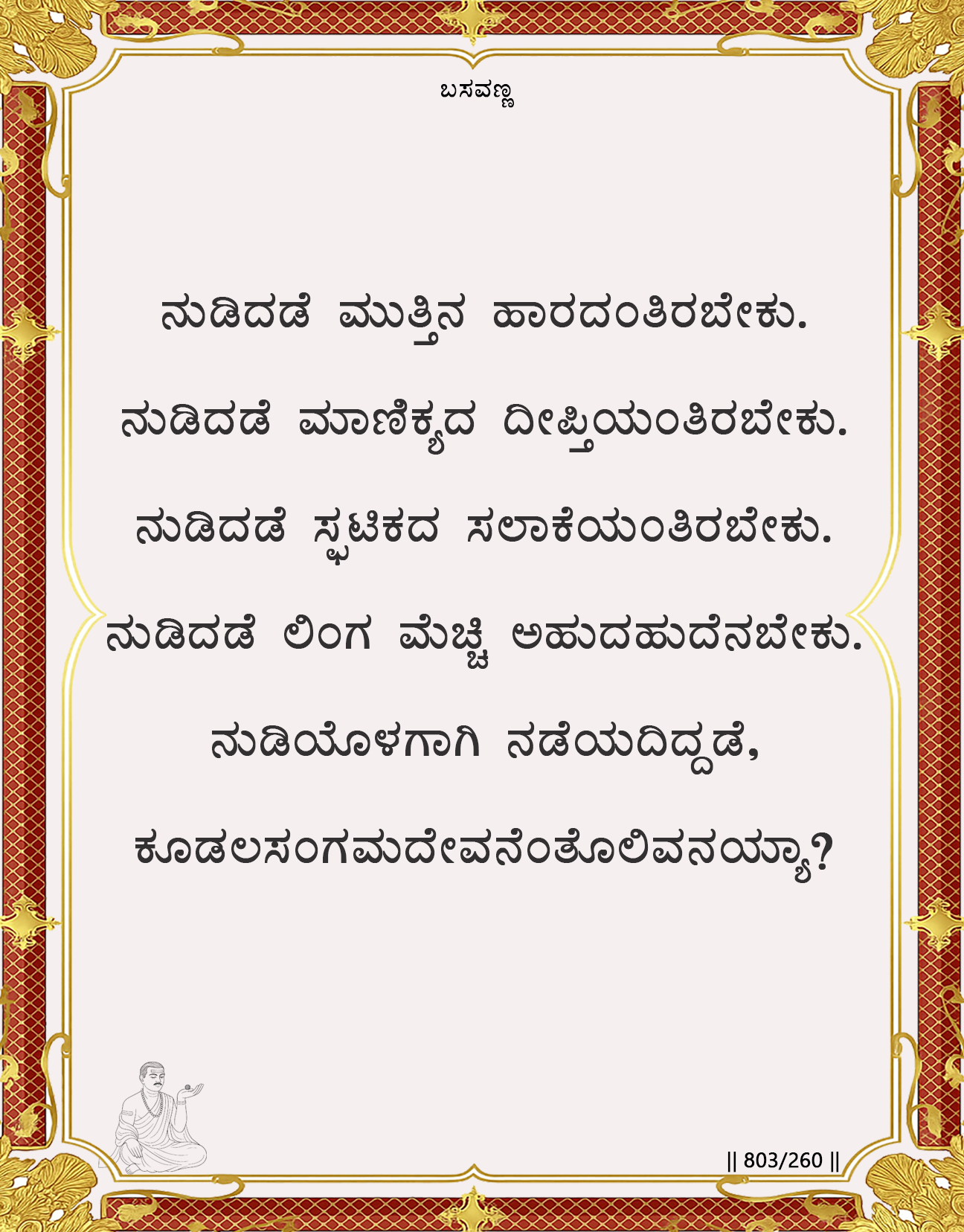
Let my speech be a garland
strung with pearls of truth.
Let it shine like the ruby
warm, radiant, filled with integrity.
Let it gleam like flawless crystal
transparent, un shadowed,
without hidden stain.
Let every word I utter delight
the Linga resting in my palm.
For if my tongue speaks one thing
while my heart holds another,
how can I call myself
a devotee of Koodalasangama?
In this powerful vachana, Basavanna elevates speech from a mundane act to a sacred spiritual discipline. He urges that words must reflect the inner state of the seeker, bearing the purity of pearls, the warmth of ruby, and the clarity of crystal. Speech becomes a form of worship Vachana Sadhana when it aligns completely with the inner Linga-consciousness. Basavanna warns that if one’s heart and tongue are disconnected, devotion becomes hollow. True Lingayoga demands integrity in the smallest actions, especially in the words we speak. Thus, the purity of speech becomes both the measure and the expression of one’s spiritual maturity.
Spiritual Context
Core Spiritual Principle: The Yoga of Speech (Vak Yoga). Speech (vak) is the creative power of consciousness made audible. It is a form of kriya shakti (action energy). Lying, flattery, gossip, or harsh speech is a misuse of this divine power that creates karmic entanglements and reinforces ego. Truthful, kind, and necessary speech is kayaka (sacred action) through sound, purifying the speaker and the listener.
Cosmic Reality Perspective: In the non-dual framework, the first manifestation of the Absolute is often considered Shabda-Brahman (Sound-Absolute). Speech is therefore a direct expression of cosmic creative energy. To corrupt speech is to corrupt one’s link to this primal creative power. Aligning speech with truth is to synchronize one’s personal vibration with the divine vibration, making one’s very life a vachana (utterance of truth).
Historical Reality (Anubhava Mantapa Context): The Anubhava Mantapa was a parliament of dialogue. Its revolutionary ideas spread through the spoken and sung word the vachana themselves. This teaching ensured that the community’s discourse was a tool for liberation, not division. It was a direct critique of the hypocrisy of orthodox priests who chanted sacred verses while upholding social injustice, and of courtiers who used flattery and deceit.
Interpretation
Pearls of Truth: Truth (satya) is not merely factual accuracy but ontological alignment with what is. A pearl forms around a grain of sand, transforming irritation into beauty. Similarly, speech should transform the raw grain of experience into a beautiful, hard truth.
Ruby’s Warmth and Integrity: A ruby’s color is its inherent nature (svabhava). Warmth represents compassion, integrity represents unwavering character. Speech must carry the heat of genuine feeling and the solidity of commitment.
Flawless Crystal’s Transparency: This is the state of ajnana (without hidden agendas). The mind should be clear enough that speech reflects reality directly, without the distortions of personal bias, manipulation, or hidden motive.
“Delight the Linga in my palm”: The ultimate purpose of speech is not social utility but divine communion. The Linga is the silent witness. Speech becomes a continuous, whispered prayer, a love song to the Divine within.
Practical Implications: Before speaking, one must pause and become the Linga’s listener to one’s own intended words. This inner checkpoint “Will this delight the Linga?” transforms casual talk into conscious communion.
The Cosmic Reality
Anga (Human Dimension): The Anga is the instrument of sound production. In its ignorant state, it is a tool of the ego, used for manipulation and self-aggrandizement. It must be sanctified.
Linga (Divine Principle): The Linga is the silent source of all sound and meaning (nada-bindu). It is the perfect listener who hears not just the words but the vibration of the heart behind them.
Jangama (Dynamic Interaction): Jangama is the sacred circuitry where the heart’s truth (Linga-consciousness) is transmitted via the mind and expressed through the tongue. It is the practice of ensuring no circuit breakers of deceit or ego exist in this pathway
Shata Sthala
Primary Sthala: Sharana. The demand for absolute integrity is the hallmark of a true Sharana. Taking refuge means you have nothing to hide and no separate agenda to protect. Your word becomes your bond, both to the community and to the Divine.
Supporting Sthala: Aikya. The state where “tongue” and “heart” cannot be separate because the individual heart has merged with the Divine Heart is Aikya. In that union, speech arises spontaneously as satya (truth), priya (dearness), and hitam (beneficial)the three qualities of divine speech.
Practical Integration
Arivu (Awareness Practices): Practice mindful silence (mauna). Observe the impulse to speak. Discern its source: is it from fear, need for approval, or from a clear, compassionate truth? Let the Linga be the filter.
Achara (Personal Discipline): Adopt a discipline of truthfulness (satyavacha). This does not mean brutal honesty, but speaking what is beneficial, true, and kind. Refrain from gossip, exaggeration, and speech meant to harm.
Kayaka (Sacred Action): Let your professional and personal communication be your kayaka. Write emails, give feedback, and engage in dialogue with the same integrity as if you were speaking directly to the Linga.
Dasoha (Communal Offering): Offer the gift of truthful and uplifting speech. Use words to clarify, unite, and heal within the community. Be someone whose word is trusted absolutely, creating a field of psychological safety and reliability.
Modern Application
“The Ecology of Polluted Speech.” We live in an age of misinformation, spin, toxic social media discourse, gossip, and performative speech. Words are cheapened, trust is eroded, and public and private discourse is often a weapon, not a bridge.
This vachana is a manual for digital and personal sanity. It teaches “vocal ahimsa” (non-violence in speech). It calls for reclaiming the sacred power of the word, using it to build rather than destroy, to reveal rather than obscure. In a world of noise, it champions the profound impact of clear, warm, truthful communication as a radical act of spiritual and social healing.
Essence
Let not a word leave this gate
that hasn’t bowed to the Truth inside.
Let it be a pearl, a ruby’s weight,
a crystal where no lie can hide.
For the tongue that wavers, splits in two,
cuts the speaker from the True.
But speech that from the heart does roll
becomes a bridge to make you whole.
This vachana establishes Speech as the Litmus Test of Integration. In psychological terms, it addresses the congruence between the conscious persona (what we say) and the unconscious shadow (what we truly feel/believe). Basavanna posits that spiritual progress is directly measurable by the closing of this gap. The “pearl, ruby, crystal” are not just virtues but symbols of a fully integrated psyche where thought, feeling, and expression are a unified, transparent field a state where the individual will is fully aligned with (and expressive of) the divine will.
Imagine your consciousness is a lake. Your words are the ripples on the surface. If the lake is muddy and turbulent (a conflicted, deceitful heart), the ripples will be chaotic and obscure. If the lake is deep, clear, and still (a heart united with the Linga), every ripple will be a perfect, beautiful reflection of the sky above. Basavanna says: Don’t just manage the ripples. Purify the lake.
This speaks to our universal experience of the guilt that follows a lie and the profound peace that comes from speaking a difficult truth. We intuitively know that integrity is wholeness, and hypocrisy is a form of self-fragmentation. The vachana validates this intuition as a spiritual law, making authentic self-expression not just an ethical choice but the very means of divine communion. It asserts that you cannot find God with a forked tongue.

Views: 0