Poetic Rendering
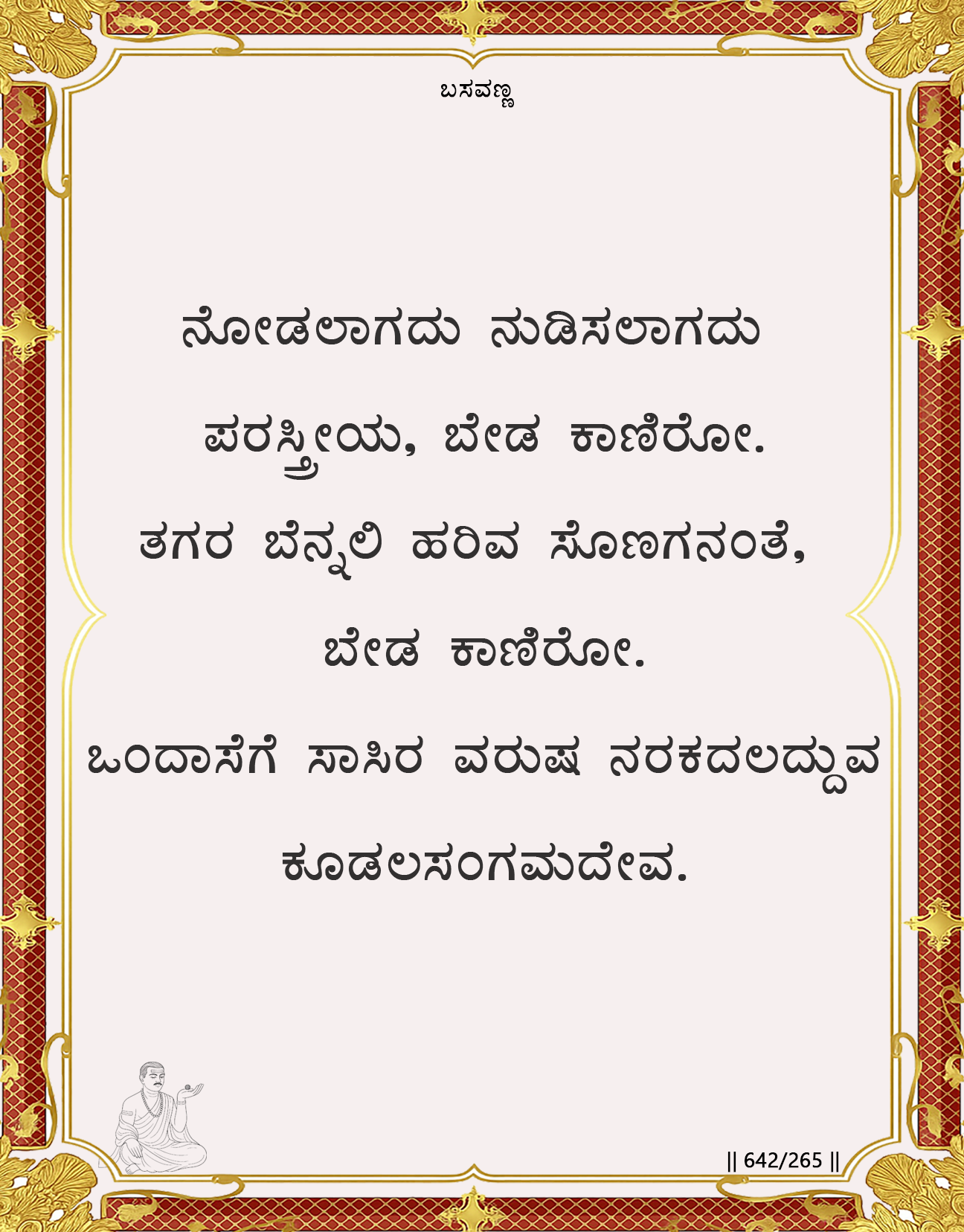
Do not cast your gaze
upon what belongs to another
you have no need for that.
Do not let greed cling to you
like a dog on the haunch of a wandering mountain goat
you have no need for that.
For one spark of lust,
one slip into craving,
can drown you in a hell
you forge with your own hands,
O seeker.
Walk steady, walk inward,
for the path to Koodalasangamadeva
is lost the moment desire
claims the throne of your heart.
In this vachana, Basavanna warns against the destructive forces of lust and greed, which can derail even sincere seekers on the path of inner realization. He uses vivid metaphors: the impropriety of coveting what is not yours, and the absurdity of a dog clinging to a mountain goat symbolizing desires that do not belong to one’s true nature. For a practitioner of Lingayoga, seeking fulfillment outside oneself creates an inner split, a psychological “hell” of confusion, guilt, and spiritual collapse. Basavanna teaches that discipline, self-restraint, and purity of intent are essential for maintaining inner unity. The true journey is inward, and even a single lapse in desire can obscure the light of Koodalasangamadeva.
Spiritual Context
Core Spiritual Principle: The Economy of Attention. Spiritual energy, particularly the energy of desire (iccha shakti), is finite. To invest it in external objects is to divert it from its true purpose: union with the Divine. The “hell” forged is not a post-mortem punishment but the present, lived experience of fragmentation, agitation, and alienation from one’s true source. Discipline (achara) is the practice of conserving and redirecting this energy inward.
Cosmic Reality Perspective: From the non-dual view, all is Shiva. Lust and greed arise from the mistaken belief that fulfillment lies in a fragment of Shiva (another’s spouse, wealth, status) rather than in the Whole. This is the primal error of avidya (ignorance). The “dog on the goat” is the absurd spectacle of one part of the Divine desperately clinging to another, not realizing they are both manifestations of the same Being. The path is “lost” because one starts running in circles within the dream of separation.
Historical Reality (Anubhava Mantapa Context): This was a crucial code of conduct for the Lingayoga community, which emphasized social mixing and equality. In such a radical setting, traditional social barriers were dissolved, making ethical self-governance paramount. This vachana provided the internal compass to prevent the new freedom from devolving into licentiousness or material competition, ensuring the revolution remained spiritual and ethical at its core.
Interpretation
“Cast your gaze upon what belongs to another…” The gaze is the first act of appropriation. It moves the object into the mental field of “mine.” The discipline begins with sense control (indriya nigraha).
“Like a dog on the haunch of a wandering mountain goat…” This is a masterpiece of psychological insight. The dog (craving) is fundamentally mismatched to the goat (the object of desire). The clinging is desperate, undignified, and ultimately futile, as the goat moves to its own terrain, dragging the dog into peril. The seeker who clings to worldly desire is dragged into terrains (suffering, karma) alien to their true nature.
“You forge with your own hands…” Emphasizes radical self-responsibility. The “hell” of jealousy, anxiety, and dissatisfaction is not imposed by God but manufactured by the mind’s own choices.
“The throne of your heart.” The heart is the seat of sovereignty. Either desire (representing the ego) rules, creating a kingdom of chaos, or the Linga (the true King) rules, establishing a kingdom of peace and order (shanti rajya).
Practical Implications: Spiritual practice must include vigilant mindfulness over thoughts and impulses, especially those of appropriation and envy. Each time one successfully turns away from a covetous thought, one strengthens the “inward walk.”
The Cosmic Reality
Anga (Human Dimension): The Anga is the kingdom. Its senses are the gates. If the gates are unguarded, invaders (desires for others’ possessions) enter and usurp the throne.
Linga (Divine Principle): The Linga is the rightful Sovereign, the source of all abundance. When installed on the heart’s throne, it bestows the contentment (santosha) that makes external craving redundant.
Jangama (Dynamic Interaction): Jangama is the loyal guard at the gate and the steward of the kingdom. It is the conscious practice of dethroning every invading desire and reaffirming the Linga’s sovereignty through every choice.
Shata Sthala
Primary Sthala: Bhakta. For the Bhakta, whose path is fueled by passionate feeling, this vachana is vital. It ensures that bhakti (devotion) is not adulterated into kama (lust) or lobha (greed). The fiery energy of the Bhakta must be exclusively directed to the Linga.
Supporting Sthala: Sharana. The ability to “walk steady, inward” without being derailed by desire is a mark of a maturing Sharana. It demonstrates that refuge in the Linga is becoming the dominant organizing principle of one’s psychology, displacing the ego’s cravings.
Practical Integration
Arivu (Awareness Practices): Practice the “gatekeeper meditation.” Watch thoughts and impulses arise at the “gate” of the senses. When a thought of craving for another’s attributes arises, acknowledge it: “This is a dog clinging to a goat.” Then consciously withdraw attention and redirect it inward with a mantra to the Linga.
Achara (Personal Discipline): Cultivate santosha (contentment) as a deliberate discipline. Regularly reflect on and feel gratitude for what you have been given by the Linga. Simplify your needs to reduce the field in which desire can operate.
Kayaka (Sacred Action): Let your work be an expression of your own inherent gifts, not a means to seize what others have. Focus on the excellence of your own kayaka, finding fulfillment in the act of offering itself.
Dasoha (Communal Offering): Foster a community of mutual support and shared abundance. When the community meets needs collectively, the internal pressure for individual greed and competition diminishes, making the “inward walk” easier for all.
Modern Application
“The Attention Economy and Comparison Hell.” Our digital environment is engineered to hijack our gaze and cultivate constant desire for what others have their lifestyles, success, beauty, and possessions. This creates a pervasive, low-grade “hell” of anxiety, inadequacy, and restless craving.
This vachana is a survival guide for the digital age. It teaches conscious detachment from the “gaze” of social media and advertising. It advocates for an intentional inward turn to find the throne of contentment within, arguing that true peace is impossible as long as our attention is auctioned to the highest-bidding desire. It is the practice of reclaiming mental sovereignty.
Essence
The eye that wanders, makes a thief.
The mind that clings, finds only grief.
A dog upon a goat’s high side
has chosen terror for its ride.
Why beg from shadows, cold and dim,
when all the Sun resides within?
Depose the want, install the King
and hear your silent center sing.
This vachana describes the Spiritual Physics of Vector Alignment. Consciousness is a vectorit has both intensity (the fire of passion) and direction. The Bhakta stage generates immense intensity. This vachana is about correcting the direction. Lust and greed are vectors pointed at finite objects, leading to collision and dissipation (hell). Bhakti is the same intensity vectored toward the infinite Linga, leading to fusion and liberation. The “discipline” is the constant calibration of direction. A single spark misdirected can indeed start a forest fire of suffering.
Imagine your mind is a powerful laser. If you point it at random, reflective objects (other people’s lives, possessions), the beam scatters wildly, burning you with chaotic, reflected light (envy, frustration). If you point it steadily at a single, perfect diamond (the Linga within), all the light converges, passes through, and emerges as a coherent, brilliant spectrum of peace and wisdom. Basavanna says: Stop pointing the laser at shiny trash. Steady it on the diamond you already hold.
This speaks to our painful experience of wanting what we cannot or should not have, and the peace that comes with contentment. It validates the intuition that covetousness is a form of self-torture. The vachana offers a clear solution: redirect the powerful energy of wanting from the ephemeral to the eternal. It reframes discipline not as repression, but as the supreme act of self-love and intelligent energy management.

Views: 0