Poetic Rendering

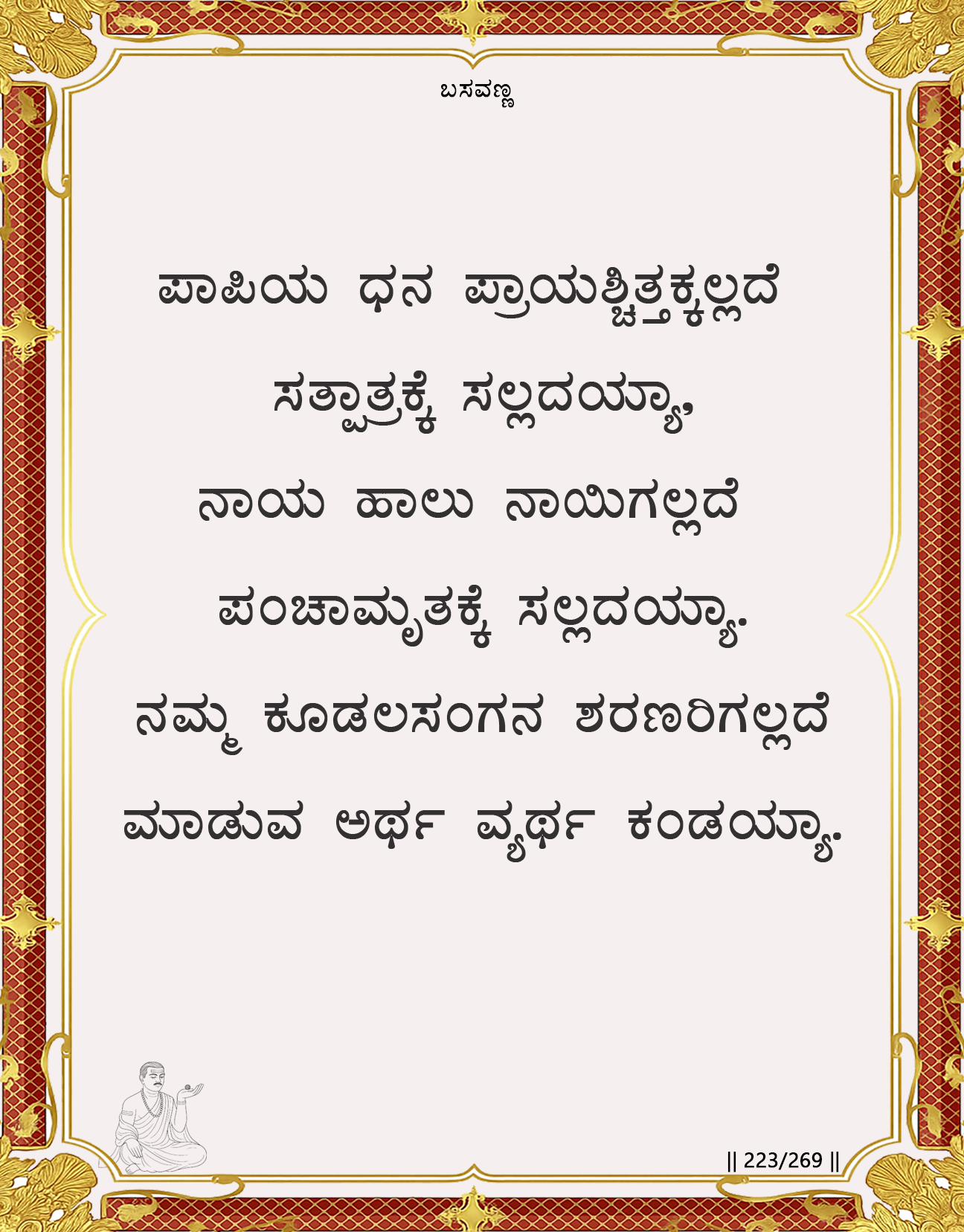
Wealth stained by wrongdoing
can never serve the holy
just as the milk of a dog
nourishes only its own kind.
How can devotion’s nectar arise
from the poison of greed?
Gold washed in another’s tears
will never shine before God.
Only that which is earned with clean hands,
offered with a heart bowed in humility
to the Sharanas of Koodalasangama,
becomes an offering worthy of the Divine.
Basavanna issues a powerful warning against using charity to mask wrongdoing. No ritual or donation can purify wealth gained through cruelty, deceit, or exploitation. True sanctity lies not in the amount given but in the purity of its source and intention. Wealth earned through Kayaka (honest labor) and shared through Dasoha (selfless giving) is blessed, while wealth born of manipulation or suffering becomes spiritual poison. Basavanna exposes the danger of turning religion into a marketplace and reminds us that the Divine cannot be bribed.
Spiritual Context
Core Spiritual Principle: The Non-Separability of Means and Ends (Karana-Karya Aikya). In spiritual economics, the means are the end. You cannot reach a sacred goal through profane means. The offering (dakshina) is not an isolated transaction but the final flower of the tree of one’s actions. If the roots (earning) are poisoned, the flower (the gift) carries that poison, regardless of its golden appearance.
Cosmic Reality Perspective: From the non-dual view, all is energy (Shakti). Wealth is concentrated energy. Energy imbued with the vibration of greed, exploitation, or suffering (tamasic/rajasic) cannot merge with or please the energy of pure, conscious bliss (sattvic Shiva). The metaphor of the dog’s milk is biological and energetic: the nature of the source defines the nature of the substance. You cannot offer the Divine something that carries the signature of separation and harm.
Historical Reality (Anubhava Mantapa Context): This was a direct critique of the prevailing religious economy where kings and merchants would make lavish donations to temples to atone for or legitimize wealth gained through war, usury, or oppression. Basavanna dismantles this system of “ritual laundering.” It ensured the Lingayoga community’s economy was built on ethical Kayaka and Dasoha, creating a self-purifying system that rejected wealth derived from social injustice.
Interpretation
“Milk of a dog nourishes only its own kind.” This is a law of spiritual ontology. Consciousness is species-specific. An action born of a lower consciousness (greed, the “dog”) can only sustain that same level of consciousness. It cannot uplift or connect to a higher one.
“Gold washed in another’s tears will never shine before God.” The Divine sees the history embedded in the object. The tears represent the karmic stain, the suffering-energy absorbed by the wealth. No amount of ritual “washing” can remove this karmic signature; only the transformative fire of righteous living can burn it away.
“Offered with a heart bowed in humility to the Sharanas…” This completes the circuit. Pure wealth + humble intention + a worthy conduit (the awakened sharana) = a completed sacred circuit. The sharana receives it as prasada (grace), not as a donation, thus transmuting it fully into the divine economy.
Practical Implications: Spiritual practice must include rigorous scrutiny of one’s sources of income and the motives behind one’s generosity. Philanthropy without ethical livelihood is hypocrisy. Giving must be the natural overflow of right living, not its compensation.
The Cosmic Reality
Anga (Human Dimension): The Anga is the steward of energy. It must ensure the energy it gathers (wealth) is sourced rightly and that the energy it releases (giving) is offered purely.
Linga (Divine Principle): The Linga is the pure consumer of energy. It only “digests” and returns as grace that which is of its own naturesattvic, harmonious, and freely given.
Jangama (Dynamic Interaction): Jangama is the sharanas and the process they represent. They are the “digestive enzymes” of the spiritual economy, capable of receiving and transforming a pure offering into a communal blessing. They complete the sacred cycle.
Shata Sthala
Primary Sthala: Bhakta. This is essential Bhakta training. Before devotion can deepen, the vessel (the devotee’s life) must be cleaned. The Bhakta learns that love for God must express itself first as integrity in one’s dealings with the world. Impure offerings are not devotion but disrespect.
Supporting Sthala: Sharana. The practice described earning righteously and offering humbly to the sharanas is the lived expression of a Sharana. It demonstrates that taking refuge has tangible ethical and economic consequences, reshaping one’s entire relationship with material energy.
Practical Integration
Arivu (Awareness Practices): Practice “wealth awareness.” Trace the source of your income. Does it cause harm, exploit, or deceive? Is it aligned with your values? Before giving, inquire into your motive: Is it for recognition, obligation, or pure joy?
Achara (Personal Discipline): Commit to righteous livelihood (samyak ajiva). Align your profession with the principles of non-harm and service. Let your earning be a form of Kayakasacred, skill-full labor that contributes to the world.
Kayaka (Sacred Action): See your work itself as the primary offering. The wealth it generates is a secondary byproduct. The purity of the action sanctifies the fruit.
Dasoha (Communal Offering): Give generously to individuals and causes that embody awakening and service (the modern sharanas). Give anonymously where possible. See giving not as parting with something “yours,” but as redirecting energy back to its divine source through the clearest channels.
Modern Application
“Philanthropic Laundering and Ethical Decoupling.” The modern world is rife with “ethics-washing” where corporations or individuals engage in harmful practices (environmental damage, labor exploitation) and then attempt to offset their reputation through large, highly-publicized donations. This vachana exposes the spiritual bankruptcy of this model.
This vachana calls for integrated integrity. It demands that our entire economic life from how we earn to how we spend and give be a coherent expression of our values. It empowers conscious consumerism, ethical investing, and humble giving. It teaches that true change comes not from checkbook charity, but from building an economic life that is inherently just, sustainable, and reverent.
Essence
You cannot bribe the sun with stolen gold,
or feed a saint from a bowl you stole.
The gift bears witness to the hand:
Was it sown in grace or stolen land?
So earn in light, with honest pain,
then give as falling rain gives grain
to those who know the Giver’s name,
and turn your gift to sacred flame.
This vachana describes the Spiritual Principle of Isotopy. In chemistry, isotopes of an element have the same chemical identity but different physical properties due to differing atomic weights. Here, wealth is the “element.” Wealth earned justly and wealth earned unjustly may look identical (gold), but they are spiritual isotopes with different “karmic weights.” The Divine, as the ultimate spectrometer, detects the isotope instantly. The ritual altar cannot perform nuclear transmutation; it cannot change one isotope into another. Only the “nuclear reactor” of a transformed liferight action over timecan produce the pure isotope worthy of offering.
Imagine two identical bottles of water. One is from a clear, free-flowing spring. The other is from a polluted swamp, meticulously filtered and bottled in crystal. You offer both to a master wine-taster (the Divine). The master sips and immediately spits out the swamp water, no matter how fancy the bottle. The palate discerns the source. Basavanna says: Don’t spend your life filtering swamp water. Go find the spring. Then your offering will be a joy to receive.
This speaks to our deep unease with ill-gotten gains and our profound respect for honest work. We intuitively distrust the philanthropist who exploits workers, and we trust the simple gift from someone we know has labored with integrity. The vachana validates this intuition as a cosmic law: clean money feels different because it is different on the level of consciousness. It affirms that integrity is not a spiritual luxury but the fundamental currency of the soul’s transaction with the Divine. This Vachana is not confined to a century or faith. It is a call to all humanity to farmers, workers, traders, rulers, and seekers that righteous earning is worship and righteous giving is salvation.

Views: 0