Poetic Rendering

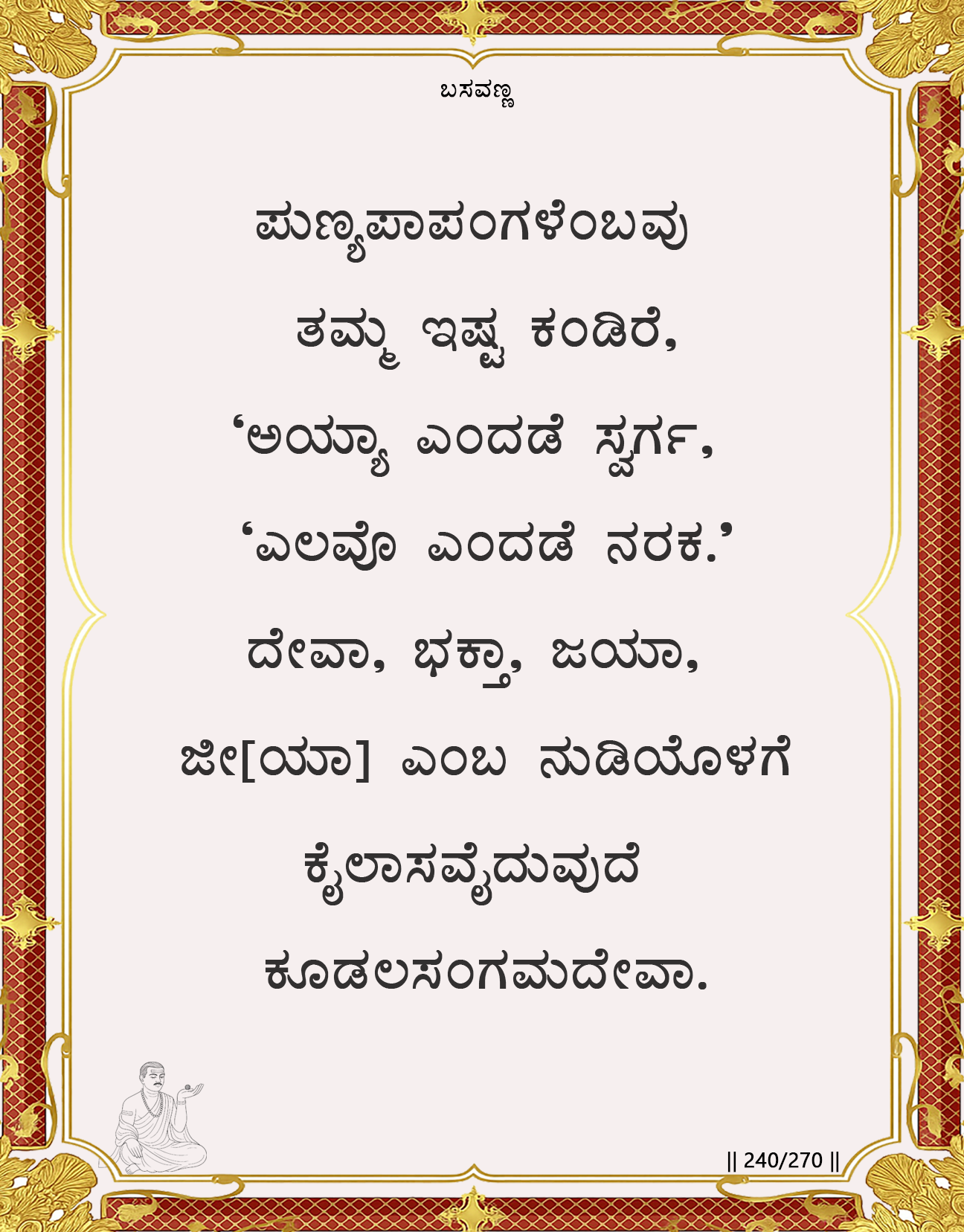
Merit and sin do not descend from the sky,
nor do they rise from some distant star
they are born in the quiet
chambers of the heart.
Whisper “Ayya!” with love,
and heaven blossoms in your very breath.
Mutter with indifference,
and a shadowed
world opens beneath your feet.
Within the sacred syllables
Deva, Bhakta, Jaya, Jeeya
lies the whole arc of awakening:
Deva, the One who beholds all;
Bhakta, the seeker who yearns;
Jaya, the victory over the storm within;
Jeeya, the soul that lives its truth.
This fourfold mantra is Kailasa itself,
O Koodalasangamadeva
the realm where word, heart, and deed
stand in seamless, shining unity.
Basavanna teaches that heaven and hell are not external realms but inner states created by the intention behind our words. Speech carries karmic power: a loving cry of “Ayya!” opens heaven within, while indifferent or careless speech creates inner hell. He shows that the sacred utterance “Deva, Bhakta, Jaya, Jeeya” contains the entire spiritual journey the Divine who sees all, the devotee who aspires, the soul who conquers inner turmoil, and the realized being who lives in truth. This fourfold mantra becomes Kailasa itself, where word, heart, and action unite. The vachana thus reveals speech as a creative force and a bridge between the finite and the infinite, turning everyday utterance into conscious spiritual practice.
Spiritual Context
Core Spiritual Principle: The Ontological Power of Speech (Vak-Shakti). Words are not merely descriptive but creative forces that shape consciousness and reality. Intentional, devotional speech (mantra) is a direct means of alchemizing inner states and aligning the individual soul (jiva) with the supreme consciousness (Shiva).
Cosmic Reality Perspective: From the non-dual view, all manifestation is a vibration (Nada Brahman) of the Divine. The mantra “Deva, Bhakta, Jaya, Jeeya” encapsulates the entire cosmic process of involution and evolution: from the Absolute (Deva) to the individuated seeker (Bhakta), through the struggle of self-mastery (Jaya), to the realized being who consciously embodies the Absolute (Jeeya). To chant it with understanding is to enact this return to source through sound.
Historical Reality (Anubhava Mantapa Context): This vachana democratized and internalized the practice of mantra japa. It made the repetition of sacred names and phrasesa practice often controlled by priests in Sanskritaccessible to all in the vernacular, emphasizing heartfelt intention over ritual correctness. It served as a practical tool for the Lingayoga community to cultivate constant remembrance (smarana) amidst daily life.
Interpretation
“Born in the quiet chambers of the heart.” This internalizes the entire framework of karma. Ethical and spiritual consequences are not externally imposed but generated from within, making the seeker utterly responsible for their inner climate.
“Heaven blossoms in your very breath… a shadowed world opens…” Demonstrates the immediate, real-time effect of consciousness colored by intention. Focused love creates expansion and connection (heaven); careless indifference creates contraction and separation (hell).
“Deva, Bhakta, Jaya, Jeeya.” This is a complete Shatsthala in miniature. Deva is the transcendent goal; Bhakta is the passionate engagement of the early stages; Jaya is the inner purification and victory of the middle stages (Prasadi, Sharana); Jeeya is the living fruit of Aikya.
Practical Implications: Every utterance becomes a potential site of practice (sadhana). The seeker is called to imbue speech with conscious intention, transforming idle talk into mindful communion and using mantra as a tool to walk the spiritual path with every recitation.
The Cosmic Reality
Anga (Human Dimension): The Anga is the vehicle of sound production. Its sacred purpose is to resonate in harmony with the divine vibration, using speech not for separation but for union.
Linga (Divine Principle): The Linga is “Deva”the silent source of all sound and meaning, the listening presence that receives the mantra. It is both the invocation and the invoked.
Jangama (Dynamic Interaction): Jangama is the activated, living mantra. It is the current of conscious sound that flows from the heart of the Anga to the Linga, unifying them in the very act of utterance. It is the bridge made of vibration.
Shata Sthala
Primary Sthala: Bhakta. The vachana’s emphasis on the power of a loving cry (“Ayya!”) and the explicit placement of “Bhakta” as the second term of the mantra anchors it in the Bhakta stage. Here, the seeker’s raw emotional energy is being channeled into the sacred technology of sound.
Supporting Sthala: Aikya. The mantra’s trajectory does not stop at devotion. It moves through “Jaya” (victory, indicative of the Sharana’s mastery) to culminate in “Jeeya,” the living embodiment of truth, which is the very definition of Aikya. The vachana thus uses the Bhakta’s tool (speech) to point toward the Aikya’s state of being.
Practical Integration
Arivu (Awareness Practices): Practice mindful listening to your own speech. Observe the tone, intent, and energy behind your words. Use the fourfold mantra as a meditation: with each term, contemplate its meaning and feel its resonance within.
Achara (Personal Discipline): Cultivate vak-tapas (austerity of speech). Speak only what is true, necessary, and kind. Before speaking, pause to ensure your words come from a centered, compassionate space.
Kayaka (Sacred Action): Let your professional and communal communication be clear and purposeful. Dedicate conversations to fostering understanding. Silently recite a mantra while working to infuse labor with sacred intention.
Dasoha (Communal Offering): Share uplifting and truthful speech. Recite vachanas or sacred phrases in community. Use words to heal, unite, and remind others of their divine nature, offering the gift of conscious sound.
Modern Application
“The Ecology of Noise and Toxic Discourse.” We are inundated with trivial, aggressive, and manipulative language via digital media and daily interaction, leading to psychic fragmentation, anxiety, and a degraded public sphere.
This vachana is a manual for linguistic sanity. It teaches that we can curate our inner and shared environments by consciously choosing our words. It advocates for a digital and verbal detox, replacing noise with nourishing sound. Practicing mantra or simply speaking with loving intention creates oases of peace and connection, turning everyday communication into a spiritual practice.
Essence
Heaven and hell are not lands afar,
but states shaped by the words you are.
A loving call can rend the veil,
a careless grunt digs your own jail.
In four soundsGod, seeker, fight, and light
the path unfolds from dark to bright.
Speak now, as if the world you make,
with every word, for heaven’s sake.
This vachana reveals Speech as a Hologram of Consciousness. In a hologram, every fragment contains the information of the whole. Each uttered word is such a fragment, carrying the complete state of the speaker’s consciousness. The fourfold mantra is a specially encoded hologram containing the entire Shatsthala journey. When chanted with understanding, it projects the full spectrum of spiritual awakening within the practitioner’s awareness, from seeking to being.
Imagine your mind is a radio. Most of the time, it picks up static and noisy stations (idle chatter, negative self-talk). The loving cry of “Ayya!” tunes it to a clear, beautiful frequency of peace. The mantra “Deva, Bhakta, Jaya, Jeeya” is like finding the station’s call signit confirms you are tuned to the ultimate source broadcast. By repeating it, you stabilize the signal until your very being becomes a transmitter of that same clear frequency.
We instinctively feel the weight of wordsthe sting of an insult, the warmth of praise. This vachana validates that instinct as a spiritual truth: our words are literal creative forces. They don’t just describe our reality; they build it, moment by moment. It empowers us with the profound responsibility and freedom to construct our inner worldand by extension, our shared worldwith the sacred material of conscious speech.

Views: 0