Poetic Rendering

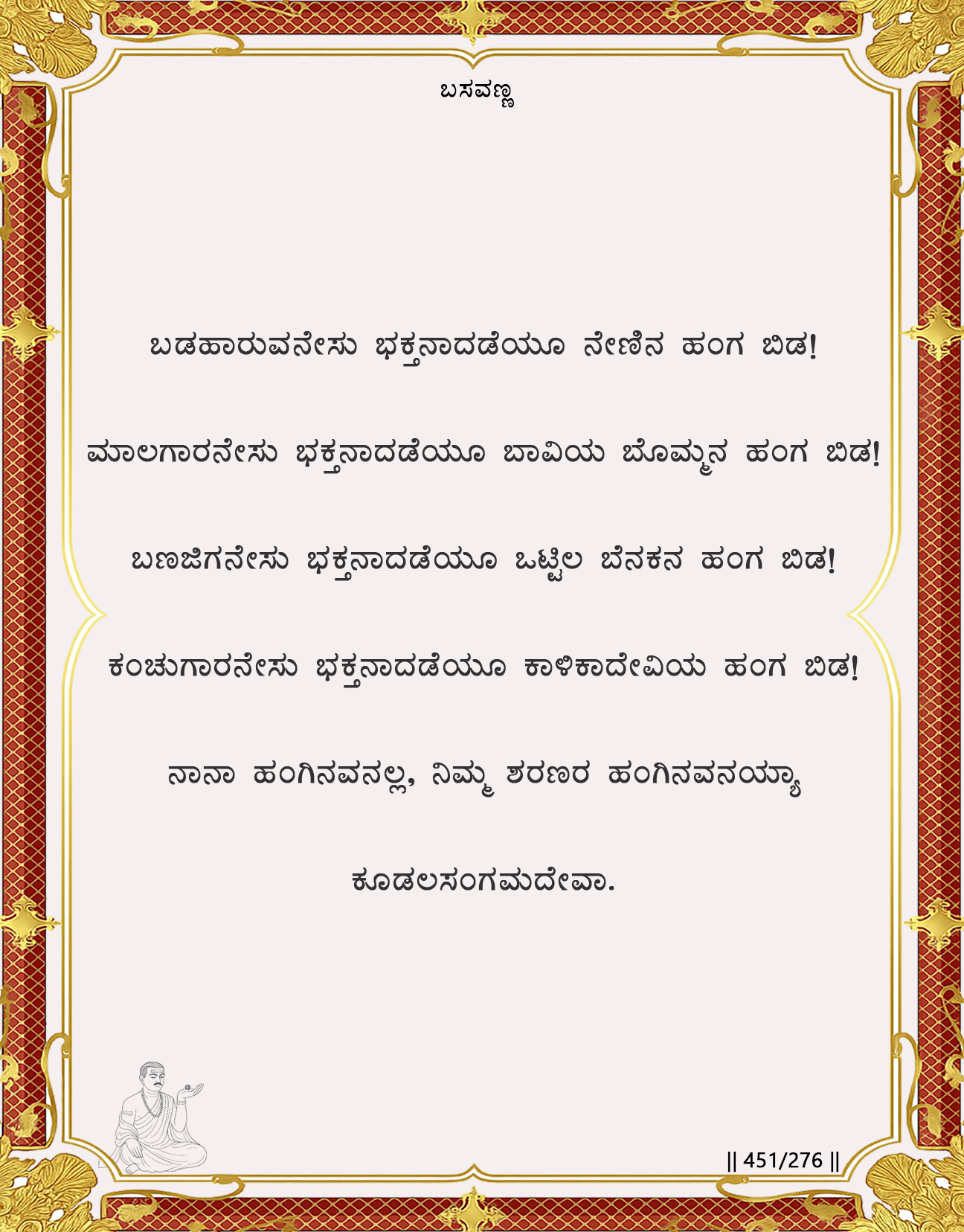
hen the Brahmin calls himself a devotee,
he still clings to the thread of pride and lineage.
When the flower-seller turns to devotion,
he keeps the same stale
well of illusion beside him.
When the merchant claims the path,
he carries along his crooked weights.
When the blacksmith becomes a devotee,
he holds fast to the hammer that feeds
the dark goddess of violence.
But I, O Koodalasangamadeva
I am bound by none of these inherited snares.
My only bondage is the living bond
to Your Sharanas.
Basavanna shows that many people adopt the outer label of devotion while still clinging to the habits, pride, and moral flaws of their old lives. The Brahmin keeps his spiritual arrogance; the flower-seller maintains his ignorance; the trader holds onto dishonesty; the smith to violence. External change without inner transformation is meaningless. Basavanna contrasts himself with these hollow conversions, declaring that his only true bond is to the Sharanas the community of realized devotees whose company alone liberates.
Spiritual Context
Core Spiritual Principle: Integral Transformation vs. Additive Religion. Genuine spirituality requires the complete severing of egoic bonds tied to one’s social, occupational, or psychological identity. Merely adding devotional practices onto an unchanged self is a form of spiritual hypocrisy that reinforces separation.
Cosmic Reality Perspective: In the non-dual reality of Shiva-Shakti, all limiting identities are contractions of the infinite consciousness. Clinging to them (as pride, habit, deceit, or violence) perpetuates the illusion of a separate self. The Sharanas represent Shakti in its liberating, guiding aspect, the force that cuts these bonds and restores the flow towards Shiva.
Historical Reality (Anubhava Mantapa Context): This vachana was a direct challenge to caste-based piety and professional arrogance within the spiritual landscape. It reinforced the Lingayoga revolution: in the Anubhava Mantapa, one had to leave all former identities at the door. Your worth came from your current state of consciousness and surrender, not your past lineage or trade.
Interpretation
The Brahmin’s Thread: Symbolizes pride in ritual purity and hereditary privilege, the ultimate spiritual arrogance that blocks humility.
The Flower-seller’s Well: Represents stagnant, unreflective habita life of repetitive action without the living water of self-inquiry.
The Merchant’s Weights: Signify the corruption of truth for gain. Dishonesty in transaction reflects a divided heart, incapable of the integrity required for union.
The Blacksmith’s Hammer: Embodies violence, whether physical or verbal, that feeds the “dark goddess” of anger and harm, directly opposed to the creative, compassionate energy of Shakti.
The Bond to the Sharanas: This is the unifying, sanctifying bond. It is a tether not to a flaw, but to the living source of correction and liberation.
The Cosmic Reality
Anga (Human Dimension): The Anga, when bound by these identities, is a fragmented, conflicted entity acting out scripts of pride, ignorance, greed, and harm.
Linga (Divine Principle): The Linga is the reality of wholeness and purity, utterly free from these contingent, limiting attributes.
Jangama (Dynamic Interaction): The Jangama (the Sharanas) is the active, cutting force that severs the Anga’s false bonds and reorients it towards the Linga. Bondage to the Jangama is the only bondage that ends all bondage.
Shata Sthala
Primary Sthala: Sharana. Basavanna’s declaration epitomizes the Sharana stage: the conscious shedding of all worldly and egoic identities to be bound only to the refuge of the Divine as manifest in the awakened community.
Supporting Sthala: Bhakta. The flawed devotees represent a Bhakta who has not allowed devotion to penetrate and purify their character. Their devotion is an ornament, not a transformative fire.
Practical Integration
Arivu (Awareness Practices): Conduct a fearless inventory of your “bonds.” What pride, ingrained habits, subtle dishonesties, or harsh tendencies do you carry from your background, family, or profession into your spiritual life?
Achara (Personal Discipline): Choose one identified bond to consciously dissolve. If it’s pride, deliberately engage in humble service. If it’s dishonesty, practice rigorous truth-telling in small things.
Kayaka (Sacred Action): Purify your work of its associated vice. Ensure your livelihood or daily duties are conducted with integrity, mindfulness, and non-harm, transforming the work itself into an act of bond-breaking.
Dasoha (Communal Offering): Seek the company of those committed to authentic transformation. Offer your service and loyalty to such a community. Let this constructive bond actively replace the older, destructive ones.
Modern Application
“Virtue Signaling and Unintegrated Identity.” We often adopt ethical, political, or spiritual labels (e.g., “woke,” “mindful,” “eco-friendly”) while retaining core selfishness, judgment, and unconscious habits. This creates cognitive dissonance and societal cynicism.
This vachana demands coherence between identity and action. It calls for a deep, personal revolution where external labels are earned through internal purification. It encourages finding or building communities where the mutual commitment is to actual transformation, not just shared opinions or aesthetics.
Essence
The priest keeps his pride, the merchant his lie,
the smith his wrath, the gardener his dry well’s sigh.
They paste God’s name on a heart unchanged,
by the old, tight chains still arranged.
I took a knife to every thread,
and bound myself to the Free instead.
This vachana demonstrates the Law of Displacement in Consciousness. The human psyche has a fixed capacity for attachment. Spiritual practice works not by creating emptiness, but by displacing lower, binding attachments (to ego, role, vice) with a higher, liberating attachment (to the Jangama/Sharana). The bond to the awakened community occupies the psychological space once held by pride or greed, thereby evicting it. The “breaking” is actually a conscious substitution.
Imagine your mind is a cup filled with muddy water (your old bonds). You want it filled with clear water (divine grace). You cannot add clear water to the muddy cup; it will just mix. You must first empty the muddy water. The bond to the Sharanas is like tipping the cup overit provides the motivation and direction to empty the old contents, making room for the new.
We are afraid of the void, of not being some thing a professional, a proud lineage-holder, a “nice person.” This vachana acknowledges that fear but offers a stunning trade: give up the fragile, constructed somethings, and you will be given a real, indestructible Someone your true Self, reflected and supported in the company of the awake. It replaces the anxiety of maintaining a false self with the profound security of being held by Truth.

Views: 0