Poetic Rendering

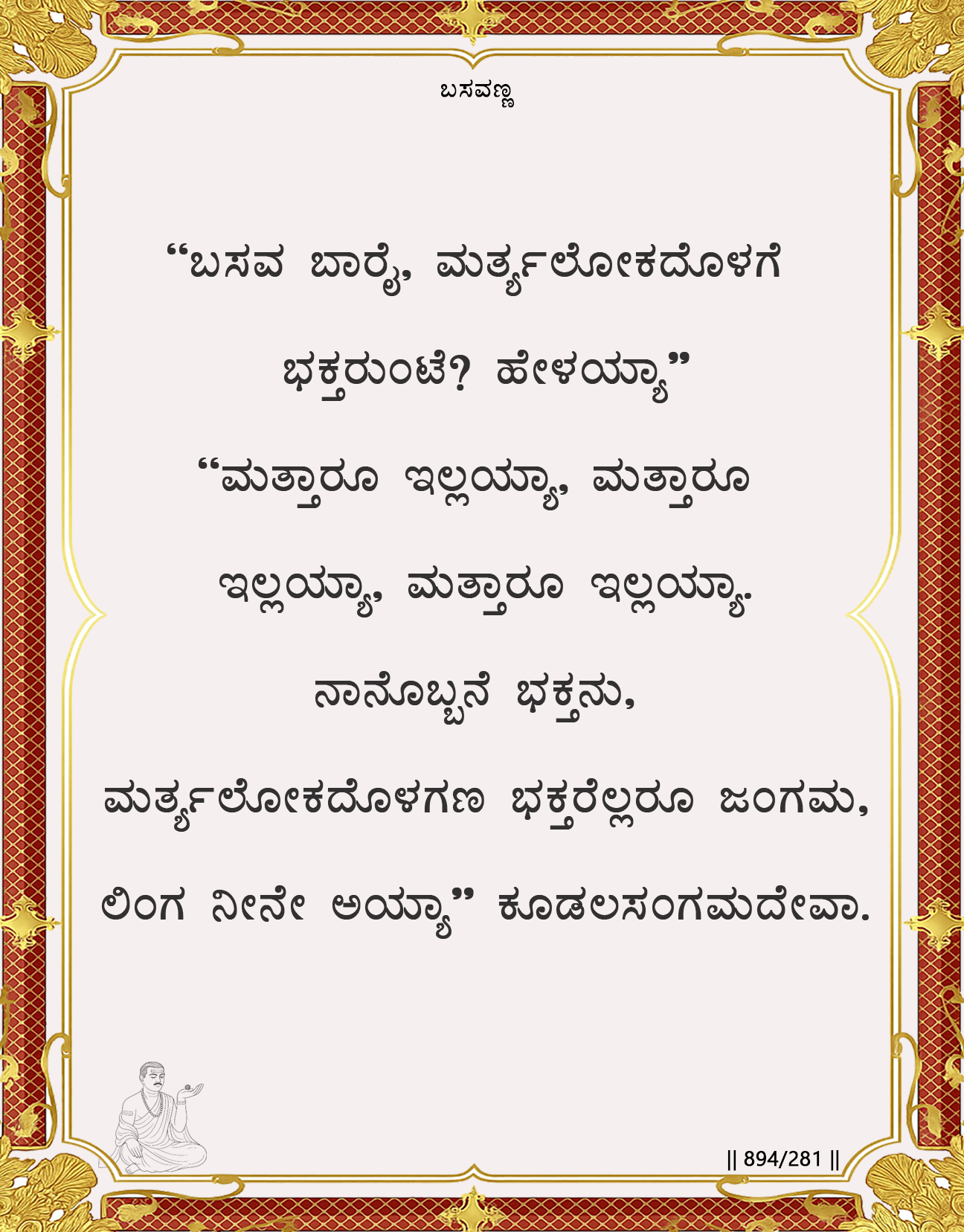
They asked him, “Basava, tell us truly
are there any real devotees
left in this mortal world?”
He smiled and said,
“None, none, none!
I alone am but a Bhakta,
a mere seeker at the threshold of Grace.
All others they are the Sharanas,
the moving Jangamas, the living Lingas
in whom the Divine walks and breathes.
And You, O Koodalasangamadeva,
alone are the eternal, changeless Linga
the Source, the Center, the All-pervading.”
This vachana is a supreme expression of non-dual realization, a direct transmission from the heart of Aikya Sthala. When questioned, Basavanna does not provide a list of qualified devotees; he shatters the very frame of the question. The inquiry “Are there any real devotees?” arises from a dualistic mind seeking to categorize and measure spirituality. Basavanna’s response obliterates this hierarchy. His triple negation, “None, none, none!” is not a statement of despair but the thunderous silence that follows the dissolution of all conceptual separation. By positioning himself as the sole Bhakta the humble learner he performs the ultimate act of spiritual courtesy and cosmic vision: he sees the entire creation not as a collection of separate seekers, but as the already-realized, dynamic expression of the Divine itself.
Spiritual Context
Core Spiritual Principle: Inverted Vision (Viparita Darshana). The pinnacle of Shivayoga is not seeing the Divine in all things, but seeing all things as the Divine. The seeker’s final role is to become the clear lens through which this truth is reflected, humbly negating their own attainment to uphold the divinity of the other.
Cosmic Reality Perspective: From absolute non-duality, there are no “devotees” (Bhaktas) separate from the “worshipped” (Linga). There is only the play of Shiva-Shakti. Basavanna’s “I alone am a Bhakta” is the playful assertion of the relative within the absolute the wave knowing itself as ocean, yet playfully assuming the form of a wave seeking the ocean. His vision of others as Sharanas/Jangamas is the perception of the ocean in every wave.
Historical Reality (Anubhava Mantapa Context): This vachana was the ultimate antidote to spiritual pride and sectarianism within the revolutionary community. It dismantled any emerging hierarchy among the Sharanas. If Basavanna, the visionary leader, saw himself as the only beginner and everyone else as the Divine, then no follower could claim superiority over another. It institutionalized divine perception as the foundation of social conduct.
Interpretation
The Question: “Are there any real devotees?” This question originates from the duality of the marketplace (Vyavaharika Satya), seeking to measure, compare, and validate spiritual progress. It is a question asked from within the dream of separation.
The Triple Negation: “None, none, none!” This is the demolition of the question’s premise. It negates the very category of “real devotees” as a separate class within phenomenal reality. It is the thunderclap of non-duality (Paramarthika Satya).
“I alone am but a Bhakta”: This is the masterstroke of spiritual pedagogy and ultimate humility. Having dissolved the category, he takes the lowest seat for himself. This prevents the hearer from placing him on a pedestal and embodies the truth that in the face of the Infinite, even the most realized is eternally a beginner.
“All others… are the Sharanas, the moving Jangamas, the living Lingas”: This is the active, gracious vision (Prasada Drishti) of the realized one. He does not see people’s flaws, struggles, or egos; he sees only their true nature as the moving, breathing expression of the Divine Principle.
“You alone are the eternal, changeless Linga”: This final declaration ensures the vision is not pantheistic but panentheistic. All is Divine because all arises from and subsists in the one, transcendent Source (Koodalasangamadeva).
Practical Implications: The practice is to consciously adopt this “Basavanna gaze.” In moments of judgment or comparison, inwardly negate the perception of the other’s limitation and affirm: “They are the Sharana, the living Linga. I am the one who is still learning to see.”
The Cosmic Reality
Anga (Human Dimension): The realm of measurement, hierarchy, and seeking. The question itself is a product of the Anga’s confused perception. Basavanna’s self-placement here is tactical; he meets the questioner at their level to pull them upward.
Linga (Divine Principle): The singular, unchanging reality Koodalasangamadeva. It is the still center that makes the glorious, dynamic perception of the Jangama-world possible. Without this anchor, the vision of “all as Divine” would be mere sentimentalism.
Jangama (Dynamic Interaction): The entire manifested universe, especially the community of beings, seen not as inert objects but as the sacred, moving, interacting presence of the Divine. This is the world experienced from Aikya not a collection of things, but a communion of sacred processes.
Shata Sthala
Primary Sthala: Aikya. The vachana is a verbal manifestation of the Aikya experience. The seer, the seen, and the process of seeing have coalesced. The statement is not a philosophy but a report from this unified state.
Supporting Sthala: Bhakta. Basavanna’s self-designation as the Bhakta is the posture of the Aikya-sthali in the relative world. It is the epitome of the humility and endless devotion that characterize the expression of union, ensuring it does not curdle into spiritual arrogance.
Practical Integration
Arivu (Awareness Practices): Practice “Triple Negation Meditation.” When a judgment arises about someone’s spiritual worth, mentally say “None.” Negate the judgment, negate the category, negate the separator. Then, consciously affirm: “To my learning eyes, you are a Sharana.”
Achara (Personal Discipline): Begin each day by assuming the “Bhakta” stance: “Today, I am the only student. Everyone I meet is my teacher, a manifestation of the Divine showing me the path.” Conclude the day by offering gratitude to Koodalasangamadeva, the Source of all these teachers.
Kayaka (Sacred Action): Perform your work as an offering to the “Sharanas and Jangamas” you perceive in your colleagues, clients, and customers. Serve the Divine in them, not their personalities. This transforms professional interactions into worship.
Dasoha (Communal Offering): In community, practice seeing through the leader’s eyes. When conflicts arise, guide participants to temporarily adopt Basavanna’s view: “What if I see myself as the only one needing to learn here, and see the other as the Divine showing me a lesson?” This resolves friction at its root.
Modern Application
The Spiritual Marketplace and Influencer Culture. We are immersed in a culture of grading gurus, comparing spiritual “progress,” and measuring authenticity direct extension of the question posed to Basavanna. This creates hierarchies, competition, cynicism, and a consumerist approach to wisdom.
This vachana instructs us to Withdraw from Spiritual Accounting. Stop evaluating who is “awake” or “authentic.” Instead, adopt the discipline of seeing all sincere seekers and even critics as “Sharanas” beings through whom life and the Divine are teaching you. Reserve the “Bhakta” label for yourself alone. This ends comparison, fosters deep reverence for others, and creates genuine humility.
Essence
“Are there any true devotees?” they cried.
“None,” the sage replied, and smiled.
“The role of seeker I alone keep;
The world is Shiva, walking, awake, asleep.
And You, the Silence from which they stream
You are the only, the unchanging Dream.”
This vachana demonstrates the observer-effect in consciousness. The ordinary mind (the questioner) observes the world and collapses the wave function into discrete objects: devotees and non-devotees. Basavanna, from the unified state, refuses to collapse the wave. His perception holds the “superposition”: all beings are simultaneously in the state of “Bhakta” and “Linga.” His verbal expression (“I am Bhakta, you are Linga”) is a conscious choice that privileges the divinity of the other, thereby entangling the hearer in a quantum of grace.
Imagine a child pointing at actors on a stage and asking, “Which one is really a person?” The playwright smiles and says, “I’m the only one here just watching. Every actor you see is a full, real person living their story. And this entire play exists within one boundless mind.” The child’s question comes from confusing the role with the reality. We are haunted by the fear of being less authentic, less evolved, less “spiritual” than others. This vachana liberates us by revealing that the solution is not to become the highest, but to see the highest in everyone else. In doing so, we occupy the only position of true peace: the humble, joyous learner in a universe brimming with divine teachers.

Views: 1