Poetic Rendering
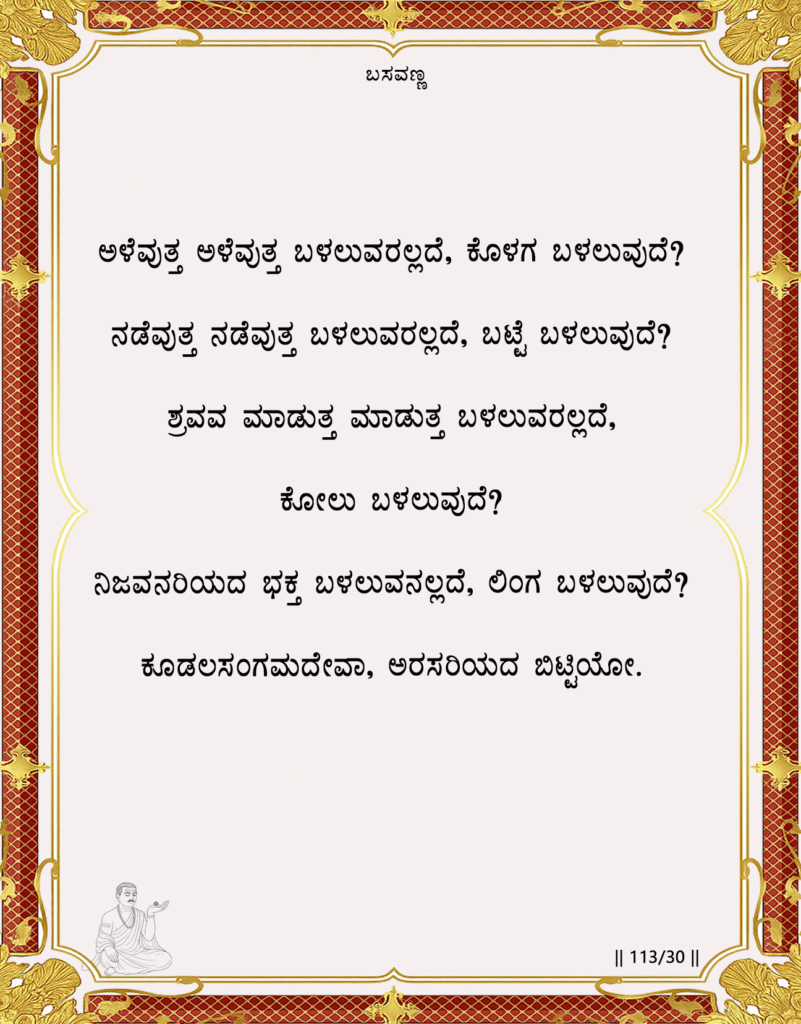
Does the pot wear out without being used?
Does the cloth fray without being worn?
Does the staff weaken without being struck?
So too the Linga does not tire,
only the ignorant devotee falters.
O Koodalasangamadeva,
do not leave me in such folly.
This vachana addresses a critical point of confusion and despair on the spiritual path. Basavanna observes that material objects a pot, a cloth, a staff wear out through use. The uninformed devotee, observing their own spiritual fatigue, may mistakenly project this weariness onto the Divine itself, believing that the Liṅga has somehow become unresponsive or that their prayers are no longer effective. Basavanna corrects this fallacy with absolute clarity: the Liṅga, as the eternal, unchanging source of consciousness and grace, is beyond all wear and tear. The problem is never with the Source, but always with the vessel the devotee’s own understanding, energy, and faith, which can falter due to ignorance, doubt, or impure intent.
Spiritual Context
Core Spiritual Principle: The Divine is an inexhaustible and unwavering source of grace. Spiritual dryness, fatigue, or the perception of God’s absence is never a failure of the Divine to provide, but a failure in the receptivity, understanding, or perseverance of the seeker. The path requires correcting the vessel, not blaming the source.
Cosmic Reality Perspective: The Linga is the eternal, unchanging reality (Nitya, Achyuta). It is compared to the sun, which is always shining; if a room is dark, the problem is with the closed windows, not the sun. The seeker’s fluctuating faith and purity are the “windows” that need cleaning.
Historical Reality (Anubhava Mantapa context): This vachana offers profound pastoral guidance. It comforts the struggling seeker by reframing their experience. Instead of seeing their fatigue as a sign of divine rejection, they are taught to see it as a call for self-purification and a deeper, more intelligent surrender. It prevents devotees from giving up in despair.
Interpretation
1. The Analogies (Pot, Cloth, Staff): These are objects that deteriorate from external use and friction. The poet uses their inherent perishability to highlight a contrast.
2. The Contrasting Truth: “the Linga does not tire…” : The Linga is not a material object. It is consciousness itself, which is not subject to the laws of decay. It does not wear out from being “used” (i.e., prayed to, relied upon). Its grace is a perpetual, overflowing fountain.
3. The Real Problem: “…only the ignorant devotee falters.” : “Ignorance” here is the misapprehension that the Linga could be unresponsive. The devotee “falters” when their faith wavers, when their practice becomes mechanical, or when their mind is clouded by desires and attachments that block the flow of grace. The fatigue is in the instrument, not the musician.
4. The Prayer: “do not leave me in such folly.” : This is a prayer for protection from one’s own lower understanding. The seeker recognizes that the capacity to persevere with right understanding is itself a grace. He is not asking God to change, but asking for the wisdom to see the truth and the strength to continue.
Practical Implications: When a seeker feels spiritually dry or feels their prayers are unanswered, they should turn their inquiry inward. The questions to ask are: “Is my practice sincere or mechanical? Is my heart pure? Is my faith conditional? Am I attached to a specific outcome?” The remedy is to purify the intention and deepen the surrender, trusting that the Source is ever-flowing.
The Cosmic Reality
Anga (Human Dimension): The human as an imperfect, fluctuating instrument. The Anga can become “dirty” (with impurities), “blocked” (with doubt), or “brittle” (with weak faith), hindering its function.
Linga (Divine Principle): Kudalasangama Deva as the perennial, omnipresent source of energy, consciousness, and grace. The Linga’s nature is to give; it never withholds.
Jangama (Dynamic Interaction): The Jangama is the flow of grace that clears the blockages in the Anga. It is also the seeker’s own prayer, which is the active, dynamic effort to realign the vessel with the source, restoring the free flow of grace.
Shata Sthala
Primary Sthala: Bhakta. This vachana perfectly captures the inner life of the Bhakta, who experiences cycles of fervor and dryness, and who must learn to rely on grace through all phases.
Supporting Sthala: Prasadi. The entire resolution lies in Prasada. The understanding that the Linga is steady is Prasada (grace as knowledge). The prayer for sustained faith is a plea for Prasada (grace as strength).
Practical Integration
Arivu (Awareness): When you feel spiritually low, practice this awareness: “The Sun is still shining. The blockage is in my atmosphere. What clouds of doubt, desire, or laziness am I allowing to gather?”
Achara (Personal Discipline): Maintain your spiritual discipline (sadhana) especially when you don’t feel like it. This is known as Nishkama Karma action without desire for the fruit. This purifies the vessel of the ego’s demands.
Kayaka (Sacred Action): Continue your work as an offering, regardless of immediate results. Trust that the act of offering itself is purifying you and making you a better vessel for grace.
Dasoha (Communal Offering): Share your struggles with the Sangha. You will find that every sincere seeker goes through these phases. This shared vulnerability becomes a Dasoha that strengthens everyone’s faith and provides the support to persevere.
Modern Application
We live in a culture of instant gratification. We expect quick results from our efforts, including spiritual ones. When meditation doesn’t bring instant peace, or when prayers aren’t answered on our timeline, we quickly lose faith, blame the method or the Divine, and abandon the path, seeking the next “quick fix.”
This vachana liberates by teaching steadfastness. It reframes the spiritual journey from a pursuit of constant bliss to a process of inner purification. It gives us the resilience to continue our practice through periods of dryness, understanding that these are not failures but essential phases of growth. It replaces the search for external signs with the cultivation of an unshakable inner trust in the ever-present Source.
Essence
The pot may crack, the cloth may fray,
The staff may break along the way.
But You, O Lord, are ever new;
The fault, dear seeker, lies in you.
Metaphysically, this vachana distinguishes between the Dhruva (the Permanent) and the Adhruva (the Impermanent). The pot, cloth, and staff are Adhruva, part of the ever-changing Prakriti. The Linga is Dhruva, the eternal Purusha/Consciousness. The “ignorance” is Adhyasa (superimposition), where the devotee mistakenly attributes the qualities of the impermanent vessel (fatigue, weakness) to the permanent source. The prayer is for Viveka (discernment) to see this distinction clearly, which is the dawn of Jnana (knowledge).
In any long-term endeavor a marriage, a career, an artistic pursuit, or a spiritual path there will be periods of difficulty and dryness. The key to success is not to blame the endeavor itself or the fundamental principles behind it, but to look inward, correct your approach, renew your commitment, and trust in the process. Perseverance, fueled by intelligent faith, is the mark of true mastery.

Views: 2