Poetic Rendering
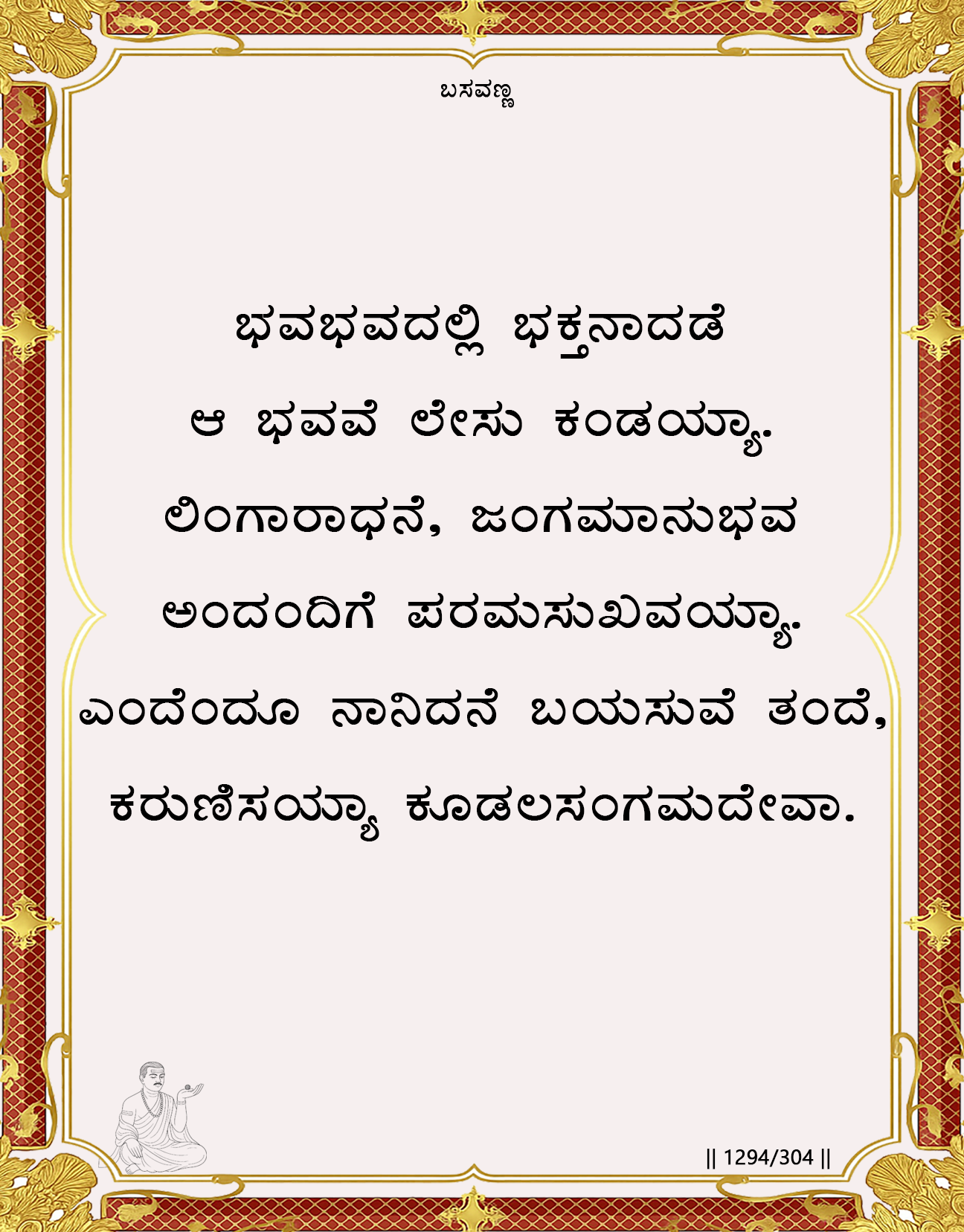
If in every pulse of my being,
in every beating moment of existence,
I am Your Bhakta
then in that very repetition
Your grace reveals itself.
By offering worship to the Linga,
and drawing living experience
from the Jangama who walks the path,
I taste the unbroken joy
that has no beginning or end.
This alone I seek forever,
this alone I yearn to hold
grant me this blessing,
O Kudalasangama Deva.
Basavanna describes the seamless continuity of devotion: when every breath, every moment, and every inner vibration is aligned with God, divine grace flows naturally. True bhakti is not occasional but rhythmic woven into the very pulse of life. He highlights two pillars of the Sharana path: Linga the inner worship of the Divine Jangama the living teacher or realized being whose presence gives experiential insight Through these, Basavanna experiences a joy that is constant and eternal, not dependent on external circumstances. The vachana expresses a simple yet profound longing: to remain forever in this uninterrupted flow of devotion and grace,
and to be upheld in it by Kudalasangama Deva. It is a prayer for continuity, constancy, and inner ripening the heartbeat of spiritual life itself.
Spiritual Context
Core Spiritual Principle: Temporal Non-Duality (Kāla-Advaita). In Shivayoga, enlightenment is not a future event but the sanctification of time itself. When each moment (Kshana) is saturated with devotional awareness, time’s succession is revealed as the pulsation of grace, not a linear march toward a distant goal. Continuity of practice dissolves the seeker’s separation from the sought.
Cosmic Reality Perspective: From the non-dual Shiva-Shakti view, the “pulse” is the primordial vibration (Spanda) of Shakti. When this vibration is consciously recognized as an expression of Shiva (through the Linga) and its flow is guided by conscious intelligence (the Jangama), it manifests as uninterrupted joy (Nityananda). The practice synchronizes the individual pulse with the cosmic rhythm.
Historical Reality (Anubhava Mantapa Context): This vachana provided the psychological and practical methodology for sustaining the Basavayoga revolution. It answered the question: How does a householder maintain revolutionary fervor amidst daily routine? The answer was to make devotion as constant as the heartbeat, supported by the living community (Jangama Sangha), transforming mundane life into a continuous liturgy.
Interpretation
1. “If in every pulse of my being… I am Your Bhakta”: This defines the scope of devotion. It is not confined to ritual hours but must permeate the autonomic and subconscious layers of life the pulse, the breath, the unnoticed gaps between thoughts.
2. “In that very repetition Your grace reveals itself”: The revelation is not in spite of repetition, but within it. The mechanical nature of repetition, when infused with conscious intent, becomes the canvas upon which grace paints its presence. The “repetition” is the rhythmic discipline (Abhyasa) that makes the mind receptive.
3. “By offering worship to the Linga… drawing living experience from the Jangama”: This outlines the complete ecosystem of practice. The Linga provides the vertical axis connection to the transcendent. The Jangama provides the horizontal axis integration into the immanent, relational world. Worship alone can become abstract; the Jangama grounds it in “living experience.”
4. “I taste the unbroken joy that has no beginning or end”: “Taste” (Rasa) signifies direct, savoring experience (Anubhava), not intellectual understanding. This joy is “unbroken” because its source is the timeless Linga, accessed through the continuous pulse of devoted awareness.
5. “This alone I seek forever… grant me this blessing”: The prayer crystallizes. The seeker’s desire is no longer for episodic visions or powers, but for the sustaining blessing (Anugraha) of this very continuity. The goal is to be upheld in the state where seeking itself transforms into abiding.
The Cosmic Reality
Anga (Human Dimension): The time-bound vessel of pulsation. Its nature is to be intermittent, distracted, and subject to breaks in continuity. Its highest purpose is to become a steady drum, rhythmically beating in tune with the divine.
Linga (Divine Principle): The eternal, unmoving source of joy. It is the silence between and within the pulses, the ground of being that makes the pulse possible. Grace is its nature, and it “reveals itself” when the pulse does not obscure it.
Jangama (Dynamic Interaction): The conduit and translator. The Jangama takes the abstract, eternal truth of the Linga and demonstrates it as a “living experience” within time. This interaction breathes life into ritual, making the timeless joy tangible within the pulses of time.
Shata Sthala
Primary Sthala: Bhakta. The aspiration for devotion in “every pulse” is the defining, earnest effort of the Bhakta stage. It is the practice of saturating daily life with remembrance (Smarana).
Supporting Sthala: Pranalingi. The “taste” of “unbroken joy” indicates the Linga becoming enlivened (Prana) within the seeker’s experience. This is the fruition the Bhakta seeks, marking a progression toward Pranalingi.
Practical Integration
Arivu (Awareness Practices): Practice “Pulse Synchronization.” Use the natural rhythm of your breath or heartbeat as an anchor. With each pulse, mentally offer a micro-surrender: “This breath for You,” “This heartbeat for You.” Link the most involuntary process to devotion.
Achara (Personal Discipline): Create “Rhythms of Remembrance.” Establish simple, recurring cues throughout the daya clock chime, a door opening, a task transitionas triggers to briefly touch base with the Linga. This weaves devotion into the fabric of time.
Kayaka (Sacred Action): Let the rhythm of your work become your worship. Whether it’s the cadence of typing, the strokes of a brush, or the steps between tasks, imbue that rhythm with the conscious intention of service, making the pulse of your labor a continuous offering.
Dasoha (Communal Offering): In community, share and celebrate “living experiences” (Anubhava) drawn from your practice. Let the Sangha function as a collective Jangama for one another, where stories of continuity inspire and uphold others in their rhythmic practice.
Modern Application
Chronic Fragmentation and Digital Interruption. Our attention is shredded by notifications, our time sliced into inefficient shards. We lack continuity in anything, leading to anxiety and a sense of meaninglessness. Our “pulses” are arrhythmic, chaotic, and seldom directed toward a unifying purpose.
Cultivate Conscious Cadence. This vachana invites us to reclaim our innate rhythm. It suggests using technology not as an interrupter but as a reminder (e.g., mindful notification settings). It teaches that spiritual health is found not in adding more practices but in imbuing the existing, repetitive pulses of our daythe commute, the meal, the walkwith devotional awareness. This transforms life from a series of distractions into a sacred, continuous liturgy.
Essence
Let every beat, a temple bell,
Each breath, a sacred syllable.
From Linga’s depth, from Jangama’s art,
A joy that does not end or start.
This constant pulse, this endless grace
The turning of the seeker’s face
Into the ever-present Sun
The many pulses made as one.
This vachana describes the achievement of spiritual coherence through phase-locking. The individual consciousness (Anga) is an oscillator with its own noisy frequency (the distracted pulse). The Linga represents a perfectly coherent, silent carrier wave. The Jangama acts as a phase-locking circuit. Through continuous devotional practice (the intention in every pulse), the noisy oscillator’s frequency is gradually pulled into phase with the carrier wave. When phase-lock is achieved, the noise disappears, and the system resonates with the “unbroken joy” of the coherent signal. The pulse doesn’t cease; it becomes a perfect expression of the silence it modulates.
Imagine a room full of ticking metronomes (individual moments of your life). Initially, they are out of sync, creating chaotic noise. The Linga is the law of physics that allows synchronization. The Jangama is the shared baseboard that transmits vibrations between them. As you devote each “tick” to alignment (setting each metronome with intention), they begin to influence each other. Eventually, all metronomes swing as one, producing a powerful, unified rhythm. The chaotic ticking is gone; what remains is a harmonious, sustained pulse that is far greater than the sum of its parts.
We often fear boredom and monotony, mistaking repetition for emptiness. Yet this vachana reveals that within repetition lies the secret of coherence. Our deepest longing is not for endless novelty, but for the profound peace that arises when the scattered pulses of our desires, fears, and actions are gathered into a single, purposeful rhythma rhythm directed toward the source of all joy. The blessing we seek is not a change in tempo, but the grace to hear our own heartbeat as the drum of the divine.
Beyond its mystical insight, this vachana offers a transformative approach to life itself: fulfillment comes not from accumulating experiences, but from deepening the quality of our presence within each one. In an age of distraction and existential anxiety, Basavanna’s prayer becomes an antidote a practice of “eternal continuity” that can turn ordinary life into continuous worship. This teaching democratizes enlightenment, making it accessible not through withdrawal from the world, but through full, conscious participation in it. The message resonates urgently today: many of our global crises stem from a fragmented, discontinuous consciousness. Healing begins when we recover a sense of sacred continuity within ourselves, in our relationships, and throughout the world. “If I must exist at all, let me exist in Your existence in devotion, awareness, and love.”

Views: 0