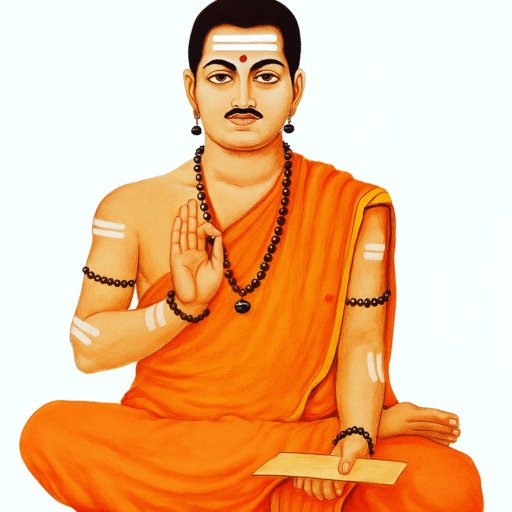

Poetic Rendering

Can a picture ever be painted
without a waiting canvas beneath it?
Can the seed awaken
without the patient womb of earth?
Can the Linga be worshiped
without the living Jangama to reveal it?
Can Rudreshwara be felt or known
without this human body as His temple?
So subtle, so tender,
so transparent is Kudalasangama Deva
the formless One who shines through form.
In the living Jangama He becomes visible,
speaks to us, touches us, guides our steps.
Beyond this, I know no other way.
Basavanna teaches that the formless Divine expresses itself only through form, just as : A painting requires a canvas, A seed requires the earth, The Linga requires the Jangama, And God requires the human body as the site of realization Each earthly medium is not a limitation but a sacred bridge. He emphasizes that Kudalasangama Deva, though ultimately formless and subtle, becomes accessible and experiential through the Jangama, the realized living guide. The Jangama is not separate from the Divine but the channel through which the Divine speaks, acts, and shines. Basavanna concludes that this living relationship Linga as principle, Jangama as living embodiment is the only authentic path he knows. The vachana expresses a profound theology of embodiment: the Infinite is known only through the finite; the Formless meets us through form.
Spiritual Context
Core Spiritual Principle: Sacred Embodiment (Mūrtāmūrta Siddhānta: The “Murtamurta Siddhanta” refers to an established theory or philosophical principle regarding the nature of reality as encompassing both “murta” (formed/material) and “amurta” (formless/non-material) aspects. This concept is explored in various Indian philosophical schools, particularly in the context of distinguishing between different categories of existence.). In Lingayoga, the formless (Nirguna) is not opposed to form (Saguna); rather, form is the legitimate and necessary manifestation of the formless. The Absolute requires the relative as its field of expression and recognition. Denying the value of form is as much an error as being trapped within it.
Cosmic Reality Perspective: In non-dual Shiva-Shakti terms, Shiva is the formless consciousness, and Shakti is his creative power that assumes all forms. The Jangama is Shakti in its most conscious, human expression fully aware of its Shiva-nature. To worship the Linga without the Jangama is to try to perceive Shiva without acknowledging Shakti, which is impossible, as they are inseparable in reality.
Historical Reality (Anubhava Mantapa Context): This vachana countered potential ascetic or overly abstract tendencies within the Basavayog a movement. It validated the revolutionary choice to center the community around the living teacher (Jangama) and the embodied practice of the householders. It argued that their path of seeing God in the human community and the working body was not inferior to ascetic renunciation but was the most complete means to realize the formless.
Interpretation
1. Canvas & Painting: The canvas is the prepared, receptive mind and body of the devotee. The painting is the divine expression (Linga) that unfolds upon it. Without the prepared canvas of a disciplined life, the divine image cannot be rendered.
2. Earth & Seed: The earth is the “soil of devotion” and the community (Sangha). The seed is the grace of the Guru or the inner Linga. The seed’s potential remains dormant without the earth’s nurturing embrace, signifying that inner realization requires the context of righteous living and fellowship.
3. Linga & Jangama: This is the core doctrinal point. The Linga as a static, ritual object or abstract principle is inert without the conscious, interpretive presence of the Jangama. The Jangama “reveals” it by demonstrating its living truth in action, speech, and grace.
4. Rudreshwara & Human Body: The body is not an obstacle but the “temple.” The divine (Rudreshwara) is “felt and known” through the senses, emotions, and actions of the human form. Spiritual practice purifies the temple so it can accurately house and reflect the deity.
5. “In the living Jangama He becomes visible… Beyond this, I know no other way”: This is Basavanna’s ultimate empirical testimony. The formless becomes epistemologically accessible only through the formal. The Jangama is the epistemological bridge. Any path claiming to bypass this embodied, relational reality is, in his experience, invalid.
The Cosmic Reality
Anga (Human Dimension): The realm of limitation and particularity. It is not an illusion to be discarded but the very ground of realization. Its limitations (form, time, space) are the necessary conditions for the infinite to express itself in knowable ways.
Linga (Divine Principle): The unmanifest, unbounded potential. It is “so subtle, so tender” that it cannot be grasped directly by the senses or mind. It is the meaning that seeks a language.
Jangama (Dynamic Interaction): The language itself. It is the dynamic, conscious form that the formless assumes to communicate with itself in manifestation. The Jangama is the Linga-in-dialogue, the divine in pedagogic motion, making the relationship between Anga and Linga a living conversation rather than a silent confrontation.
Shata Sthala
Primary Sthala: Sharana. The vachana’s entire argument validates the Sharana’s choice to take refuge in the living Jangama and the embodied path. It defines the Sharana stage as the conscious dwelling in this form-formless continuum.
Supporting Sthala: Aikya. The underlying truth that makes this possible is the non-duality of Aikya. The Jangama can reveal the Linga because they are not two. The seeker’s body can be the temple because it is not separate from the deity. The teaching points toward this ultimate unity.
Practical Integration
Arivu (Awareness Practices): Practice “Seeing the Formless in Form.” In meditation, visualize the Linga, then contemplate how its principles (peace, love, consciousness) are embodied in the life and teachings of your guide or a saint. See the form as the perfect vehicle for the formless quality.
Achara (Personal Discipline): Honor your body as the temple. Engage in physical care (sattvic food, exercise) not as vanity but as temple maintenance. Perform Istalinga worship with the understanding that the ritual form (the physical Linga) is the sacred meeting point with the formless.
Kayaka (Sacred Action): See your work as the “canvas” for the divine painting. Whatever you create or maintaina clean room, a well-made product, a solved problemview it as the form through which conscious integrity (the formless) becomes visible.
Dasoha (Communal Offering): Deeply respect the Jangama principle within your community. Value lived experience and embodied wisdom over abstract dogma. Create structures where elders or those with practical spiritual maturity are heard, seeing them as channels of the formless truth for the collective.
Modern Application
Digital Disembodiment and Abstract Spirituality. We increasingly live in abstract, digital realms, consuming spiritual content as information from distant, mediated sources. This leads to a disconnect between our philosophical understanding and our embodied experience, creating “spiritual bypassing” the use of lofty ideas to avoid earthly responsibilities and relational work.
Re-embody Your Spirituality. This vachana calls us back to the tangible. Seek a living guide or community you can interact with directly. Engage in physical rituals, serve with your hands, and learn from people whose wisdom is etched in their faces and actions, not just their words. Understand that if a spiritual truth cannot be embodied, it is not yet fully realized. Make your life the canvas, your community the earth, and your actions the temple where the formless is invited to dwell.
Essence
The seed needs soil, the paint needs ground,
The sacred sight, in form, is found.
The Formless, subtle, speaks through clay
The Jangama shows the only way.
This body, temple, holds the key
To know what eyes will never see.
In form’s embrace, the boundless known
The seed, the tree, the truth are one.
This vachana articulates the interface principle of consciousness. The formless (Linga) is pure, unmanifest potentialan infinite field of silent awareness. Form (Anga, Jangama) is the necessary interface where this potential becomes actual, knowable, and active. The human body-temple and the living Jangama are not mere symbols but functional interface sconsciousness rendered into relational, temporal terms. The Jangama is the “active reference,” the form through which the formless calibrates our perception, teaching us to recognize itself not as an object, but as the very subject shining through all form. The universe operates on this interfacial logic: the Absolute realizes itself through the relative.
Imagine an ocean (the formless Divine). You cannot know the ocean by standing on the shore and staring at the horizon. You need a vessel (the body/temple) to enter it, and a skilled sailor (the Jangama) to teach you how to navigate its currents, read its depths, and understand its nature from within. The vessel and the sailor do not limit the ocean; they are the means by which you move from being a spectator to a participant in its reality. Denying the vessel and sailor leaves you stranded on the shore of abstraction.
We feel a profound tension between our finite, fragile humanity and our intuition of the infinite. This vachana reveals that this tension is not a problem to be solved by escaping our humanity, but the very dynamic through which the infinite is realized. Our human form with its capacity for relationship, service, and sensory experience is the perfect instrument for this realization. The longing for a living guide (Jangama) is the intelligence of the heart seeking the correct interface. True spirituality, therefore, is not the rejection of the human condition but its full, conscious embrace as the temple, the canvas, and the fertile earth where the seed of the infinite ripens. As Basavanna teaches, this fusion of Awareness (Linga) and Compassion (Jangama) is the living science of realization: to serve life consciously is to worship the Eternal.

Views: 1