Poetic Rendering

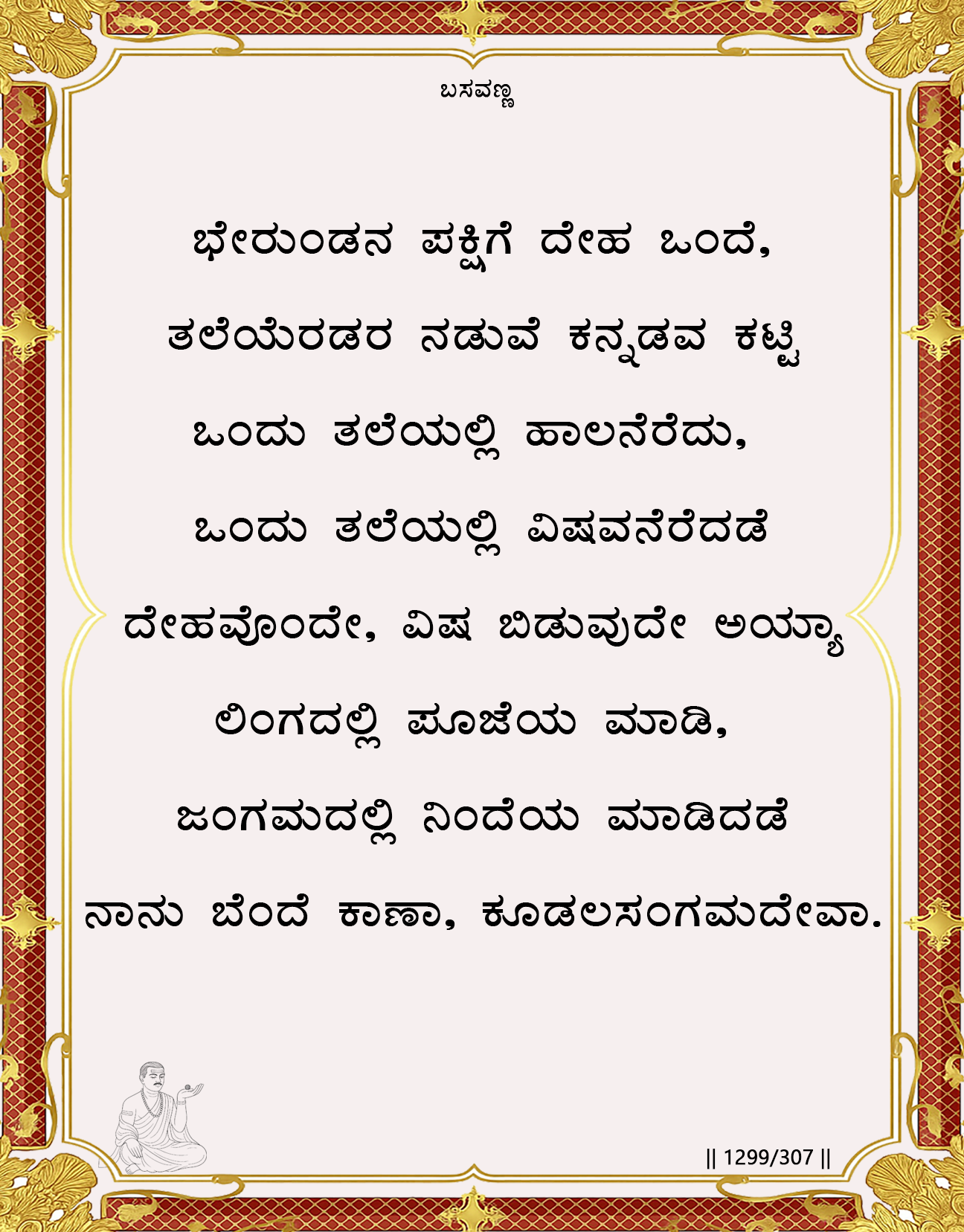
The Bherunda bird
one body, two heads.
Draw a curtain between them,
feed one head nectar
and the other poison
does not the same body
burn in anguish?
So it is, O Kudalasangama:
if I worship the Linga
yet slander the Jangama,
my own devotion
turns into the fire
that consumes me.
The Destruction Born of Divided Devotion In this vachana, Basavanna unfolds one of his most striking metaphorsthe Bherunda, a mythical two-headed birdto expose the inner contradiction of divided devotion. Though the bird has two heads, it shares one body; what harms one ultimately harms both. This serves as a vivid mirror to the seeker’s inner life. Basavanna warns against a spiritual split: revering the Linga (the transcendent Divine) while dishonoring the Jangama (the living embodiment of that same Divine). Such a contradiction is not merely a moral failingit is a form of spiritual self-harm. Just as poison given to one head destroys the entire bird, disrespect toward the Jangama nullifies one’s worship of the Linga. This vachana thus functions as both critique and caution. It exposes the human tendency to compartmentalize spirituality honoring the sacred in ritual while wounding it in life. Basavanna teaches that true devotion is indivisible:
ethical integrity and spiritual insight must arise from the same source. The unity of Linga and Jangama is not symbolic but existential to violate one is to violate the other, and ultimately, to wound oneself.
Spiritual Context
Core Spiritual Principle: Indivisible Unity of Perception and Action (Dṛṣṭi-Kriyā Aikya). Spiritual realization is not a private experience but a state of being that must express itself coherently in all dimensions of life. The divine perceived (Linga) and the divine served (Jangama) are one.
Cosmic Reality Perspective: This is a definitive statement of non-dual (advaita) ethics. The Shiva-Shakti dynamic here is the inseparability of transcendent consciousness (Shiva as Linga) and its active, manifest power (Shakti as Jangama). To reject the power is to falsify one’s relationship with the source.
Historical Reality (Anubhava Mantapa Context): This vachana was a radical social solvent in the Anubhava Mantapa. It dismantled the priestly privilege that allowed ritual purity to coexist with social oppression. It established a new social contract for the Basavayoga community: your spiritual standing is nullified if your social conduct is harmful. It made spiritual accountability the bedrock of communal life.
Interpretation
1. “The Bherunda birdone body, two heads.” This establishes the metaphysical premise: individual consciousness (jīva), though appearing fragmented in its functions (thinking, feeling, acting), is a singular field of awareness. The “two heads” are not separate entities but conflicting modes of engagement within one being.
2. “Feed one head nectar and the other poison… does not the same body burn in anguish?” This describes the law of karma not as external retribution but as intrinsic consequence. Anguish (tāpa) is the inevitable thermodynamic result of contradictory energies (sattvic nectar vs. tamasic poison) forced to coexist in a closed system (the one body). The pain is the system’s struggle to return to equilibrium.
3. “If I worship the Linga yet slander the Jangama, my own devotion turns into the fire that consumes me.” Here, devotion (bhakti) is revealed as a potent energy. When directed with hypocrisy, this very energy, instead of dissolving the ego, amplifies its contradictions, becoming the “fire” (agni) of self-consumption. The worship is not invalidated by an external judge; it auto-combusts.
Practical Implications: This makes introspection non-negotiable. A seeker must constantly audit not just their meditation, but their speech, judgments, and treatment of others. Spiritual practice becomes the integration of all life’s domains. There is no “spiritual progress” that exists independently of ethical and relational harmony.
The Cosmic Reality
Anga (Human Dimension): The Anga is confronted with its own capacity for internal schism. The practice is to become a integrator, healing the split between the “worshipping head” and the “acting head.” The Anga’s maturity is measured by the consistency of its reverence, from the private altar to the public square.
Linga (Divine Principle): Koodalasangama Deva is understood here as the principle of non-contradiction in the absolute. The Linga is not a passive icon but the active standard of coherence. To approach the Linga while fostering contradiction is to fail to perceive its true nature as all-pervading, undivided reality.
Jangama (Dynamic Interaction): The Jangama is the litmus test of realization. It represents the divine in motion, in relationship, in the vulnerable human form. Slandering the Jangama is the act of denying divinity its full expression. Honoring the Jangama is the practice of seeing the Linga’s movement in time and space, completing the circle of worship.
Shata Sthala
Primary Sthala: Sharana. The Sharana stage demands total surrender (ātmā-nivedana). This vachana exposes the shadow of that stage: the attempt to surrender the self to the Linga while withholding surrender in the form of respecting the Jangama. This creates the “Bherunda agony,” a state of stalled progress where the seeker is tortured by their own half-measures.
Supporting Sthala: Maheshwara. The Maheshwara is one who has internalized the greatness of the Lord and acts from that awareness. The hypocrite depicted is a failed Maheshwarathey have perceived the greatness (hence they worship) but have not let it reorganize their entire behavioral matrix. The poison of slander proves the perception is not yet embodied.
Practical Integration
Arivu (Awareness Practices): Practice “moment-to-moment integrity checks.” Before, during, and after any act of worship or prayer, consciously scan your mental and emotional stance toward others. Is there contempt, judgment, or dismissal? This bridges the gap between the heads.
Achara (Personal Discipline): Institute a personal vow: “I will not perform my daily iṣṭalinga puja if I am consciously harboring malice or have spoken ill of someone without cause that day.” Let the discipline of worship be contingent on the discipline of speech.
Kayaka (Sacred Action): Reframe all work as service to the Jangama-principle in others. Whether a teacher, farmer, or administrator, see the recipient of your work not as a separate “other,” but as a manifestation of the divine dynamic your worship honors. This unifies the nectar and the action.
Dasoha (Communal Offering): In community gatherings, make space for accountability, not just celebration. Create a culture where loving correction is offered if a member’s spiritual talk is belied by harmful actions, applying Basavanna’s teaching to nurture the one body of the community.
Modern Application
Virtue Signaling & Tribal Identity. The digital age perfects the Bherunda split: curating a persona of spiritual or ethical enlightenment online (nectar) while engaging in toxic tribalism, cancel culture, or passive aggression in direct interactions (poison). The “agony” manifests as epidemic anxiety, inauthenticity, and societal polarization.
Embodied Integrity as Revolution. In a world of curated images, the most radical act is to become a person whose private convictions, public speech, and professional actions are aligned. This applied Lingayoga means your environmental activism must reflect in your consumption; your talk of equality must reflect in your workplace; your spiritual study must soften your heart in conflict. This coherence becomes a quiet, transformative force.
Essence
One sky, two eyes that see
if one looks to heaven, the other condemns the earth,
the soul goes blind.
O moment of Union,
to split your name is to shatter the mirror:
the worshipper and the slandered
are the same face, unrecognized,
and the prayer burns the hands that pray.
This vachana describes a quantum entanglement of moral and spiritual states. The “nectar” of worship and the “poison” of slander are not independent variables. Once generated within the single quantum system of the individual consciousness, they become entangled. The positive waveform of devotion is collapsed and its energy inverted by the negative waveform of hatred, resulting in the decoherence of spiritual progress into the classical, painful state of “anguish.”
It’s like trying to heat and cool your house with the same system by setting the thermostat to both scorching and freezing. The system doesn’t deliver two results; it strains, breaks down, and leaves you in extreme discomfort. Your soul is that house.
We all fear the cost of full integrity. We want the comfort of spiritual ideals without the inconvenience of challenging our prejudices, and the status of moral authority without the sacrifice of our hidden indulgences. Basavanna exposes this universal bargain and reveals its catastrophic failure: the split we create to protect ourselves becomes the very fire that consumes us. Wholeness is not a luxury; it is the only condition for true peace.

Views: 0