Poetic Rendering

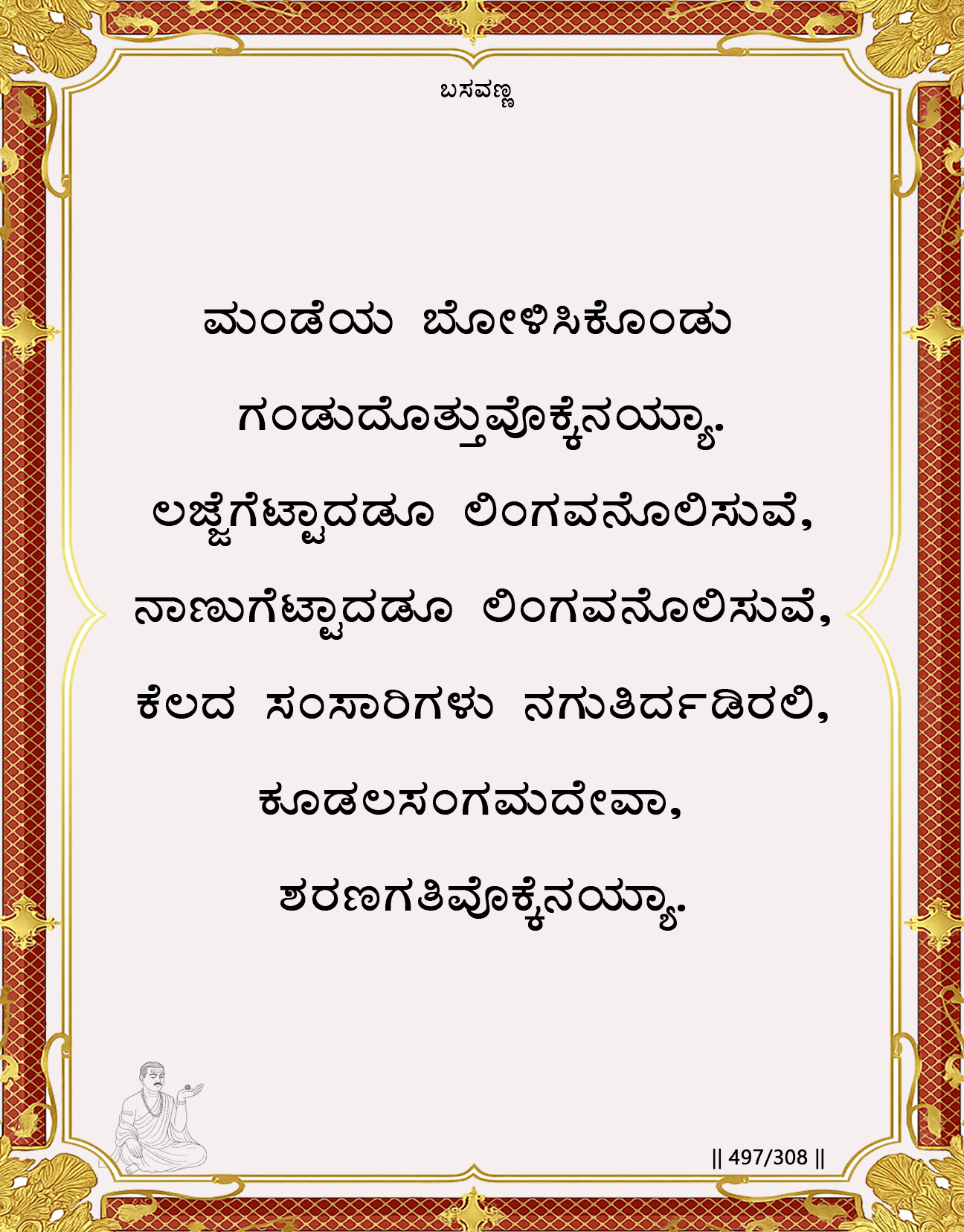
Though my head is shaven,
I shall walk upright
steadfast as any man.
Let them laugh, let them mock;
let honor fall away,
let shame too be cast aside.
Whatever the world may say or do,
my reverence for the Linga
will never waver.
Let those still tangled
in worldly pride and scorn
jeer as they please
O Kudalasangama,
I know only this:
to live as Your Sharana.
Freedom That Comes From Standing in Truth Alone This vachana proclaims the highest form of spiritual freedom the courage to live from the core of one’s inner truth, unshaken by society’s judgments. Basavanna uses the striking image of the shaven head, symbolizing renunciation not of the world, but of the world’s approval. It is a conscious divesting of external identifiers: status, reputation, honor, and even the fear of disgrace. Basavanna declares that true dignity arises not from social validation but from the unwavering alignment of one’s life with the Divine. When the seeker’s identity is rooted in Linga-consciousness, neither praise nor ridicule can add to or diminish their inner stature. Honor and shame become equally weight less mere shadows passing over a mind grounded in truth. This vachana marks a mature flowering of the Sharana path. The devotee is no longer defined by public perception or social norms; their identity arises directly from their inner union with the Divine. Basavanna transforms vulnerability into strength: the moment we cease fearing others’ opinions, devotion becomes fearless, pure, and uncompromised. To live as a Sharana, then, is to step into a freedom that is both radical and serene a freedom born of belonging only to the Divine.
Spiritual Context
Core Spiritual Principle: Sovereignty Through Singular Belonging (Eka Śaraṇya). Ultimate freedom is achieved not by independence from all things, but by becoming absolutely dependent on, and defined by, the One Reality. This paradox liberates one from every lesser dependency.
Cosmic Reality Perspective: This is a non-dual declaration of identity. The Shiva-Shakti dynamic here is the stable, unmoving center (Shiva as Linga) granting the power (Shakti) for fearless engagement with the phenomenal world. The devotee, anchored in the center, remains unswayed by the turbulent play of māyā (illusion) in the form of social opinion.
Historical Reality (Anubhava Mantapa Context): This vachana was a manifesto of the Shivayoga revolution’s social courage. To publicly wear the iṣṭalinga and reject caste marks was to invite ridicule from orthodox society. Basavanna here provides the inner rationale and fortitude for this act. It fortified the community to withstand social ostracization by re-framing mockery as an insignia of true commitment, transforming a potential source of shame into a badge of honor rooted in divine, not human, valuation.
Interpretation
1. “Though my head is shaven, I shall walk uprightsteadfast as any man.” The “shaven head” is a deliberate act of de-identification from social-religious archetypes (the yogi, the ascetic, the priest). To “walk upright” is to claim an inner authority that is self-validating. This establishes the body itself as a site of truth, no longer conforming to external postures of respectability.
2. “Let honor fall away, let shame too be cast aside.” Basavanna identifies honor (māna) and shame (apamāna) as a binary trap, a single mechanism of social control. To be free of one, you must be free of both. Their “casting aside” is not an act of willpower but a natural consequence (phala) of the mind’s re-anchoring. They lose their gravitational pull.
3. “Whatever the world may say or do… I know only this: to live as Your Sharana.” This final movement collapses all possible external conditions into a singular, unwavering internal orientation. The phrase “I know only this” indicates a state of epistemological certainty. All other “knowings” (what people think of me, what is proper) have been subsumed into the knowing of one’s state of refuge.
Practical Implications: This defines the endpoint of sādhana: fearlessness (abhaya). Practice is no longer about acquiring qualities but about shedding the internalized social auditor. Every moment of anxiety about reputation becomes a call to re-establish in the refuge. Social interaction becomes a līlā (play), not a test.
The Cosmic Reality
Anga (Human Dimension): The Anga achieves its final form as the pure vessel. The “shaven head” symbolizes the emptying out of all egoic and social content. The Anga is no longer a composite of roles but a clear, open space through which the Linga’s presence is expressed without distortion. Its dignity is intrinsic, not conferred.
Linga (Divine Principle): Koodalasangama is realized as the only valid referent. In a universe of relative opinions, the Linga stands as the absolute standard. The devotee’s alignment is so complete that the Linga becomes the devotee’s sole “public” the only opinion that matters. This is the fulfillment of seeing the Linga in all; here, one sees all in the Linga.
Jangama (Dynamic Interaction): The Jangama here is the fearless flow of authentic being-in-the-world. It is the lived expression of this inner sovereignty. The Jangama moves through societal spaces without absorbing their values, like water flowing through a pipe without taking its shape. The mockery of others is just noise that cannot alter its course.
Shata Sthala
Primary Sthala: Aikya. This vachana is the spoken truth of one established in Aikya (Union). The dissolution of the duality between honor and shame externally mirrors the dissolution of the subject-object duality internally. The declaration “I know only this” arises from the unified consciousness that no longer oscillates between external poles.
Supporting Sthala: Pranalingi. The Pranalingi is one for whom the Linga is the very life breath. This vachana demonstrates the social consequence of that state. When one’s vital energy (prāṇa) is sourced from the Linga, the social “air” of approval and disapproval becomes superfluous. One can breathe freely in any atmosphere.
Practical Integration
Arivu (Awareness Practices): Practice “Witnessing the Inner Social Panel.” In moments of hesitation or shame, identify the internalized voices of parents, peers, or society. Consciously thank them and dismiss them, stating inwardly: “My reference is the Linga alone.” Shift your audience from the projected many to the indwelling One.
Achara (Personal Discipline): Choose one small, authentic expression that defies a trivial social convention (e.g., dress, a polite fiction, a habitual people-pleasing gesture). Perform it consciously as an achara of inner sovereignty, offering the minor discomfort as a kayaka of self-liberation.
Kayaka (Sacred Action): Perform your duty (kayaka) as an offering placed directly at the feet of the Linga, bypassing the desire for human recognition. At work or home, act from integrity and skill, and consciously release the action from any need for thanks, praise, or even notice.
Dasoha (Communal Offering): Create spaces within community where members can share vulnerabilities and experiences of being judged without needing consolation, but rather to reaffirm their shared refuge in the Linga. The community’s role becomes reinforcing this inner anchor, not fighting external critics.
Modern Application
The Performance Self and the Anxiety of Visibility. In the age of social media and personal branding, the self has become a curated performance optimized for external validation (“likes,” follows, accolades). The “shaven head” is the antithesis: a deliberate de-optimization of the social self. The resulting anguish is the pervasive anxiety of “how am I perceived?”
Cultivating the Inner Referent. The practice of Basavayoga today is to constantly redirect the source of self-worth from the fluctuating marketplace of opinions to the steady truth of divine immanence. This means making life choices (career, relationships, lifestyle) based on inner calling and integrity, not on prestige or fear of obscurity. It allows for digital detox not as escapism, but as reclaiming the citadel of one’s own mind.
Essence
They took my turban, my crown of station,
and left the sky.
They stripped me of name, of kin, of face,
and left the mirror, empty, clear.
Let their laughter be the wind,
let their scorn be the rain
this ground I stand on
is borrowed from no man.
O Union of All Moments,
to be your place
is to be unshakable.
This vachana describes a phase transition in consciousness from social entanglement to quantum coherence. The individual consciousness particle, once “entangled” with the collective field (honor/shame, praise/blame), decoheres into a chaotic state of anxiety. Through singular anchoring in the Linga (the unified field), it achieves a new, stable coherence. In this state, it is responsive but not reactive; it interacts with the social field without losing its own definite frequency (“I know only this”).
Imagine your sense of self is a boat. If it’s tied to ten different docks (your boss’s opinion, your family’s expectations, society’s trends), every wave rocks it violently. Basavanna cuts every rope but one the anchor to the ocean floor itself (the Linga). Now, the same waves pass by, but the boat is steady, held by something unmoving and greater.
Our deepest addiction is to being somebody. We fear insignificance more than death. Basavanna’s radical therapy is to willingly become a “nobody” in the eyes of the world, to discover you are everything in the eyes of the Divine. The terror of mockery is the final gatekeeper; walking through it reveals that our true self was never the fragile character being judged, but the vast awareness that perceives the judgment and remains, unalterably, free.

Views: 0