Poetic Rendering

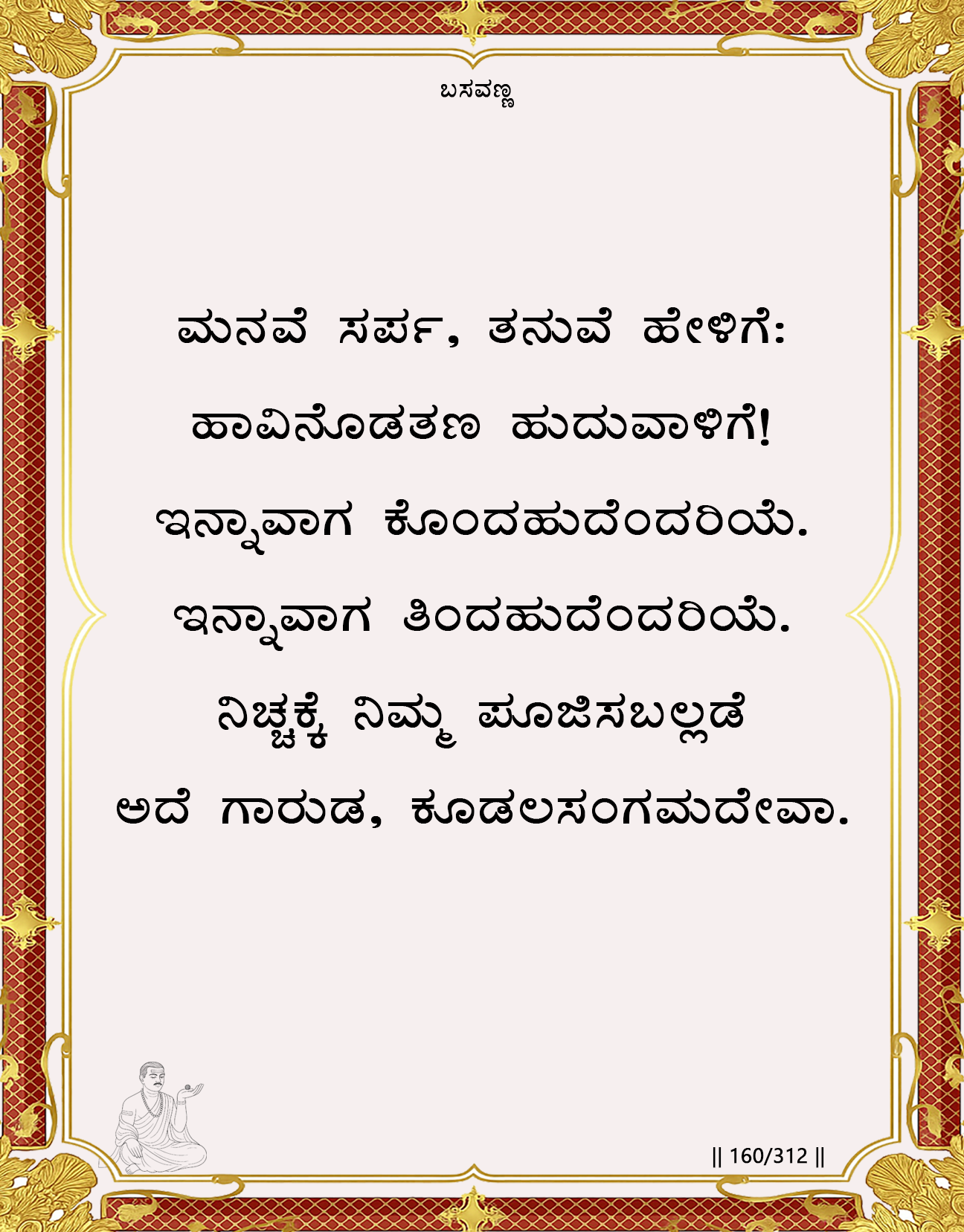
The mind is a serpent,
the body its bamboo basket.
To live beside such a serpent
is to live in vigilance.
Do not ask when it will strike,
nor when it will swallow you whole
its ways are never known.
So I keep my gaze fixed on You,
every instant an offering,
every breath a watchful prayer.
This vigilance itself
is the eagle that conquers the serpent
O Kudalasangama Deva.
In this vachana, Basavanna gives one of his most striking psychological and yogic teachings. He compares the mind to a serpent unpredictable, subtle, and potentially dangerous. The body is its container. One cannot control when the serpent-mind will strike with anger, desire, fear, or delusion. Therefore, the path is not to suppress or fear it, but to cultivate constant awareness the spiritual vigilance that keeps the serpent from turning destructive. This vigilant awareness is symbolized by the eagle (Garuda), the natural adversary and conqueror of serpents. For Basavanna, this vigilance is unbroken remembrance of the Divine, a steady inner gaze toward the Linga, a continuous offering of awareness. When consciousness remains anchored in Kudalasangama, the serpent-mind loses its venom and becomes harmless. It is not destroyed, but transmuted. Thus, Basavanna teaches that liberation is achieved not by escaping the mind, but by illuminating it through unwavering devotional awareness.
Spiritual Context
Core Spiritual Principle: Vigilance as the Substance of Devotion (Bhakti-Sāra Avadhāna). The essence of devotion is not emotional fervor but unwavering attentiveness. This conscious attention is both the path and the protection; it is the practice that transforms the practitioner.
Cosmic Reality Perspective: This is a non-dual strategy for engaging duality. The Shiva-Shakti dynamic is internalized: Shiva is the still, focal point (Linga), and Shakti is the power of focused attention (the eagle’s gaze). The serpent represents the chaotic, tangential movements of Shakti when not aligned with Shiva. The practice realigns energy with source, ordering chaos into conscious flow.
Historical Reality (Anubhava Mantapa Context): This vachana provided practical psycho-spiritual technology for the revolutionary Shivayoga community. Leaving orthodox structures meant facing intense internal fears (of social ostracization) and external threats. This teaching gave them a tool: transform anxiety into vigilant worship. The “serpent” of societal pressure and inner doubt could be overcome not by confrontation, but by a higher, collective focus on their shared divine center (iṣṭalinga).
Interpretation
1. “The mind is a serpent, the body its bamboo basket.” This establishes the topography of the self. The “basket” (body) is not the problem; it merely contains and reveals what is within. The serpent (mind) is not evil but a powerful, amoral force of nature. Its venom is the capacity of thought and emotion to create suffering when operating unconsciously.
2. “Do not ask when it will strike… its ways are never known.” This acknowledges the inherent unpredictability of the unconscious mind. Trying to predict or control each thought is futile and exhausting. Basavanna rejects a tactical, micro-managing approach to spirituality in favor of a strategic one.
3. “So I keep my gaze fixed on You… This vigilance itself is the eagle that conquers the serpent.” This reveals the meta-strategy. Instead of engaging with the content of the mind (the serpent’s movements), one changes the context. The “eagle” is not a second object fighting the first; it is the quality of consciousness high, panoramic, detached that arises when attention is fully absorbed in the divine. Conquest here is not destruction but neutralization through superior positioning.
Practical Implications: This reframes all spiritual practice as the cultivation of a specific quality of attention. Meditation is not about emptying the mind but about training its gaze. Challenging emotions are not enemies to be slain but indicators that one’s “gaze” has wavered. The solution is always to return to the focal point, not to analyze the distraction.
The Cosmic Reality
Anga (Human Dimension): The Anga is the field of practice. It is the basket containing both the challenge (serpent) and the solution (the potential for an eagle’s gaze). The Anga’s work is to consciously choose and sustain the gaze, to feed the eagle through remembrance (smaraṇa), starving the serpent of identificatory energy.
Linga (Divine Principle): Koodalasangama is the absolute focal point. It is the sun to the eagle’s sight. The Linga provides the “why” for vigilanceit is of ultimate valueand the “how”its simplicity and constancy make single-pointed focus possible. It is the still point that makes discernible all movement around it.
Jangama (Dynamic Interaction): The Jangama is the living vigilance in action. It is the unbroken thread of awareness moving through daily life. A true Jangama is one for whom this eagle-gaze has become their default state; their very movement through the world is a vigilant offering, and their presence helps others lift their own gaze.
Shata Sthala
Primary Sthala: Prasadi. The key to this vachana is Prasadithe grace-bestowed clarity and steadiness. The power to maintain the “eagle’s gaze” amidst the mind’s turbulence is not a willful achievement but a sustained gift. Each moment of successful vigilance is a moment of receiving and embodying grace.
Supporting Sthala: Sharana. The stance described is the essence of Sharanataking refuge. Here, refuge is not a passive hiding place but an active, vigilant anchoring. The devotee takes refuge in the gaze itself, which is their connection to the Divine. It is a refuge of alertness, not of sleep.
Practical Integration
Arivu (Awareness Practices): Practice “Noting the Basket.” When emotional turmoil arises, first feel the “basket” the physical sensations in the body. This creates initial detachment from the “serpent’s” story. Then, consciously redirect attention (the gaze) to the Linga or the feeling of the divine presence, however faint.
Achara (Personal Discipline): Establish a “Vigilance Trigger.” Choose a common daily activity (e.g., touching a door handle, hearing a phone ring) as a trigger to check and steady your “gaze.” Use it to offer a moment of conscious remembrance, training the eagle’s habitual return.
Kayaka (Sacred Action): Perform work as an exercise in sustained gaze. Choose to hold the intention of service or offering (the Linga) as your primary focus, letting the details of the task (the potential distractions/serpents) be secondary. This builds the muscle of vigilant engagement.
Dasoha (Communial Offering): In community, help hold the collective gaze. Gently guide conversations and shared practices back to the essential focus when they scatter into gossip or negativity. Be a reminder of the eagle’s perspective for the group.
Modern Application
The Hyperactive Serpent & The Distracted Gaze. The digital age is the ultimate serpent-basket, with endless, algorithmically-engineered strikes on our attention. Our gaze is chronically fragmented, leaving us psychologically vulnerable and spiritually starved. Anxiety is the new normal.
Digital Sannyasa of Attention. The practice of Basavayoga today is a radical sannyasa (renunciation) not of the world, but of distracted attention. It is to use technology while vigilantly guarding the “eagle’s gaze.” This means single-tasking, digital fasts, and consciously offering periods of sustained attention to the divine center, retraining the mind from its conditioned fragmentation. It is the ultimate act of counter-cultural resistance.
Essence
I do not tame the coil and hiss,
I simply stop defining the world
by its shadow.
I build my nest in the sun,
and from that height,
the patterned threat below
becomes mere geography.
O Lord of Union,
my only strategy
is to be so absorbed in Your light
that I forget I ever learned to fear the dark.
This vachana describes the quantum principle of the observer effect applied to consciousness itself. The “serpent” is consciousness in a superposition of potential emotional states (anger, fear, desire). The act of focusing the “eagle’s gaze” (observation) collapses the wave function. However, instead of collapsing it into one of the serpentine states, the observation anchored in the Linga collapses consciousness into a state of ordered, focused awareness. The observer (the Anga) determines the observed (the mind’s state) by the choice of observational framework (Linga-centric vs. ego-centric).
Your mind is like a radio picking up many stations (serpent’s hisses). Trying to silence each annoying station is futile. Basavanna’s solution is to stop fiddling with the dial and instead plug in a high-quality audio cable (the eagle’s gaze) directly into the source of perfect music (the Linga). When you do this, you still know the other stations are there, but you no longer hear them. Your experience is defined by your direct connection.
We are terrified of the contents of our own minds. We try to manage, suppress, or positively think our way out, which only gives the serpent more energy. Basavanna offers the profound relief of a divine distraction. The answer to mental suffering is not within the mind’s drama, but beyond it, in a commitment of attention so complete that the drama loses its audience and its power. Peace is found not in the absence of the serpent, but in the presence of a higher fascination. “When the mind’s wild energy bows to the Divine, poison turns to prayer, and awareness dawns as light.”

Views: 0