Poetic Rendering
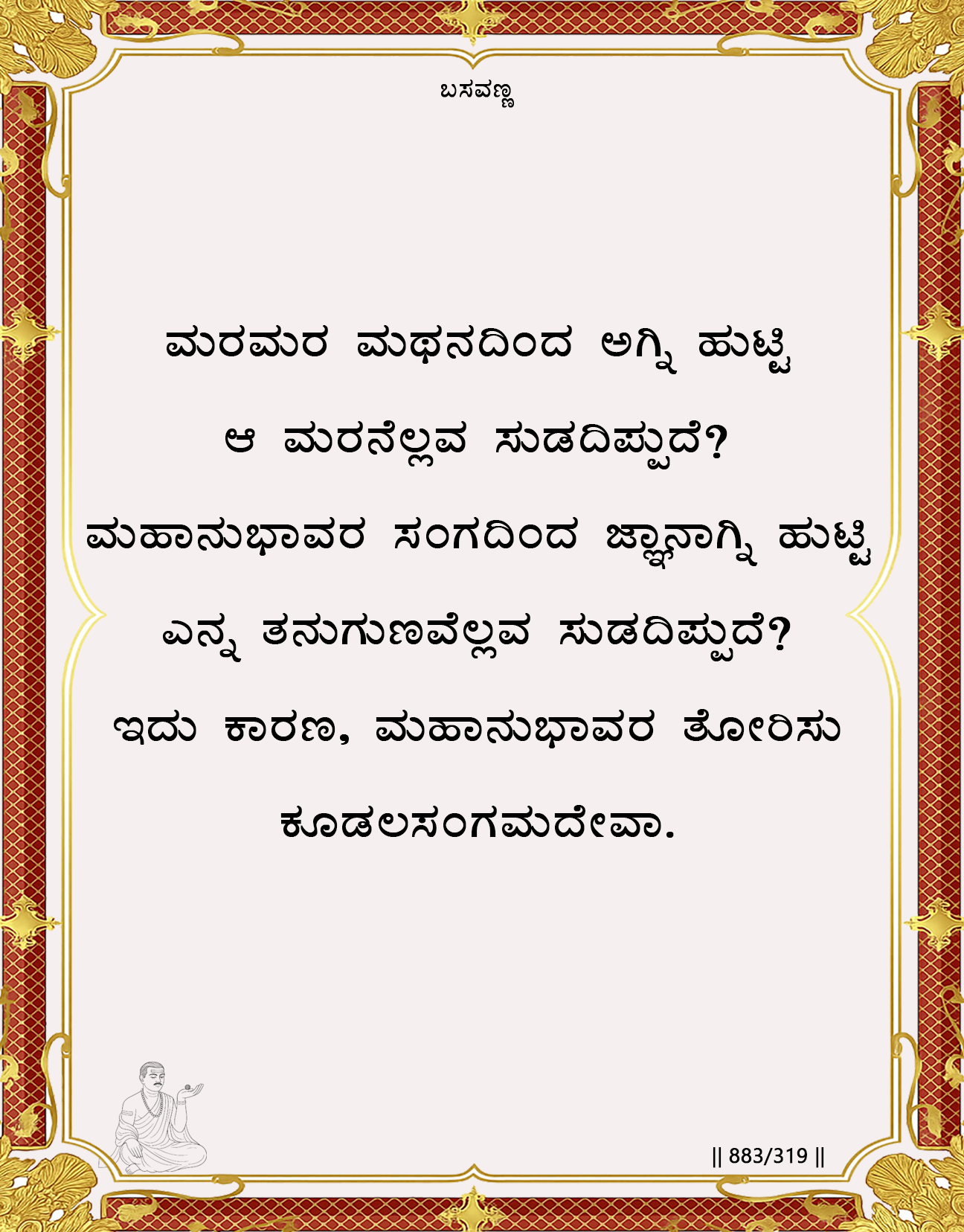
When two dry sticks strike each other,
fire awakens and burns the very wood that bore it.
So too, in the company of noble souls,
the fire of knowledge arises,
consuming all faults of body and mind.
Grant me ever such company,
O Lord Koodalasangama,
where even my ignorance becomes light.
The Friction of Souls that Awakens Light This vachana reveals Basavanna’s profound understanding of spiritual alchemy through the metaphor of fire-making. He presents a complete spiritual physics: just as friction between two sticks generates physical fire, the sacred friction between souls in authentic spiritual community generates the fire of transformative knowledge. This teaching represents the essence of the Way of Basava’s approach to spiritual community not as a comfort zone but as a crucible for transformation. Basavanna recognizes that genuine awakening requires both the “sticks” of sincere seekers and the “friction” of honest engagement, where egos rub against each other not to cause conflict but to spark illumination. The vachana presents spiritual community as essential not for consolation but for combustion the sacred fire that consumes all impurities.
Spiritual Context
Core Spiritual Principle: The Law of Transformative Friction (Gharsana-Jñāna). Awakening is not a solitary event but a relational catalysis. The necessary “heat” for burning away impurities is generated through the dynamic, sometimes challenging, engagement with other committed seekers and realized beings.
Cosmic Reality Perspective: This is a non-dual physics of collective awakening. The Shiva-Shakti dynamic is present in the metaphor: Shiva is the latent fire (pure consciousness), Shakti is the kinetic energy of friction (engaged spiritual dialogue, service, challenge). The “two sticks” represent the apparent duality of seekers, but the fire they produce is non-dual awareness, consuming the separateness of the sticks themselves. Koodalasangama is the process (sangama) where friction (koodala) leads to divine revelation (deva).
Historical Reality (Anubhava Mantapa Context): This vachana articulates the operative principle of the Anubhava Mantapa itself. The Mantapa was not a monastery for silent meditation but a vibrant parliament of souls, a forum for intense debate, shared kayaka, and mutual critique. Basavanna validates this model, stating that the very “friction” of their radical equality and honest discourse was not a problem to be managed, but the essential fuel for their collective spiritual combustion.
Interpretation
1. “When two dry sticks strike each other, fire awakens and burns the very wood that bore it.” This establishes the principle of catalytic self-transcendence. The “dryness” signifies a prerequisite: purification from the “sap” of worldly attachments. The “striking” is intentional, engaged practice within community debate, service, accountability. The fire (agni) is jñāna, the light of non-dual awareness. Crucially, it consumes its own cause: the egoic identity (the stick) that sought awakening is itself the fuel.
2. “So too, in the company of noble souls, the fire of knowledge arises, consuming all faults of body and mind.” This transfers the metaphor to the human domain of consciousness. “Noble souls” (sajjanas) are those who are themselves “dry sticks”purified, intentional, capable of creating fruitful friction. Their company provides the resistant surface against which our own rough edges are smoothed and our latent heat is generated. The “faults” (doṣas) are the impurities that prevent clear burning; they are the first fuel.
3. “Grant me ever such company… where even my ignorance becomes light.” This is a prayer for ecological placement. Basavanna does not ask for individual wisdom, but for the sustained environment where wisdom naturally ignites. The final alchemy: even ajñāna (ignorance), when thrown into this collective fire, does not extinguish it but adds to its brilliance, being converted into the light of lessons learned and humility gained.
Practical Implications: Spiritual practice must be relational. Isolated asceticism is insufficient. One must seek out and contribute to a community of practice that challenges complacency, reflects blind spots, and provides the “friction” of diverse perspectives united in a common goal. The work is to become a “dry stick” purified and ready and then to engage fully, not avoidively, with fellow seekers.
The Cosmic Reality
Anga (Human Dimension): The Anga is the fuel and the aspirant flame. Its work is two-fold: to dry itself through discipline (sādhanā) and to willingly engage in the friction of community. It must overcome the fear of being “rubbed the wrong way” and see conflict as potential catalysis, not merely disruption.
Linga (Divine Principle): Koodalasangama is the latent fire in all wood. It is the divine consciousness inherent in every seeker. The Linga is not just the goal (the flame), but the very combustibility of the seeker. The process of sangama (union) is this ignition event, where the individual’s latent divinity becomes manifest through relational grace.
Jangama (Dynamic Flow): The Jangama is friction-in-motion. It is the living interaction between souls that sparks insight. A realized Jangama is a “live wire,” a being whose presence itself creates the catalytic friction that ignites others. They are the “second stick” for countless seekers.
Shata Sthala
Primary Sthala: Bhakta. This vachana is central to the Bhakta stage, which requires the container of satsaṅga to mature. The bhakta’s devotion can remain sentimental or fanatical without the refining friction of noble company that tempers it into the steady fire of jñāna.
Supporting Sthala: Sharana. The Sharana is one who has taken refuge. This vachana reveals that a primary refuge is the satsaṅga. The community of seekers is not just support; it is an active agent of grace, the very means by which refuge transforms the refugee.
Practical Integration
Arivu (Awareness Practices): Practice “Friction Awareness.” In community settings, when you feel irritated, challenged, or contradicted, pause. Ask: “Is this merely personal friction, or is it the sacred friction that could sand down my ego and generate light? What can I learn from the heat?” Use the discomfort as fuel for self-inquiry.
Achara (Personal Discipline): Commit to being a “dry stick.” Identify one area of “moist” attachment (to an opinion, a comfort, a self-image) and consciously work to dry it through practice, making yourself more ready for constructive ignition.
Kayaka (Sacred Action): Engage in collaborative kayaka (community projects) as a designed friction practice. Working closely with others towards a shared spiritual goal naturally creates the friction that reveals your impatience, pride, or individualism offering them as fuel to be burned in the fire of collective accomplishment.
Dasoha (Communal Offering): Cultivate a community culture that values “divine friction.” Create safe spaces for loving debate, constructive feedback, and challenging questions. Honor those who provide honest reflection, not just those who provide comfort.
Modern Application
The Echo Chamber and Spiritual Bypassing. Online spirituality often creates homogeneous groups that reinforce existing beliefs (echo chambers), avoiding the friction necessary for growth. Conversely, conflict is often seen as purely toxic, leading to “spiritual bypassing” using spiritual ideas to avoid necessary interpersonal friction and growth.
Curating Catalytic Community. The practice of Lingayoga today requires intentionally building or joining communities that are diverse in thought but united in foundational values and purpose. It means seeking out and valuing the “noble soul” who disagrees with you respectfully, who challenges your assumptions, and whose presence helps you burn hotter and brighter. It transforms “safe spaces” into “brave spaces” where friction leads to light, not just to warmth.
Essence
Alone, I was only wood,
potential warmth.
It was the meeting, the strike,
the grateful grind
against another’s truth
that drew the first spark from my heart.
Let me always burn
in such company,
where every argument is kindling,
every difference a chance
to blaze.
This vachana describes the nuclear fusion model of spiritual awakening. Individual consciousness atoms (sticks) under pressure and in close proximity (friction in satsaṅga) overcome their electrostatic repulsion (egoic boundaries). When they “fuse,” a tremendous amount of energy is released (the fire of jñāna), and a new, more stable element (the liberated being) is formed. The mass deficit the “wood” that is consumed is converted directly into luminous energy. The reaction is self-sustaining only under the right conditions of heat and pressure (the sustained grace of noble company).
Think of a team of climbers roped together on a mountain. The friction of the rope against the rock, and of each climber needing to coordinate with the others, creates blisters and strain (the heat). But that same friction is what prevents a fatal fall and allows the entire team to ascend heights impossible alone. The shared struggle burns away the climbers’ individual fears and limitations, forging a collective strength and vision. The mountain (the goal) is ascended through the very friction it imposes.
We are ambivalent about friction. We crave the warmth of agreement but need the heat of challenge to grow. Basavanna resolves this by sacralizing the challenge. He teaches that our spiritual companions are not just for comfort, but for catalysis. The person who irritates us, who sees through our pretensions, who holds a different mirror up to our soul, may be the very “stick” sent by grace to ignite us. Our task is not to find a frictionless life, but to find the sacred friction that turns our struggles into light.

Views: 0