Poetic Rendering
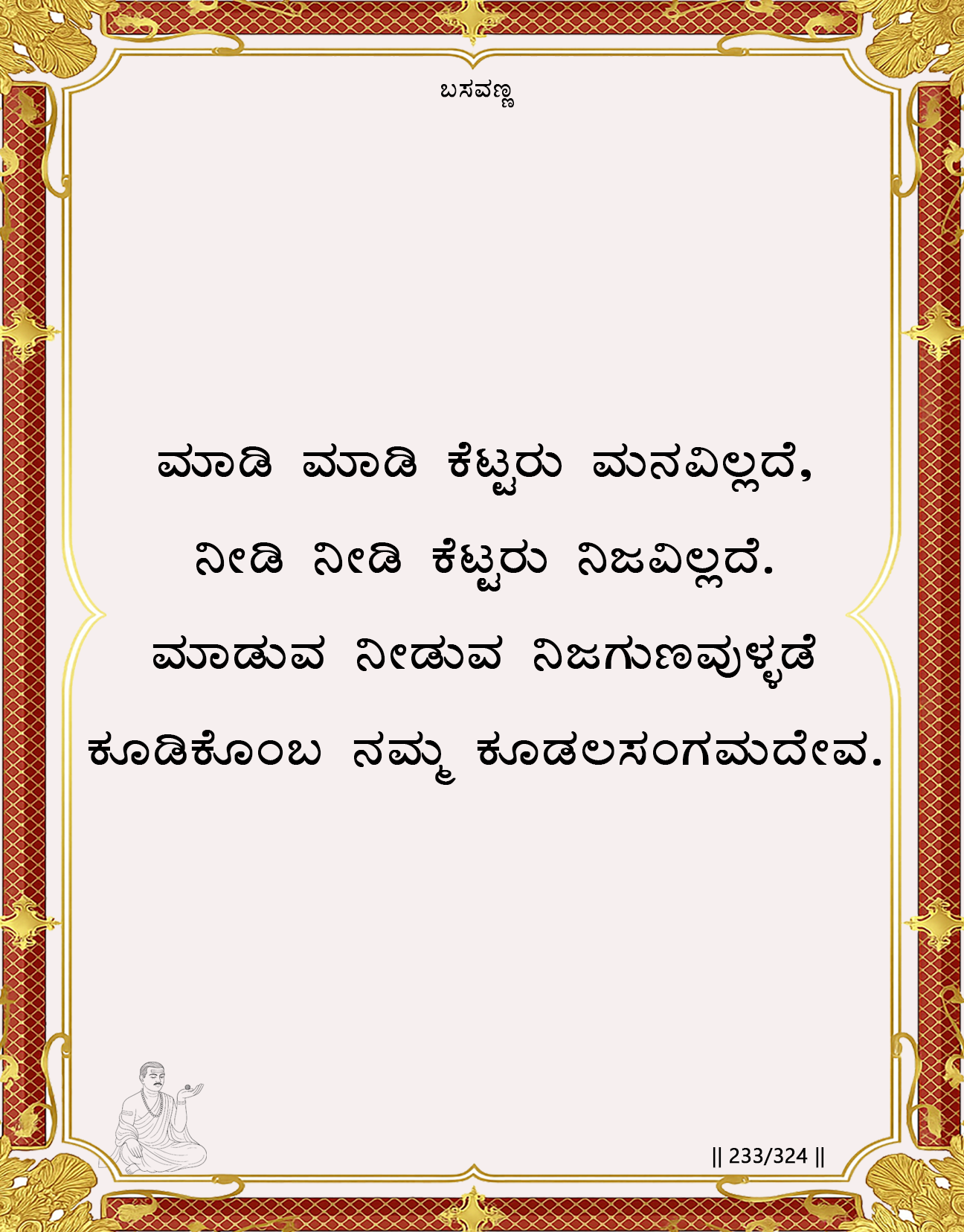
Doing and doing, they act without knowing,
Giving and giving, they offer without feeling.
Their deeds lack truth, their acts lack soul
How then shall they unite
with Koodalasangama Deva?
The cosmic principle here is Resonance through Presence. The universe itself repeats yet never repeats the same. Every sunrise is unique because it shines through awareness. Hence, Basavanna reminds that the divine law is not “repetition” but renewal. Life is sacred when each moment is fresh not a copy of the last. When Action Becomes Habit, and Habit Forgets the Heart This vachana represents Basavanna’s incisive critique of mechanical spirituality the dangerous tendency for religious practice to devolve into empty habit devoid of conscious presence. He addresses the fundamental error of confusing quantity with quality in spiritual life, where the accumulation of religious acts substitutes for genuine inner transformation. The teaching exposes what might be called “spiritual automation” the state where practitioners perform rituals, charity, and worship through force of habit while their consciousness remains disengaged. Basavanna presents the essence of the Way of Basava as conscious engagement: every action, no matter how small or routine, must be infused with awareness and heartfelt intention to have spiritual efficacy. Thus, Basavanna’s voice rings across centuries: “Do not act for show; act from your soul.”
Spiritual Context
Core Spiritual Principle: Consciousness as the Substance of Action (Kriya-Sāra Caitanya). The spiritual value of an action resides not in its external form or frequency, but in the quality of conscious presence that infuses it. An action devoid of awareness is spiritually inert, a corpse of a deed.
Cosmic Reality Perspective: This is a non-dual critique of unconscious manifestation. In the Shiva-Shakti dynamic, Shakti is the creative power of action. When this power moves unconsciously, driven by habit and saṃskāra (mental impression), it is mere nature (prakṛti), not worship. When infused with Shiva (pure awareness), the same power becomes līlā (divine play). Koodalasangama is the union (sangama) of awareness (Shiva) and action (Shakti); mechanical action is their divorce.
Historical Reality (Anubhava Mantapa Context): This vachana served as an internal corrective against the ritualization of the revolution. As the Basavayoga movement established new norms and daily practices (kayaka, dasoha), Basavanna preemptively warned against these very practices becoming new orthodoxies performed mindlessly. It was a call to keep the revolutionary fire of conscious engagement alive, to prevent the living path from hardening into just another dead religion.
Interpretation
1. “Doing and doing, they act without knowing.” This describes the state of somnambulistic activity. The repetition (“doing and doing”) emphasizes the cyclic, closed-loop nature of habit. The body moves, but the light of jñāna (knowing, awareness) is absent. This is action as a neurological reflex, not a spiritual choice. It is karma (action) without jñāna (knowledge), which, according to the Gita, is ignorance.
2. “Giving and giving, they offer without feeling.” This exposes the hollowness of unfeeling charity. Giving (dāna) is considered a supreme virtue. But here, it is performed compulsively, without bhāva (feeling, heartfelt sentiment). The act is stripped of its relational quality; it becomes a transaction of the ego, a numbing discharge of duty rather than a warm expression of connection. It is dāsōha (sharing) without prema (love).
3. “Their deeds lack truth, their acts lack soul… How then shall they unite?” This delivers the spiritual verdict. “Truth” (satya) here means authenticitythe congruence between inner state and outer action. “Soul” (ātman) means the animating principle of conscious life. An action lacking both is a phantom act; it has no spiritual mass or gravity. Union (sangama) requires resonance between two conscious realities. One cannot resonate with the ultimate Consciousness through unconscious behavior.
Practical Implications: The benchmark for spiritual practice shifts from quantitative accumulation (“I chanted 1000 names”) to qualitative depth (“Was I present for each one?”). Every act of worship, service, or discipline must be preceded by a conscious “firing” of intention and infused with steady attention. If the mind is absent, it is better to stop and recover awareness than to continue mechanically.
The Cosmic Reality
Anga (Human Dimension): The Anga is called to awaken from being a spiritual robot. Its task is to install the “operator” of awareness back into the cockpit of action. It must learn to interrupt autopilot, to feel the texture of its own deeds, and to infuse routine with fresh attention. Its practice is mindfulness-in-action.
Linga (Divine Principle): Koodalasangama is pure, undivided awareness. The Linga is not a statue that collects mechanical offerings; it is the living standard of conscious presence. An unconscious act, even if directed at the Linga, does not reach it, for it is not transmitted on the frequency of awareness. The Linga responds only to the signal of conscious love.
Jangama (Dynamic Flow): The Jangama is consciousness in motion. A true Jangama’s life is a continuous stream of “knowing doing” and “feeling giving.” For them, there is no gap between action and awareness, between offering and love. They are the antithesis of the automaton; they are the alchemist who turns leaden habit into golden worship through the fire of attention.
Shata Sthala
Primary Sthala: Bhakta. This vachana diagnoses the Bhakta’s great disease: devotional formalism. The bhakta may love the idea of God but fails to bring that love into the very substance of their actions. The cure is to transform bhakti from a scheduled activity into a continuous quality of engaged attention.
Supporting Sthala: Maheshwara. The Maheshwara is defined by seeing the Great Lord everywhere. Mechanical action is the failure of this vision; it sees the ritual but not the Lord in the ritual. To move beyond automation is to begin to see the divine presence shimmering within the very act of doing and giving.
Practical Integration
Arivu (Awareness Practices): Practice “The Pause of Knowing.” Before initiating any routine spiritual or charitable act, pause. Ask: “Am I here? Do I know what I am about to do? Do I feel why I am doing it?” Only proceed when you can answer “yes.” This inserts consciousness into the automation loop.
Achara (Personal Discipline): Choose one routine practice (e.g., morning prayers, a daily chore) and designate it as your “Consciousness Lab.” For one week, perform it with exaggerated attention to every sensation, thought, and emotion that arises. Break the trance of habit.
Kayaka (Sacred Action): In your work, practice “Single-Tasking as Worship.” Give your full attention to one task until completion, feeling its texture and purpose. Let the quality of your attention be your primary offering, surpassing the quantitative output.
Dasoha (Communal Offering): In community, share not just what you did, but how you did it. Create spaces to discuss the challenge of staying present. Gently help each other recognize when practice is becoming mechanical, and re-inspire each other towards heartfelt engagement.
Modern Application
The Notification Spirituality and Mindless Busyness. The digital age thrives on and rewards automated, distracted action endless scrolling, multitasking, and performative virtue-signaling. Our spiritual practices can mimic this: meditating with a timer while planning the day, or sharing inspirational quotes without absorbing them. We are drowning in “doing and doing” while starving for “knowing and feeling.”
The Radical Act of Unitasking. The practice of Lingayoga today is a radical commitment to unitasking with full feeling. It means putting the phone away not just during prayer, but during a meal, a conversation, a walk. It means giving a gift with full attention on the recipient, not on the social credit it might bring. It is to rebel against the culture of automation by insisting that the only action worth doing is one fully inhabited by the soul.
Essence
The wheel that turns
because it was pushed yesterday
is not moving; it is falling.
I will not confuse the echo of habit
for the voice of prayer.
Let my one true deed,
soaked in attention,
outweigh a mountain of ghostly rituals.
For the bridge to You, O Lord,
is built only with stones
of conscious moment,
mortared with felt grace.
This vachana describes spiritual practice as a real-time system requiring a high sampling rate of awareness. Mechanical action is like a system running on cached data (past habits, stored rituals) with a near-zero sampling rate of current conscious input. The output (the deed) is thus not a response to the present-moment reality (the divine presence) but a replay of old code. “Truth” and “soul” are the data of immediate, conscious experience. Union (sangama) is the state of perfect resonance, which is only possible when the system’s output (action) is generated from a high-fidelity, real-time sampling of the input (divine reality). Automation fails because it has disconnected the output from the input.
Imagine a singer (the devotee) trying to harmonize with a constant, subtle note (the Linga). If the singer is only mouthing the words from memory while thinking about dinner, they will be out of tune and rhythm. To harmonize, they must listen intently to the note (knowing) and feel the desire to blend with it (feeling). Then their voice can truly meet it. Basavanna says all our spiritual “doing and giving” is just noise if we’re not first listening and feeling for the divine note.
We are creatures of habit seeking efficiency. We apply this to spirituality, hoping to automate our way to heaven. Basavanna shatters this, asserting that the spiritual path is inherently inefficient it demands the full, costly resource of our attention every single time. The comfort of routine is a trap; the fatigue of constant conscious engagement is the path. Our longing for ease is precisely what keeps us from the union we seek, for God is not found in the sleep of habit, but only in the alert, tender, and sometimes exhausting wakefulness of love.

Views: 0