Poetic Rendering

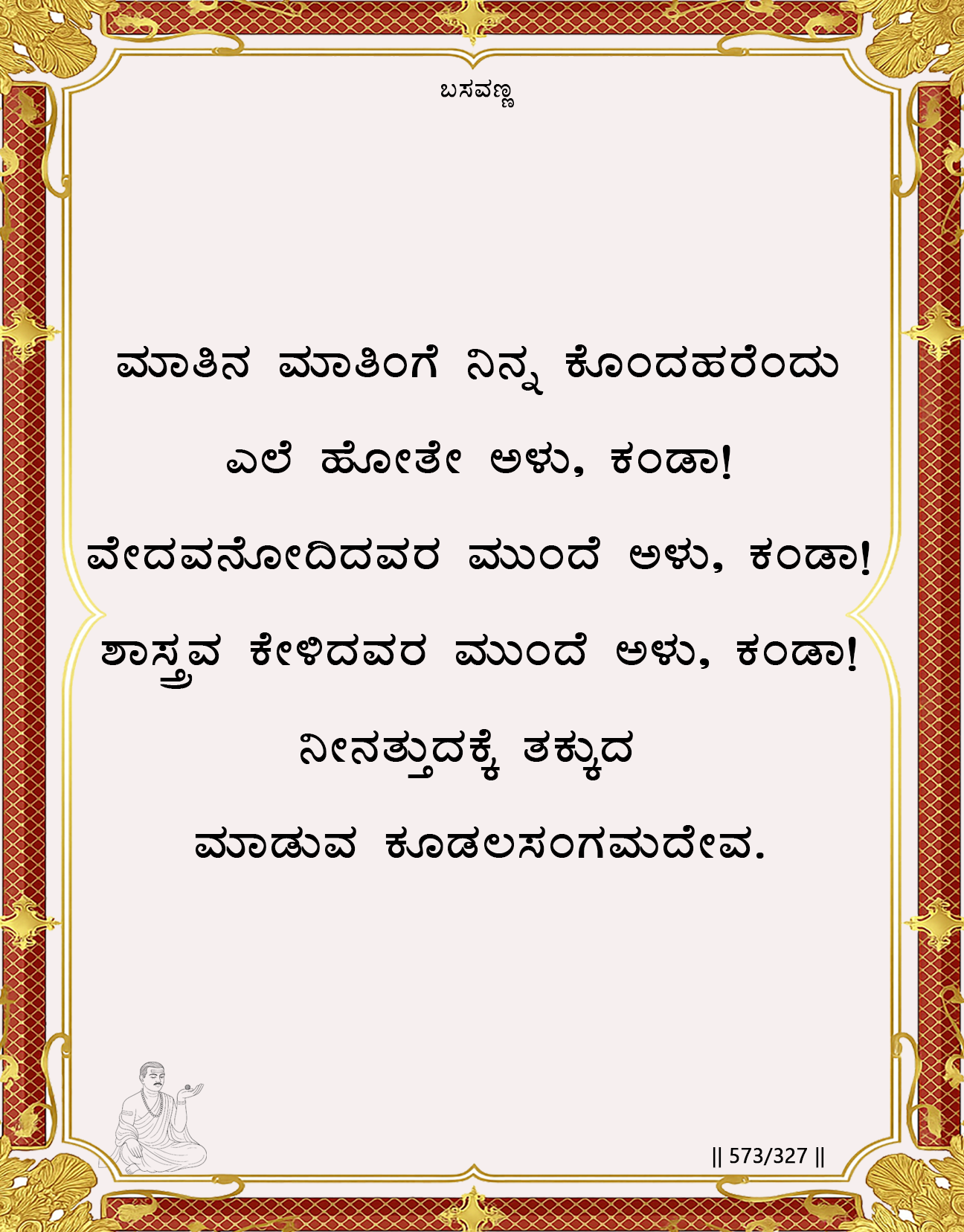
When words are hurled like blades,
when speech repeats and cuts again
seeking to bind you, the helpless goat
weep when you see this!
Those who stand before the sacred text
and try to grasp it only through the eyes
they too can only weep.
Those who merely hear the
scripture sounded aloud,
thinking the echo itself is wisdom
they also weep.
For every tear born from seeing this trap,
for every cry that rises from true awakening,
Kudalasangama Deva
returns clarity or distance in equal measure.
In this vachana, Basavanna cautions seekers against becoming sacrificial goats to words. He warns that mesmerizing speech, the weight of ancient scriptures, or the authority of reciters and scholars can enslave the unguarded mind. Words may be revered, repeated, or interpreted, but without inner realization they become weapons cutting both the one who speaks and the one who listens. Those who only look at the Vedas cry. Those who only hear the Vedas cry. Those who try to understand the Divine through words alone weep in helplessness, for words cannot reveal the One who lives within. Basavanna states that this weeping is not weakness it is the dawning of insight: the realization that mere verbal knowledge cannot lead to union. Those who rely solely on scriptural expertise, intellectual pride, or borrowed wisdom who mislead others with their word-based knowledge remain distant from Kudalasangama Deva in the same measure as the ego they cling to. Thus the tears of a sincere seeker become purifying, while the pride of the word-bound becomes their own bondage. This vachana is ultimately a call to recognize the Divine not in words but in direct living experience for only inner understanding bridges the distance to Kudalasangama.
Spiritual Context
Core Spiritual Principle: The Liberation from Semantic Bondage (Śabda-Pāśa Mukti). The final chains to be broken are not those of desire alone, but those of conceptual knowledge and linguistic dogma. True freedom is freedom from the very tools we use to seek it, when those tools become idols.
Cosmic Reality Perspective: This is a non-dual critique of linguistic mediation. The Shiva-Shakti dynamic is direct, experiential vibration. Scriptures and teachings (Shakti as vāk or speech) are meant to point to Shiva (pure consciousness). When the pointer is mistaken for the destination, Shakti becomes a binding force, not a liberating one. The “blades” are the frozen, repetitive forms of Shakti (dogma, tradition) that cut one off from her living source.
Historical Reality (Anubhava Mantapa Context): This vachana was a direct challenge to Brahmanical scholasticism and scriptural hegemony. In a society where the Vedas were considered infallible, divine, and accessible only to a priestly class, Basavanna democratized spirituality by declaring that both the literate scholar and the illiterate listener are equally distant if they stop at the words. It empowered the common seeker by stating that their tear of sincere longing was more valid than the scholar’s mastery of dead letters.
Interpretation
1. “When words are hurled like blades… seeking to bind you, the helpless goatweep when you see this!” This identifies language as a potential instrument of violence and sacrifice. The “goat” is the innocent, seeking consciousness. The “blades” are dogmatic assertions, clever arguments, and authoritative quotes used not to illuminate, but to subdue and ritually sacrifice the seeker’s own capacity for direct inquiry on the altar of tradition.
2. “Those who stand before the sacred text… they too can only weep. Those who merely hear… they also weep.” This declares the ultimate failure of both scholarship and passive reception. The scholar (“looks with eyes”) is engaged in exegesis, mistaking interpretation for truth. The listener (“hears the echo”) is engaged in pious consumption, mistaking resonance for realization. Both are reduced to tears upon the shocking realization that their meticulous engagement with the map has not transported them to the territory.
3. “For every tear born from seeing this trap… Koodalasangama Deva returns clarityor distancein equal measure.” This reveals the divine law of reciprocal alignment. The tear is an offering of humility and shattered illusion. In return, grace provides the “clarity” of direct perception (pratyakṣa). Conversely, for those who wield words as blades to build their own authority (the binders, not the bound), their pride creates a self-measured “distance.” God’s “distance” is not punishment but the natural state for a consciousness that has chosen the separation of egoic ownership over knowledge.
Practical Implications: Spiritual study must be coupled with the constant intention to see through the words to the reality they indicate. The moment one feels bound by a doctrine or impressed by mere eloquence, one must pause and seek the feeling behind the words. The goal is to use scripture as a mirror for self-inquiry, not as a cage for the mind.
The Cosmic Reality
Anga (Human Dimension): The Anga must transition from goat to witness. Its task is to develop discernment (viveka) to see when words are being used as binding blades versus liberating pointers. It must learn to weep not in despair, but in the liberating recognition of its own prior bondage, thereby becoming free of it.
Linga (Divine Principle): Koodalasangama is the silence before and after all words. It is the reality that is anirvacanīya (inexpressible). The Linga is not in the Veda; the Veda, at best, points to the Linga. To know the Linga is to move from the poetry of description to the silence of identity.
Jangama (Dynamic Interaction): The Jangama is truth-in-motion beyond texts. A true Jangama’s life is the scripture. They do not quote authority; they embody it. Their presence does not bind with concepts; it liberates through direct demonstration. They are the living answer to the tears of those trapped in words.
Shata Sthala
Primary Sthala: Prasadi. The key event is the gift (Prasadi) of seeing the trap. This disillusionment is the most valuable grace for an intellectually inclined seeker. The subsequent “clarity” is the continuing grace that follows surrender of intellectual pride.
Supporting Sthala: Maheshwara. The Maheshwara is one who sees the Great Lord everywhere. This vachana implies that one cannot see the Lord in all if one is still seeing the world through the thick lens of textual dogma and argument. The weeping is the softening of that lens.
Practical Integration
Arivu (Awareness Practices): Practice “Listening for the Silence.” When reading or hearing spiritual teachings, consciously listen for the gaps between words, the space from which they arise. Pay more attention to the inner resonance (bhāva) a teaching triggers than to its intellectual formulation.
Achara (Personal Discipline): Periodically engage in “Scriptural Fasting.” Designate times where you abstain from reading or listening to spiritual commentary. Instead, sit in silence or engage in selfless service (kayaka), allowing your direct experience to become your only scripture.
Kayaka (Sacred Action): Let your work be your primary scripture. Practice seeing the divine principles (service, integrity, presence) expressed in your actions, rather than merely reading about them. Inscribe the teachings on your behavior, not just in your memory.
Dasoha (Communal Offering): In community, shift discussions from “what does the text say?” to “what does our experience show?” Share personal insights and struggles, valuing lived authenticity over scholarly citation. Create a culture that honors the tear of realization more than the perfect quote.
Modern Application
Spiritual Information Overload and Guru-tainment. The digital age provides endless access to spiritual texts, lectures, and debatesa constant barrage of “blades.” Seekers can become perpetual consumers of spiritual content, mistaking accumulation of information for progress, and following charismatic speakers (“goat-herds”) who may bind rather than free.
Cultivating Direct Contemplation. The practice of Lingayoga today requires disciplined curation of input and priority on direct contemplation. It means using teachings as a mirror, not as a library. It involves regularly unplugging from the marketplace of spiritual ideas to digest and embody the few truths that resonate, letting them bring tears to your eyes and transformation to your life. Truth is measured by its fruit in your being, not by its pedigree in tradition.
Essence
They prepared the altar of scholarship,
whetted the knives of tradition.
I was the goat, groomed for sacrifice
to a god made of paper and ink.
Then I saw the rope was woven of letters,
the altar built of verses.
I weptand the salt dissolved the binding.
Now I walk, a free animal,
grazing in the pastures of a silence
no scripture could ever fence.
This vachana describes the transition from symbolic processing to direct perception in consciousness evolution. The brain is a superb symbol-processor (handling words, concepts). Consciousness itself is pure perception. Spiritual maturation requires a shift in primary processing from the symbolic matrix (the “blades”) to the perceptual ground (the “clarity”). The “tear” is a systemic eventthe overload of the symbolic processor when it intuits the vastness of the perceptual field it cannot encode. This crash opens a pathway for the system to re-boot into a direct-perception mode, which is what “clarity” is. Those who keep fortifying the symbolic processor (the binders) increase their distance from the perceptual ground.
Imagine being in a famous, breathtaking cathedral. One person spends their time reading every plaque, studying the architectural diagrams, and arguing about the meaning of each stained-glass window (the scholar/listener). Another person finally puts the guidebook down, sits in a pew, and just lets the space, the light, and the silence wash over them. They are moved to tears. The first has information about the cathedral. The second has an experience of it. Basavanna says the path to the Divine is through the tearful experience, not the guide book though the guidebook might point you to the pew.
We crave the safety and certainty of knowledge systems. We want a spiritual manual with clear instructions. Basavanna exposes this craving as the final, most subtle barrier. Our reliance on words, concepts, and authorities is a way to avoid the terrifying responsibility and vulnerable intimacy of direct encounter with the naked Real. The tear is the moment we admit our deepest longing cannot be satisfied by a book, a quote, or a guru’s promise. It is the surrender of the mind’s last claim to know, which paradoxically is the very opening through which knowingness itself floods in. We are not goats to be sacrificed to the god of dogma; we are the living temple awaiting its own silent, overwhelming consecration.

Views: 1