Poetic Rendering

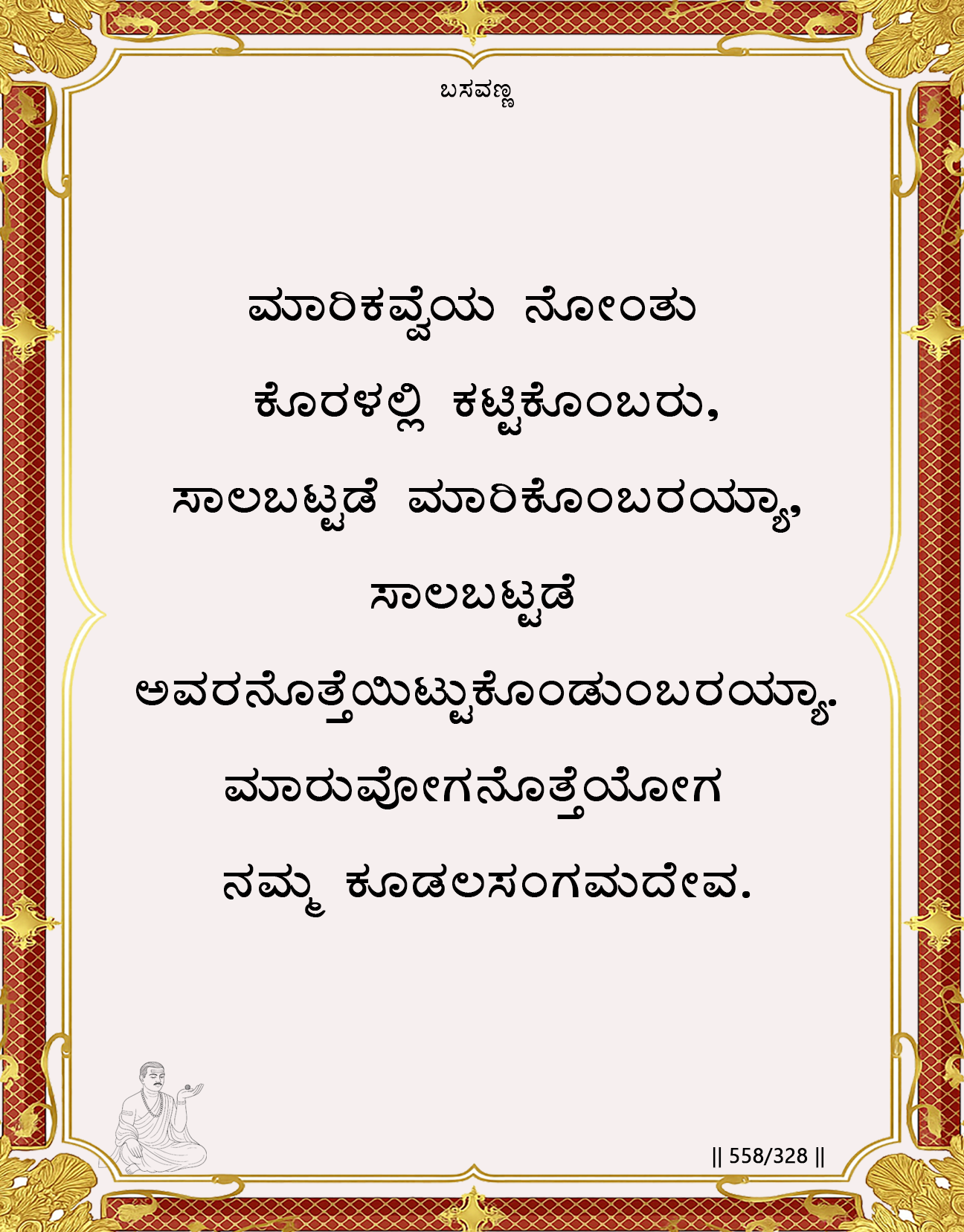
The image of Marikavve,
cast in precious metal,
is worn proudly on the neck
yet when debt tightens,
they sell her.
When money presses hard,
they pawn her at the lender’s door,
trading sanctity for silver.
But You,
O Kudalasangama Deva
You cannot be bought,
cannot be pledged,
cannot be bartered.
The One who dwells within,
the One who breathes in all beings,
cannot be taken to the marketplace
for any man’s bargain.
In this vachana, Basavanna uses a bold, everyday image from village life: a precious metal idol of the goddess Marikavve taken as collateral or sold when people fall into debt. This practice becomes the sharp mirror through which he exposes a greater error treating God as a transactional commodity. Unlike the metal idol that can be pledged, traded, or weighed for its price, the Linga is not an object but the all-pervading Divine within the seeker, in the Linga held in worship, and living as the Jangama. Divinity cannot be exchanged, leveraged, or used as spiritual currency. Basavanna critiques those who approach faith as a negotiation: “I give this, You must give me that.” Such bartering arises from ignorance of the Divine nature. True spirituality in the Way of Basava is non-transactional, rooted in direct relationship and inner realization, not in offerings, bargains, or deals. Basavanna declares that the Eternal cannot be taken to a pawnshop; and those who attempt such commerce with God reveal their misunderstanding not of ritual, but of the very essence of Divinity.
Spiritual Context
Core Spiritual Principle: Non-Transactional Grace (Akraya Prasāda). The divine-human relationship is one of grace, not commerce. The Divine is not a party to a contract but the very ground of being that can never be objectified, owned, or used as leverage. Realization dawns when one stops trying to deal with God and starts abiding in God.
Cosmic Reality Perspective: This is a non-dual critique of objectification. Shiva (pure, all-pervasive consciousness) cannot be reduced to Shakti’s form (the idol). To pawn the idol is to admit its reality is contingent on material value. The true Linga, as Shiva-Shakti inseparably united, is the reality of the pawner, the pawnbroker, and the idol itself it can never be placed on the counter. The marketplace is the realm of duality (buyer/seller); the Divine is the non-dual substrate of the market itself.
Historical Reality (Anubhava Mantapa Context): This was a radical economic theology for a merchant society. Basavanna, as a treasurer, directly addressed the mercantile mindset of his community. He severed the link between piety and prosperity, challenging the pervasive belief that ritual investment (in idols, temples) guaranteed financial return. He spiritualized economic distress by saying that while debt may force you to pawn your idol, it can never touch the God within you, thus offering profound solace and redefining true security.
Interpretation
1. “The image of Marikavve… is worn proudly on the neck yet when debt tightens, they sell her.” This exposes conditional devotion. The idol is a badge of piety and a spiritual asset in good times. Its value is tied to its material composition (precious metal) and its perceived power to bless. In crisis, this devotion proves hollow, revealing that the worship was never of the Divine but of security itself.
2. “When money presses hard, they pawn her at the lender’s door, trading sanctity for silver.” This reveals the hierarchy of fear. When the immediate fear of material lack overwhelms the abstract fear of spiritual consequence, the “sacred” object is readily commodified. The act of pawning is a perfect metaphor for a faith held “on loan” from tradition, not owned through experience.
3. “But You, O Kudalasangama DevaYou cannot be bought, cannot be pledged… cannot be taken to the marketplace for any man’s bargain.” This establishes the metaphysics of the priceless. The true Linga is Subject, not object. It is the “I” within, not a “thing” possessed. As the very ground of awareness and being, it is the context in which all transactions occur, and thus can never be an item within those transactions.
Practical Implications: Examine your spiritual motivations. Are you praying for a result, or praying as an expression of love? Are you giving charity to gain merit, or giving as an outflow of inherent compassion? The practice is to perform all action, including worship, as kayaka (sacred duty) without an inner ledger of expected spiritual or material returns.
The Cosmic Reality
Anga (Human Dimension): The Anga is the merchant of the self. Its confusion is in misidentifying its most valuable asset. It tries to trade in exterior symbols (idols, rituals, good deeds) while remaining ignorant of the inner treasure that gives all else value. Its purification involves burning the inner ledger.
Linga (Divine Principle): Kudalasangama is inherent value. It is not valuable for something else. It is value itself. Like the space in a room, it cannot be pawned; it is the condition that allows the pawnshop to exist. It is the breath in all beings the essential, non-negotiable fact of life.
Jangama (Dynamic Interaction): The Jangama is faith-in-action beyond transaction. A true Jangama is the lived truth that the Divine cannot be commodified. Their presence embodies the principle that the sacred is in the relationship, the service, the awareness never in a transferable object. They are the “unpawnable” life, moving through the marketplace.
Shata Sthala
Primary Sthala: Prasadi. The core revelation is a moment of Prasadi the gracious understanding that what you thought was your spiritual capital (the idol/ritual) is perishable, while the true Divine is the eternal, unlosable ground of your being. This disillusionment with transactional religion is itself the greatest gift.
Supporting Sthala: Sharana. The Sharana is one who has taken total refuge. This vachana defines what refuge is not: it is not a conditional contract (“I take refuge if You protect my wealth”). True refuge is unconditional surrender to that which cannot be lost, even in total material loss.
Practical Integration
Arivu (Awareness Practices): Practice “Witnessing the Inner Pawnbroker.” In moments of desire or fear, notice the mind’s tendency to make internal bargains (“If I meditate now, I’ll have a good day” or “God, if You help me here, I’ll do X”). Simply observe these transactions without judgment, reaffirming that your practice is for abiding in truth, not for brokering deals.
Achara (Personal Discipline): Engage in a practice of non-transactional giving. Give somethingtime, help, a donationconsciously and anonymously, with no expectation of thanks, merit, or reciprocal benefit. Feel the freedom of action divorced from the ledger.
Kayaka (Sacred Action): Perform your daily work as an offering, but not a quid pro quo. See your labor itself as the form of worship, not as a currency to purchase divine favor. Let the integrity and presence in the work be the goal.
Dasoha (Communal Offering): In community, challenge subtly transactional language about spirituality. Shift from “What will I get from this practice?” to “What does this practice reveal about what I already am?” Foster a culture where support is given without creating debt, spiritual or otherwise.
Modern Application
The Prosperity Gospel and Spiritual Consumerism. Modern spirituality is often marketed as a product buy this course, adopt this practice, follow this guru, and you will get peace, success, healing. Faith becomes an investment portfolio. Social media piety can become a performance to gain followers (social capital), a digital version of “wearing the idol proudly.”
Cultivating Inherent Worth. The practice of Shivayoga today means ruthlessly examining one’s motivations and disentangling spirituality from self-improvement projects and success mantras. It means finding the “unpawnable” core within one’s inherent dignity and connection to the whole that remains secure regardless of financial, social, or health status. Security is redefined as abiding in that which cannot be taken to any market.
Essence
They fashioned God from silver,
wore her close against the heart’s accounting.
When the numbers bled red,
they weighed her on the scale,
took the coins, and called it necessity.
I looked at my empty hands,
felt the breath moving in my chest,
the beat no ledger could record.
Here is the wealth that cannot be spent,
the treasure no thief can find.
Kudalasangama
not a figure for the neck,
but the neck itself,
the breath, the beating,
the priceless, unpawnable life.
This vachana maps the ontological error of projection and the epistemic shift to inherent value. The mind projects the concept of “value” onto external objects (idols, rituals, outcomes) and then engages in symbolic transactions with thema closed loop within the conceptual realm. Basavanna points to a value that is a priori: consciousness itself (the Linga within), the condition for any valuation to occur. Realization is the collapse of the projection, causing all conceptual value to flow back to its source. This reveals the source as the only real “currency”existence itself. This pattern exposes a universal cosmic law: dharmic reciprocity is not a transaction but an alignment. When we outsource truth and responsibility (to idols, priests, or systems), we create existential debt. The moment we reclaim responsibilityceasing to use truth as collateral and starting to live as its embodimentwe realign with the divine flow, where the sought-after abundance was always available through transformation, not transaction.
Imagine you have a deed to a piece of land (the idol). You can mortgage it at a bank (the pawnshop). Now imagine you are the land itself (the Linga within). Can you mortgage yourself to yourself? The land is unaware of the deeds traded upon it; it simply is. Basavanna says we are the land, not the deed. Our suffering comes from confusing the paper for the ground. In all domains of life relationships, work, citizenship this confusion manifests as exhausting spiritual bookkeeping, score-keeping in relationships, calculating returns on contributions, or seeking external solutions. Freedom is the recognition that the land (your true nature) cannot be pawned.
Our deepest anxiety is resource scarcity not just of money, but of love, time, merit, and life itself. We manage this anxiety by creating spiritual insurance policies and seeking shortcuts, which is a transfer of responsibility. This vachana confronts the ultimate futility of that project. It offers the only true security: identifying with the consciousness that witnesses the coming and going of all wealth, all idols, all bargains. This is the terrifying and liberating truth that what we truly are can never be secured because it can never be lost. We are not merchants in the marketplace of grace; we are the very space in which the market is held. The modern malady of mortgaging the planet for profit is the same error pledging the future for present comfort. Basavanna’s message liberates us: the moment we stop trying to find better deals with reality and start taking responsibility for our inherent truth, the pledge around the idol’s neck loosens, and we realize the heart has already paid its dues. Freedom lies not in negotiation, but in the profound simplicity of authentic participation in the cosmic dance.

Views: 1