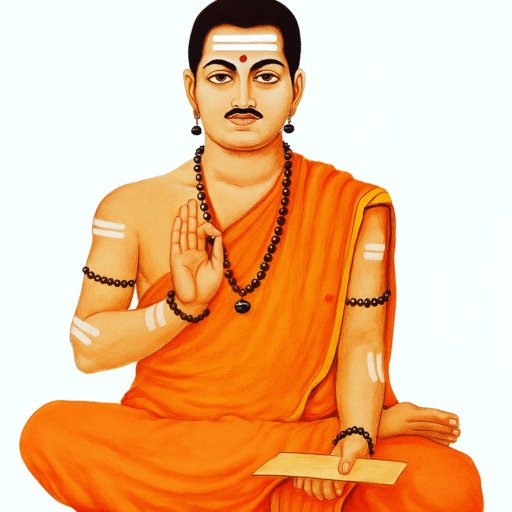

Poetic Rendering

Death and the cremation ground they are not two, they are one.
But what, O Lord, is true death?
When the eyes wander from
Your light, that is death.
When the tongue strays from truth,
that is death.
When the heart forgets Koodalasangama
that is death indeed.
For even while breathing, one may be dead;
and in Your remembrance, even ashes live.
This vachana represents Basavanna’s profound redefinition of death from a physical event to a spiritual condition. He transforms the conventional understanding of mortality by locating it not in the cessation of biological functions but in the fragmentation of consciousness from its divine source. The teaching presents the Way of Basava’s radical insight: that true life consists in continuous remembrance of the Divine, while true death occurs in the moments of forgetfulness that punctuate our daily existence. Basavanna reveals that the cremation ground is not merely an external place where bodies are burned but the internal space where egoic identifications must be consumed in the fire of awareness. This vachana marks the shift from fearing physical death to cultivating spiritual aliveness through unwavering presence.
Spiritual Context
Core Spiritual Principle: Remembrance as Ontological Aliveness (Smarana Sat). Existence (sat) is not merely biological; it is qualitative. One is truly alive only to the extent that one consciously remembers and abides in the source of consciousness. Forgetfulness is not a mistake but an ontological lapsea fall from being into a state of spiritual non-being.
Cosmic Reality Perspective: This is a non-dual dissection of the life-death continuum. Shiva (pure, unchanging Consciousness) and Shakti (the dynamic power of attention) are inseparable. When Shakti (as our faculties) functions in alignment with Shiva, that is Life-in-essence. When Shakti functions autonomously, caught in its own projections, that is a localized “death” within the field of Consciousness. The “cremation ground” is the transformative fire of Shiva that constantly burns away these dead, autonomous patterns of Shakti.
Historical Reality (Anubhava Mantapa Context): This was a radical democratization of immortality. In a context obsessed with rituals for afterlife salvation, Basavanna declared that the stakes were not in the future but in the present moment. He made enlightenment an urgent, daily concern accessible to everyone weaver, farmer, or scholar by framing it as the vigilance of one’s own senses and heart. It shifted the focus from securing a good death to cultivating a fully alive life.
Interpretation
1. “When the eyes wander from Your light, that is death.” This establishes perception as cognition of the Divine. Eyes that see only forms, without perceiving the conscious light (prakāśa) that illumines them, are organs of a living corpse. Sacred perception (dṛṣṭi) is the first faculty of the awakened Anga.
2. “When the tongue strays from truth, that is death.” This identifies speech as the manifestation of reality. The tongue is not just a muscle but an instrument of creation (vāk). Speech divorced from truth (satya) is a destructive, world-distorting force that severs the speaker from the foundational order (ṛta) of existence.
3. “When the heart forgets Koodalasangamathat is death indeed.” This reveals the heart as the seat of existential orientation. The “heart” (hṛdaya) is the core of being. Forgetting here is not a memory lapse but an existential re-orientation toward the peripheral (ego, world) and away from the central Source. This is the root death from which all others stem.
Practical Implications: Spirituality is no longer a compartmentalized activity but the continuous calibration of one’s moment-to-moment existence. Every sensory input, every word, every heartbeat becomes a site of spiritual practicean opportunity to choose life (remembrance) over death (forgetfulness).
The Cosmic Reality
Anga (Human Dimension): The Anga is the gatekeeper of aliveness. Its duty is the vigilant stewardship of its own faculties. It must train the eyes to see light, the tongue to speak truth, and the heart to hold the Linga. Its failure is not sin but a self-inflicted entropy.
Linga (Divine Principle): Kudalasangama is the ever-present ground of aliveness. It is not remembered as a past event but recognized as the timeless context of the present. It is the Light behind sight, the Truth behind speech, the very beating of the heart. It is what remains when all forgetfulness is burned away.
Jangama (Dynamic Interaction): The Jangama is remembrance-in-motion. A true Jangama does not periodically remember God; their very movement is God-remembering. Their perception, speech, and action are so aligned that they become a continuous life-force, a walking antidote to the spiritual death in the world.
Shata Sthala
Primary Sthala: Prasadi. The entire teaching is a moment of supreme Prasadi. The grace is the devastating and liberating awareness that we are dying constantly, which simultaneously reveals the only way to truly live. This shocking gift dismantles the ignorance that fears only the physical end.
Supporting Sthala: Aikya. The state described where the eyes, tongue, and heart are inseparably united with their source is the lived reality of Aikya (union). This vachana provides the functional diagnostic for whether one is abiding in that union or not.
Practical Integration
Arivu (Awareness Practices): Implement “The Three-Gate Check.” At random moments, pause and conduct a tripartite scan: 1) Eye-Gate: Am I seeing just objects, or am I aware of the conscious presence manifesting as this sight? 2) Speech-Gate: Is my next word necessary, true, and kind? 3) Heart-Gate: Is my inner feeling-tone one of connection or separation?
Achara (Personal Discipline): Observe a daily “Moment of Resurrection.” Choose a routine activity (e.g., drinking water, opening a door) and consciously use it as an anchor to remember Kudalasangama. Let this tiny act symbolize the rebirth of attention from forgetfulness.
Kayaka (Sacred Action): Infuse your work with the question, “Does this action come from remembrance or forgetfulness?” Let the quality of your attention, not just the outcome, define the sacredness of the labor.
Dasoha (Communal Offering): Create “Circles of Remembrance.” In community gatherings, share not just intellectual understandings but simple, present-moment experiences of “aliveness” or recognized “small deaths.” Practice deep, truthful listening where the speaker’s words are met with the remembrance of the divine in them.
Modern Application
The Zombie of Distraction. We suffer from continuous partial attention, scrolling through life with wandering eyes. We engage in pervasive, low-truth communication (small talk, gossip, curated personas). Our hearts are chronically forgetful, seeking source-like fulfillment in stimuli, validation, and consumption, leading to existential numbness despite physical comfort.
Cultivating Digital Sati and Existential Urgency. The practice of Basavayoga today means treating digital consumption as a cremation ground for attention entering with conscious intent. It means valuing authentic, vulnerable speech over performative discourse. It uses the diagnosis of “spiritual death” not for guilt but as a compassionate alarm clock, creating an urgent, loving imperative to wake up now, in this very click, this very conversation, this very breath.
Essence
You tremble at the pyre’s final flare,
blind to the countless sparks
that die in your distracted gaze,
the truths left unspoken on your tongue,
the heartbeats given to forgotten gods.
The true ground of burning is within
where inattention chars the present,
where lies smolder in the throat,
where the hearth of remembrance grows cold.
Do not fear the fire that comes once.
Fear the cold that comes always.
For the body will find its ashes,
but only you can choose
to be the flame, or the ember forgotten.
This vachana performs a dimensional collapse from linear time to the eternal present. It takes the future-facing, time-bound concept of “death” and collapses it into a present-moment metric of “conscious coherence.” Biologically, we exist in a spacetime continuum. Spiritually, aliveness is measured by the coherence of our wavefunction (attention) with the fundamental field (Linga). Each moment of forgetfulness is a decoherencea localization into the separate “particle” of ego. Remembrance is the re-coherence with the unified field. The “cremation ground” is the constant measurement apparatus of awareness, collapsing potential into the lived reality of either life (coherence) or death (decoherence).
Imagine your mind is a radio. The Linga is the broadcasting station of pure, clear signal (Truth/Light/Love). “Life” is when your radio is tuned precisely to that station you receive the signal in full clarity. “Death” is when you turn the dial away, even slightly, into static or other stations (distraction, falsehood, separation). The static is still within the broadcast range of the station, but you are not receiving it. You are “dead” to the music. The vachana says: stop worrying about the radio breaking down in the future (physical death). Worry about how you are tuning it right now. The ultimate goal is to realize you are the signal, not the radio.
Our terror of physical death is a projected shadow of our unconscious guilt over not living. We fear the end because we intuit we haven’t fully inhabited the middle. Basavanna exposes this shadow and offers the cure: to live so completely in each moment with undivided attention, truthful expression, and heartfelt connection that the concept of death loses all meaning, because you are identified with the deathless principle of Life itself. The final freedom is not in cheating death, but in realizing, through relentless remembrance, that what you truly are was never born and thus can never die.

Views: 0