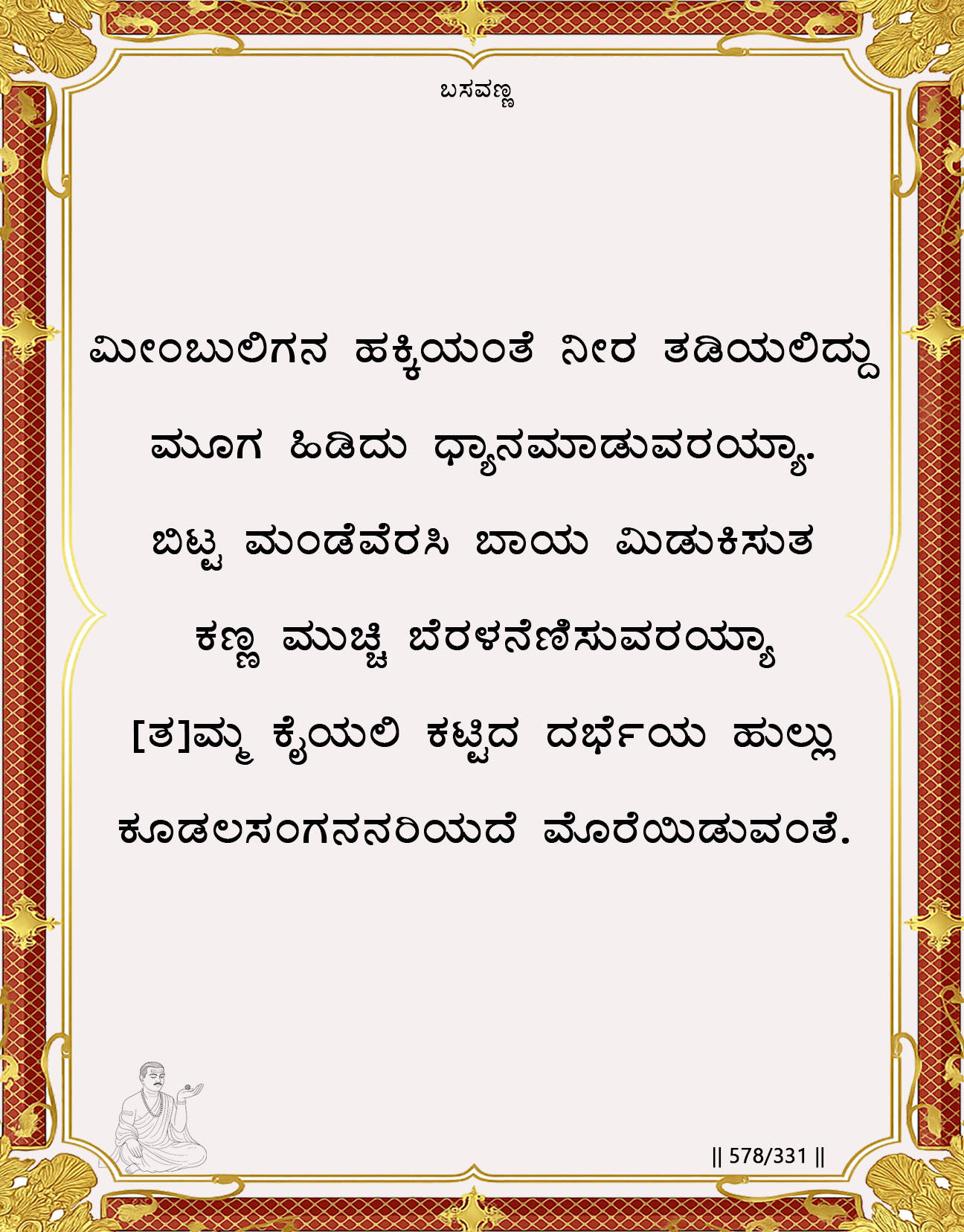
Poetic Rendering
Like the crane that stands in the pond
on a single leg,
waiting for the faint glow-worm
to rise from the waters
so they wait, so they strain,
yet miss the light within.
Holding their noses,
forcing their breath,
eyes shut tight,
whispering secret syllables,
fingers turning the prayer-beads,
darbha-grass bound in sacred knots
they busy themselves with
the machinery of ritual.
But, O Kudalasangama,
without the knowing of You,
all this becomes only movement in the dark
the restless flutter of wings
seeking a light
they themselves refuse to see.
Summary Awareness Is the Breath of Real Worship In this vachana, Basavanna uses the evocative image of a crane standing in patient stillness, waiting for a faint glimmer of light from the water. The crane symbolizes a seeker absorbed in outward discipline yet unaware of the luminous source within. He describes practitioners engaged in ritual austerities breath-control, chanting, bead-counting, body-bindings of darbh a yet lacking inner awakening. Through this, Basavanna does not condemn ritual, but reveals its limitation when performed mechanically, without the recognition of the all-pervading inner Linga. The essence of the teaching is clear:
- Outer discipline without inner awareness becomes imitation, not realization.
- Ritual without understanding turns into spiritual darkness.
- True prayer begins only when one recognizes the Divine within.
Basavanna’s message is a gentle yet uncompromising reminder: awareness, not austerity, is the life of devotion.
Spiritual Context
Core Spiritual Principle: Awareness as the Substance of Ritual (Jñānātmaka Kriyā). Ritual actions are empty shells unless filled with and animated by the conscious awareness of the Divine’s immanent presence. The efficacy of any practice is directly proportional to the quality of arivu (awareness) brought to it.
Cosmic Reality Perspective: This is a non-dual critique of ritual objectification. In Shiva-Shakti terms, rituals are patterns of Shakti (energy/action). When performed with the understanding that Shakti is none other than Shiva (consciousness) in motion, the ritual is worship. When performed as a mechanical sequence, divorcing action from its source in consciousness, Shakti becomes a binding, repetitive force that reinforces separation. The seeker becomes an automaton of Shakti, not a devotee of Shiva.
Historical Reality (Anubhava Mantapa Context): This was a direct challenge to ritualistic Brahmanism and Tantric formalism. In a landscape crowded with complex sādhanās, yantras, and mantras promising powers, Basavanna reduced the entire spiritual equation to one variable: inner knowing. He democratized realization by stating that a simple act done with full awareness of the Indweller was infinitely superior to the most elaborate ritual performed mechanically.
Interpretation
1. “Like the crane that stands in the pond on a single leg, waiting for the faint glow-worm to rise from the waters so they wait, so they strain, yet miss the light within.” This identifies the fundamental error of directional seeking. The crane’s posture represents austerity and patience, but its attention is misplaced. The “glow-worm” symbolizes a transient, external, minor source of illumination. The tragedy is the seeker’s intense effort directed toward a faint, reflected light, while ignoring the sun of consciousness blazing within.
2. “Holding their noses, forcing their breath… they busy themselves with the machinery of ritual.” This describes the confusion of the container for the content. The practices listed (prāṇāyāma, japa, mudrā) are powerful tools designed to calm and focus the mind in order to reveal the inner light. Here, they have become ends in them selves a spiritual busywork that occupies the seeker with the “machinery,” distracting them from the destination.
3. “But, O Kudalasangama, without the knowing of You, all this becomes only movement in the dark…” This delivers the decisive criterion for validity. The pronoun “knowing” (jñāna) is active and intimate. It is not intellectual knowledge about God, but direct recognition of God as one’s own conscious ground. Without this, all movement no matter how sacred the for mis merely kinetic energy in the void of ignorance.
Practical Implications: Any spiritual practice must begin with, be sustained by, and culminate in the conscious remembrance of the Divine Presence. The practice itself should be constantly examined: “Is this drawing my awareness inward, or is it merely occupying my attention?”
The Cosmic Reality
Anga (Human Dimension): The Anga is the ritual instrument. Its purpose is not just to do but to be done through. It must learn to perform actions while maintaining the stance of the witness, using the discipline of the body and breath to silence the mind so the Linga within can be perceived.
Linga (Divine Principle): Kudalasangama is the self-luminous witness. It is the light by which the crane sees the pond, the glow-worm, and its own leg. It is the awareness that is present before, during, and after all ritual. It is not the fruit of practice but its ever-present context.
Jangama (Dynamic Interaction): The Jangama is consciousness-in-action. A true Jangama’s life is a ritual where every gesture, word, and breath is saturated with the “knowing of You.” For them, there is no separation between sacred act and daily life because the same awareness illuminates both.
Shata Sthala
Primary Sthala: Bhakta. This stage involves devoted practice. This vachana refines that practice, moving the Bhakta from a focus on the forms of devotion (rituals) to the essence of devotion (loving awareness).
Supporting Sthala: Maheshwara. The transition point is the dawn of “knowing” (jñāna). This knowing the perception of the Linga as the all-pervading reality is the defining characteristic of the Maheshwara stage. The vachana pushes the Bhakta toward this threshold.
Practical Integration
Arivu (Awareness Practices): Before any ritual, pause and establish “Awareness as the Primary Actor.” Silently affirm: “It is the light of Kudalasangama within that will perform this action through this body.” Maintain this thread of witness-consciousness throughout.
Achara (Personal Discipline): Simplify one ritual. Choose a routine practice and strip it to its bare essence. For example, if you chant, reduce the number of repetitions and focus completely on the meaning and feeling of each syllable, feeling it resonate in the heart-center.
Kayaka (Sacred Action): Practice “Ritualizing the Ordinary.” Take a mundane, daily activity (making tea, washing hands) and perform it with the same attentive presence, sacred intentionality, and gratitude as you would a formal ritual. Let this erase the artificial line between sacred and profane.
Dasoha (Communal Offering): In group worship, include periods of silent sitting between rituals. Use this silence not as a break, but as the core practice a time to collectively turn inward and touch the awareness that unites everyone beyond the shared action.
Modern Application
Spiritual Consumerism and Quantified Self. We treat practices like items on a to-do list (meditated for 20 mins, chanted 108 times). Apps track our “streaks,” turning inner growth into a gamified external achievement. We consume spiritual techniques like products, collecting them without ever deeply inhabiting one.
Cultivating Depth Over Dashboard. The practice of Shivayoga today means resisting the commodification of practice. It involves choosing a simple practice and committing to it not for a tracked result, but for the quality of presence it cultivates. It asks: “Am I more aware, more compassionate, more present? “metrics no app can measure. It turns from being a spiritual consumer to becoming a consecrated vessel.
Essence
You learned the stance, the hold, the count,
the sacred fold of grass.
You mastered every outer form
as seasons turned and passed.
A crane upon a single leg,
poised by the darkening stream,
you wait for some small, swimming light
to grant your night a gleam.
Unclench your fist. Release the breath.
Unseal your weary sight.
The light you seek on distant waves
is what now sees the night.
No bead, no knot, no whispered word
can give what you refuse:
to be the very lamp that lights
the path you fear to choose.
This vachana exposes the cognitive error of externalizing the internal observer. Consciousness is the primary, non-local reality that perceives all objects, including the body performing rituals. The ritualist makes consciousness itself into an object (a future “glow-worm” of experience to be gained) and thus becomes blind to its ever-present subjective nature. This is a profound metaphysical category error. Basavanna’s correction points to a recursive realization: the “knowing of You” is not a new object known but the recognition that the knower itself is the known, the seeker is the sought. Ritual, when done with this understanding, becomes a dance of consciousness with itself, not a petition from a separate self to an external deity.
Imagine painstakingly building an incredibly sophisticated astronomical telescope (the rituals). You point it at the horizon, waiting to see a specific star (the glow-worm). All the while, you are standing directly under the noonday sun (the Linga within), whose light is so overwhelming it illuminates the very telescope you’re using. Basavanna says: “Stop waiting for the star. Recognize the sun. Your telescope is wonderful, but its true purpose is to help you understand light, not to make you forget the source that’s already shining on you.”
We are comforted by complexity and effort. A simple, direct truth feels too naked, too accessible, and too demanding of immediate responsibility. Elaborate rituals provide a tangible path, a sense of progress, and a deferral of the terrifying/intimate moment of simple, naked awareness. Basavanna strips away this comfort. He declares that the moment of truth is not at the end of a long journey of ritual accumulation, but at the beginning of a simple turn of attention inward. Our fear is not of failure, but of the sublime simplicity that would render our cherished struggles obsolete. We would rather be the crane, forever waiting in noble posture, than to turn our head and be blinded and dissolved by the sun we truly are.
The Path of Basava ultimately reveals that the essence of any practice spiritual or worldly is the consciousness we bring to it. When we stop performing life and start being fully present to it, every action becomes worship, and every moment becomes an opportunity for awakening through Lingayoga. Basavanna’s wisdom thus becomes a universal dharma: Do not seek the glow-worm become the light.

Views: 0