
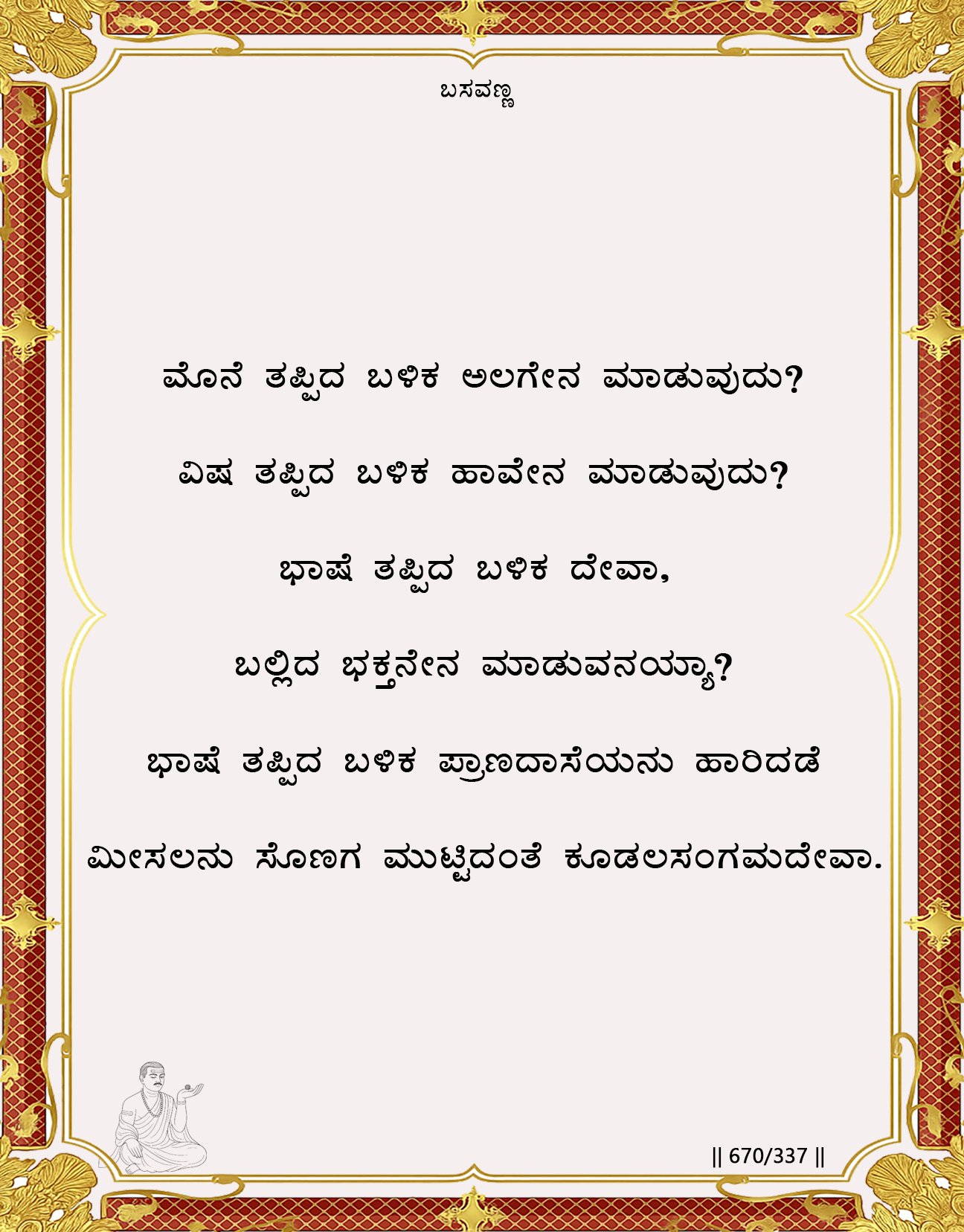
Poetic Rendering

Of what use is a sword
whose edge has grown dull?
Of what strength is a serpent
when its venom runs dry?
Of what worth is a devotee
whose word wavers from truth,
whose vowonce firm as a bridge
collapses beneath desire?
For when resolve is touched
by the dog-greed of the senses,
even the realized one
cannot save himself from the fall,
O Kudalasangama Deva.
In this vachana Basavanna points to integrity the alignment of word, vow, and inner being as the essential foundation of the spiritual path. He uses three comparisons to make this clear: A blunt sword cannot protect. A serpent without venom cannot defend. A devotee without truth cannot stand. Just as these objects lose their essential nature when deprived of their defining quality, a seeker loses spiritual stature when their vow (vrata) is compromised. Basavanna warns that even a realized devotee becomes vulnerable when touched by greed, desire, or sensory weakness symbolized by the fallen state associated with a dog’s unrestrained hunger in the cultural context. The teaching is direct: Truthfulness is the sacred bridge between the devotee and the Divine. Once that bridge breaks, even wisdom cannot prevent the fall.
Spiritual Context
Core Spiritual Principle: Integrity as Ontological Alignment (Satya-Saṁsthiti). Truthfulness is not merely a moral virtue but the structural integrity of the self. A vow (vrata) is a conscious alignment of one’s personal energy with cosmic order (ṛta). Breaking it creates a metaphysical fracture that severs connection, regardless of other attainments.
Cosmic Reality Perspective: This is a non-dual equation of truth with existence. In Shiva-Shakti dynamics, Shiva is pure consciousness/truth. Shakti is the power of manifestation. When the individual’s Shakti (speech, action, resolve) is perfectly aligned with Shiva (truth), it becomes a conduit for grace. “Sensory greed” is Shakti spinning autonomously, creating noise that collapses the bridge. The “fall” is not punishment but the natural consequence of dis-integration.
Historical Reality (Anubhava Mantapa Context): In a community built on revolutionary trust, where traditional social contracts of caste were dissolved, personal integrity became the sole social currency. This vachana was the ethical bedrock, warning that any compromise in truthfulness would destroy not only the individual’s spiritual progress but also the fragile, trust-based fabric of the Lingayoga community itself.
Interpretation
1. “Of what use is a sword whose edge has grown dull?” The sword represents discriminative wisdom (viveka). Its edge is sharpened by practice and truth. Bluntness is the loss of clarity, leaving one defenseless against the illusions of ego and Maya.
2. “Of what strength is a serpent when its venom runs dry?” The serpent symbolizes transformative spiritual energy (kuṇḍalinī śakti). Its venom is the potent power to “kill” ignorance. When depleted by compromise or dissipated desire, the energy lacks the focused potency for transformation.
3. “Of what worth is a devotee whose word wavers from truth, whose vowonce firm as a bridge collapses beneath desire?” This is the central thesis. The “word” (vāc) is creative power. The “vow” is the architectural blueprint for the spiritual life. Desire (kāma) represents a seismic shift in foundational priorities. The collapse is structural, not incidental.
4. “For when resolve is touched by the dog-greed of the senses, even the realized one cannot save himself from the fall.” This is the stern warning against complacency. “Dog-greed” signifies an indiscriminate, base hunger. “Resolve” (saṅkalpa) is the focused intent that sustains the bridge. The fall is from a heightened state of awareness back into identification with sensory impulsesa spiritual gravity that affects all who ignore it.
Practical Implications: Spiritual practice must include rigorous honesty with oneself. Vows should be simple, clear, and inviolable. Regular self-auditing of one’s alignment between inner intention, spoken word, and action is non-negotiable.
The Cosmic Reality
Anga (Human Dimension): The Anga is the bridge-builder and maintainer. Its materials are truthfulness, steadfastness, and sensory restraint. Its constant work is inspection and repair, ensuring no corrosion of compromise weakens the structure.
Linga (Divine Principle): Kudalasangama is the far shore and the foundational law of gravity. It is the reality of Truth that awaits on the other side, and it is also the principle that any deviation from truth leads to a fall. It is both the destination and the rule of the journey.
Jangama (Dynamic Interaction): The Jangama is the bridge in constant use a life where every step is taken upon the firm planks of integrity. They demonstrate that the bridge is not crossed once, but is the very path itself, requiring perpetual care with each footfall.
Shata Sthala
Primary Sthala: Bhakta. The Bhakta stage is where this foundational integrity is hammered out on the anvil of daily life. The vachana provides the quality control standard: devotion is meaningless without the steel of truth.
Supporting Sthala: Sharana. The Sharana is one who has taken refuge. This vachana defines the minimum condition of that refuge: one cannot surrender to God while withholding surrender to truth. The vow is the contract of that surrender.
Practical Integration
Arivu (Awareness Practices): Practice “The Three-Point Check.” Before speaking or acting, pause to verify: Is this true? Is this necessary? Is this aligned with my deepest vow? This builds conscious gatekeeping at the threshold of expression.
Achara (Personal Discipline): Undertake a “Vow of Minimal Truth.” For a period, take on a simple, observable vow (e.g., punctuality, a dietary restriction) and keep it with absolute precision. Let this discipline strengthen the “muscle” of integrity.
Kayaka (Sacred Action): In your work, institute a personal code of “no hidden compromises.” Whether anyone is watching or not, complete tasks with full honesty and quality. Let your labor be an unshakable bridge of trust.
Dasoha (Communal Offering): Foster a community culture of “Truthful Support.” Create mechanisms where members can gently and lovingly hold each other accountable to shared commitments, not as criticism but as mutual bridge-maintenance.
Modern Application
The Era of Personal Branding and Convenient Truth. We live in a culture that often rewards spin, curated personas, and “flexible” ethics. Integrity is sacrificed for likes, profit, or short-term advantage. The internal bridge is constantly compromised, leading to widespread existential anxiety and societal distrust.
Cultivating Radical Integrity. The practice of Shivayoga today is a revolutionary act of rebuilding the inner bridge. It means prioritizing inner congruence over external validation. It involves auditing one’s life relationships, work, digital presence for alignment with truth. It is the commitment to be one thing, undivided, which in a fragmented world is the source of ultimate peace and power.
Essence
They polished the sword of wisdom,
charmed the serpent’s fiery course,
built a bridge of sacred vows
from the heart’s deep, resolute source.
But a word bent for convenience,
a hunger let slip its chain,
and the edge dulled, the venom cooled,
the bridge gave way to the floodplain.
Not by mystic arts alone
does the seeker reach the shore,
but by the planks of truth laid down,
and the will to keep them sure.
For the Divine is steady ground,
and only a steady soul can cross.
All else is a splendid fall
into the chasm of “almost.”
This vachana describes the principle of coherence in conscious systems. An individual is a complex system of thoughts, emotions, words, and actions. Integrity is the measure of coherence among these subsystems. High coherence (truthfulness, vow-keeping) creates a stable, resonant structure capable of channeling higher states (grace). Sensory greed introduces noise incoherent, chaotic impulses that disrupt the system’s standing wave pattern. The “fall” is a phase transition from a coherent, ordered state to a decoherent, disordered one. Even a “realized” system (one that has achieved high coherence) remains susceptible to noise-induced decoherence if vigilance is lowered.
Imagine a suspension bridge (your spiritual life). The cables are your vows, the deck is your daily actions, and the towers are your core truths. Sensory greed is like corrosion or a sudden, unbalanced load. You can have the most beautifully designed bridge, but if you let the cables rust or drive too many heavy trucks of desire across it at once, it will collapse. Basavanna says: your primary spiritual job is not to admire the view from the bridge, but to be the relentless engineer who checks for rust, balances the load, and never, ever compromises on the quality of the steel.
We fear external consequences but often tolerate internal contradictions. We believe we can compartmentalizable spiritual in one area and dishonest in another. This vachana reveals the profound law of psychic unity: the self cannot be divided. A breach of integrity in one area weakens the entire structure of being. Our anxiety and sense of inauthenticity are the warning tremors of this structural damage. The path to peace and power is not through adding more spiritual decorations to a shaky bridge, but through the sober, unglamorous work of repairing its foundation with the unyielding material of truth.

Views: 0