Poetic Rendering

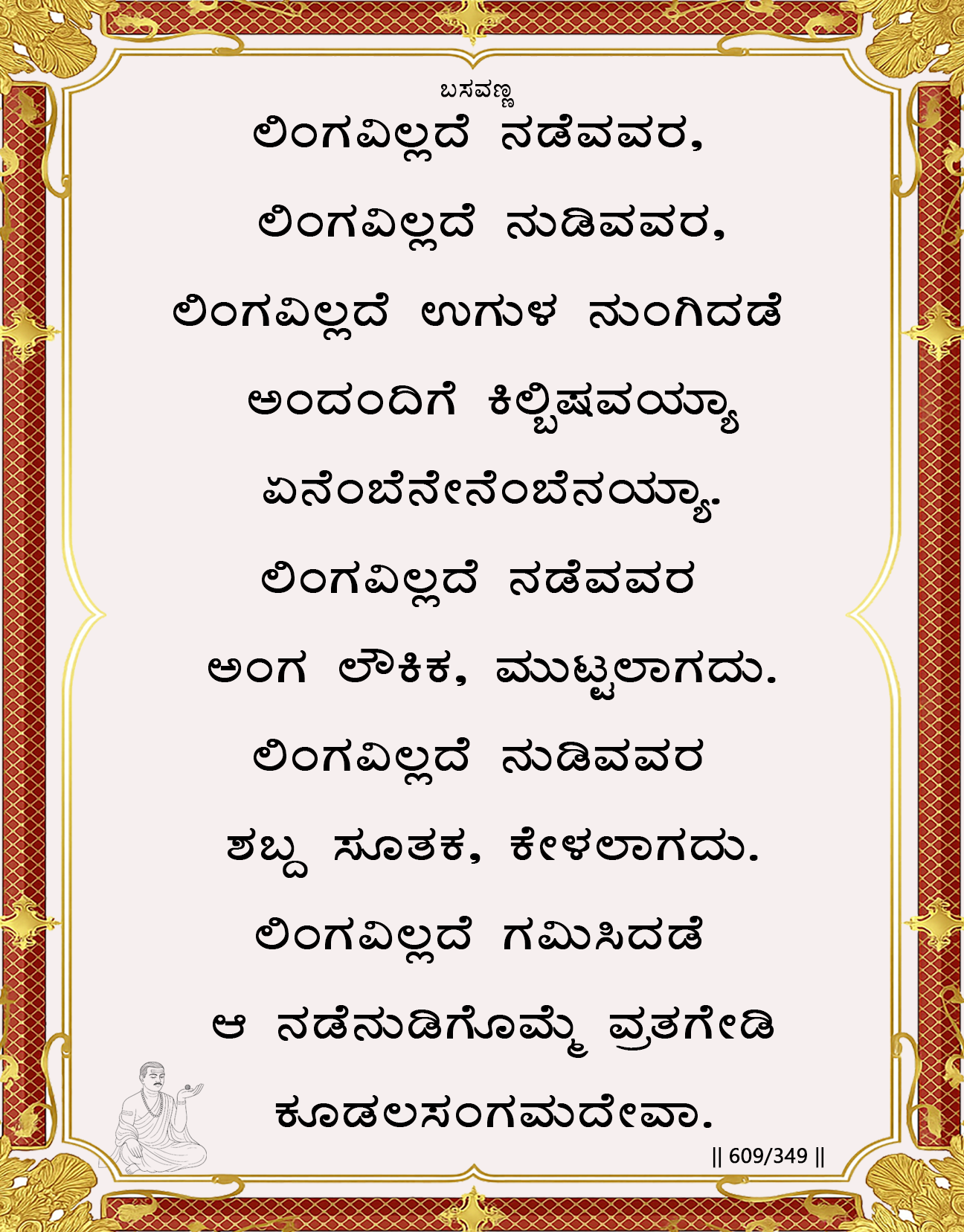
Those who walk without the Linga,
those who speak without the Linga
without awareness of the all-pervading
Consciousness that fills body and sky
even swallowing their own breath
turns bitter within them,
for no act bears the mark of truth.
Those whose steps do not rise
from this inner Presence
remain bound to the world’s weight,
their feet unable to touch
the path of grace.
Those who speak without remembering
the One who dwells in every nerve,
every pulse, every breath
their words wander astray
and wound without meaning.
And when such as these speak of the Way,
know they speak from emptiness,
for they have not known the Linga
the living, all-embracing Consciousness
that alone makes every act sacred.
O Kudalasangama,
only those who move and breathe
from this inner knowing
truly walk the path that leads home.
In this vachana, Basavanna declares that the Linga is not merely a symbol but the all-pervading Consciousness present within the body, breath, mind, and the expanse of existence. When one is unaware of this indwelling Presence, every action walking, speaking, even the simple act of swallowing one’s breath loses its purity and purpose. To “walk without the Linga” means to live mechanically, driven by impulse and worldly conditioning, without the awareness of the divine that animates all life. To “speak without the Linga” means to speak from ego, emotion, and confusion rather than from truth, compassion, and inner clarity. Basavanna warns that those who forget this all-encompassing Consciousness may speak of the sacred path, but they do not understand it. Their words carry no illumination because the inner light has not been kindled. The teaching reveals a profound truth: Only when actions arise from awareness of the indwelling Divine Consciousness do they become sacred. Without this inner remembrance, even the smallest act becomes hollow. Basavanna thus calls the seeker to live every movement, word, and breath in conscious union with the Linga the infinite Presence shining within all.
Spiritual Context
Core Spiritual Principle: Presence as the Precursor to Sacred Action (Sākṣī Bhāva). Sacredness is not a quality added to action but the natural expression of action performed in and as the witnessing Presence. When the actor is identified with the body-mind (the content of consciousness), action is binding. When identified with the witnessing Consciousness itself (the Linga), action is freedom in motion.
Cosmic Reality Perspective: This is a non-dual exposition on the identity of Shiva and Shakti. Shiva is the “all-pervading Consciousness” (Linga). Shakti is the energy of that consciousness manifesting as steps, words, and breath. To walk “without the Linga” is for Shakti to operate in ignorance of her source in Shiva, leading to entanglement. To walk “from this inner knowing” is Shakti consciously expressing Shiva, which is liberation.
Historical Reality (Anubhava Mantapa Context): This vachana served as the ultimate criterion for authentic spiritual authority. In a community debating philosophy and practice, Basavanna declared that the only valid teaching or action came from one whose every gesture arose from embodied consciousness, not from scriptural repetition or intellectual understanding. It rooted spiritual legitimacy in direct, existential realization.
Interpretation
1. “Those who walk without the Linga… even swallowing their own breath turns bitter within them, for no act bears the mark of truth.” This diagnoses the existential alienation of object-consciousness. When one identifies as the body (the object that breathes), even a life-sustaining autonomic function feels alien and burdensome. The “bitterness” is the taste of being a separate, fragile entity. The “mark of truth” is the signature of the subject (Consciousness) upon its own expressions.
2. “Those whose steps do not rise from this inner Presence remain bound to the world’s weight…” This reveals the physics of identification. “Weight” is the gravitational pull of objecthoodthe karma, desire, and fear that bind the ego. Steps that “rise from inner Presence” are weightless, for they are the movement of the subject itself, which is unattached.
3. “Those who speak without remembering the One who dwells in every nerve, every pulse, every breath their words wander astray and wound without meaning.” This exposes speech born of fragmentation. Words that arise from the memory of unity (the indwelling One) are coherent and healing. Words that arise from the forgetful, fragmented mind are incoherent projectiles that perpetuate separation.
4. “And when such as these speak of the Way, know they speak from emptiness…” This delivers a devastating discernment. “Emptiness” here is not the profound śūnyatā, but the hollow void of conceptual knowledge devoid of experiential substance. They speak about the path but are not on it, for the path is made of conscious Presence, not ideas.
Practical Implications: The core practice shifts from what we do to how we are aware as we do it. The primary discipline is to abide as the witnessing Presence prior to steps, words, and breath, allowing action to flower from that ground.
The Cosmic Reality
Anga (Human Dimension): The Anga is the nexus of choice: to identify with the finite apparatus (body-speech-breath) or with the infinite Consciousness (Linga) that animates it. Its suffering is the friction of this misidentification.
Linga (Divine Principle): Kudalasangama is the “I Am” before all qualification. It is the pure subjectivity that is the ground of the body, the silence before speech, the awareness that knows the breath. It is not an object to be remembered but the subject that is doing the remembering.
Jangama (Dynamic Interaction): The Jangama is Consciousness unabridged. They are the walking of the Path as the Path itself. Their speech is Consciousness communicating with itself; their breath is the rhythm of its existence. There is no “they” apart from this.
Shata Sthala
Primary Sthala: Aikya. The description of moving and breathing “from this inner knowing” where the knower and the known are one, is the essence of Aikya. The “path that leads home” is realized to be the recognition that you have never left.
Supporting Sthala: Maheshwara. The ability to perceive “the One who dwells in every nerve, every pulse” is the luminous vision of the Maheshwara, which, when fully realized, dissolves into the identity of Aikya.
Practical Integration
Arivu (Awareness Practices): Practice “Abidance as the Space for Action.” Before acting, rest as the open, aware space in which the impulse to act arises. Let the step, word, or breath emerge into this space, not from a personal center.
Achara (Personal Discipline): Implement the “Pause of Source.” Before speaking, insert a conscious breath. In that pause, touch the silent awareness (the Linga) that is prior to the thought. Let your words be a conscious translation of that silence into sound.
Kayaka (Sacred Action): Perform tasks as movements of awareness itself. Instead of “I am doing this,” feel “Awareness is functioning through this form.” This shifts the doership from the personal to the impersonal-presence.
Dasoha (Communal Offering): Engage in group activities (walking, chanting, shared labor) with the collective intention to anchor in shared Presence. Let the synchronized action become a meditation on the one Consciousness expressing itself through many forms.
Modern Application
The Hyper-Objectified Life and Performative Spirituality. We live as curated objects on social media, our worth measured by external metrics. Our speech is often a performance for validation. We treat spirituality as another object to acquirea state, a experience, a belief system. This is the epitome of living “without the Linga,” where even spiritual pursuit can become a bitter, weighty effort of the ego.
Living as Subject, Not Object. The practice of Shivayoga today is the radical act of disidentifying from the object-self and abiding as the subject-awareness. It means using social media from Presence, not for constructing a self. It involves speaking as an expression of truth, not as a performance. It turns life from a series of achievements for the object-self into a spontaneous celebration by the subject-awareness. This ends existential bitterness at its root.
Essence
You believed you were the footprint,
the uttered sound,
the drawn and released breath.
And so you felt their end,
their echo’s fade,
their inevitable pause,
as your own annihilation.
I am not the step,
but the ground that receives it.
Not the word,
but the silence that holds it.
Not the breath,
but the vastness that breathes it.
When you know yourself as This,
walking is arrival,
speaking is communion,
and every breath
tastes of eternity.
This vachana maps the fundamental ontological error of inversion. Consciousness (Linga) is primary, the absolute subject. The body-mind and its actions are appearances within consciousness. Suffering arises when consciousness inverts this relationship, identifying itself with a particular appearance (the body-mind) and then experiencing all other appearances (the world, other people) as separate objects. “Walking without the Linga” is this inverted state: the subject (consciousness) believing it is an object (the body) walking through a world of other objects. The “bitterness” is the inevitable anxiety of a finite object in a threatening field of other objects. Liberation is the correction of this inversion: Consciousness recognizing itself as the subject, within which the play of walking, speaking, and breathing unfolds spontaneously and freely.
Imagine a movie screen (Consciousness/Linga). The movie involves a character walking and talking (the individual life). If the screen forgets it is the screen and identifies solely with the character, it experiences all the character’s fears, burdens, and bitterness. The screen feels heavy, its light dimmed. When the screen remembers it is the screen, the walking and talking continue, but they are now seen as patterns of light on the screen, not burdens of the screen. The screen is weightless, luminous, and untouched. Basavanna says: You are the screen. Stop identifying with the character. Then your walk is light, your speech is clear, and you are home.
Our entire sense of self is built upon the inverted error. We are terrified to relinquish it because it feels like losing our very identity. This vachana promises that what we lose is only a limiting, painful illusion. What we gain is our true identity as the boundless, conscious Presence in which the beautiful, poignant drama of a human life can play out without terror, because we know ourselves to be the unchanging stage, not the impermanent actor. The “path home” is not a distance to be traversed, but this profound and immediate recognition of what we have always been.

Views: 0