Poetic Rendering
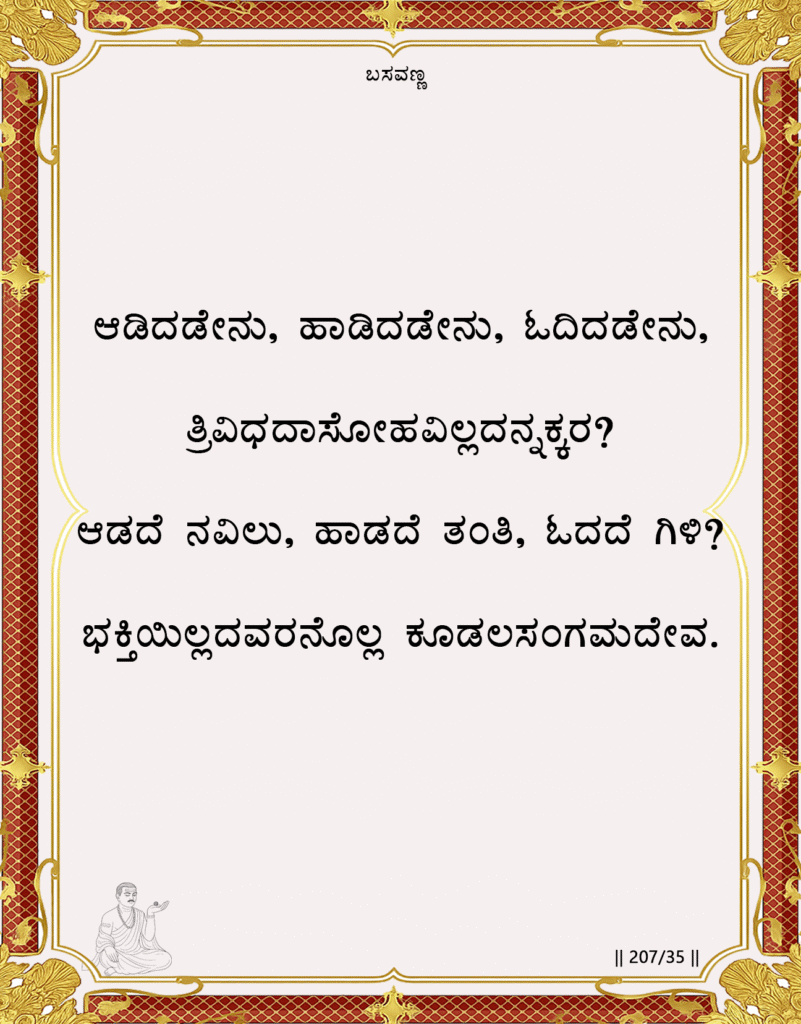
What is the use of dancing,
or singing,
or reading aloud
if the heart holds no dasoha:
service, sharing, surrender?
The peacock may dance,
the lute may sing,
the parrot may recite its words
but without true devotion within,
none of it pleases You,
O Kudalasangamadeva.
Basavanna teaches that outward acts of worship dance, song, or scripture are worthless without the inner spirit of dasoha. Without service, sharing, and surrender, devotion becomes mere performance. True worship is the transformation of the heart, not the display of ritual.
Spiritual Context
Core Spiritual Principle: The essence of worship is not the external performance of rituals but the internal attitude of selfless offering and surrender (Dasoha). Without this inner spirit, the most elaborate rituals are hollow and mechanical, incapable of connecting the soul to the Divine.
Cosmic Reality Perspective: The Linga is consciousness itself, which can only be realized through a conscious, loving relationship. Mechanical actions, no matter how beautiful, lack this conscious love and therefore cannot bridge the gap between the individual and the Absolute. They remain in the realm of inert matter (Jada).
Historical Reality (Anubhava Mantapa context): This vachana is a direct critique of empty ritualism and performative piety, which were prevalent in the religious practices of the time. It anchors the Lingayat path in the revolutionary principle that true spirituality is measured by one’s compassionate action and inner transformation, not by ritual proficiency.
Interpretation
1. The Empty Rituals (Dancing, Singing, Reading): Basavanna lists three common forms of devotional expression. He does not condemn the actions themselves but questions their purpose when divorced from their inner substance.
2. The Essential Ingredient: “if the heart holds no dasoha” : Dasoha is revealed as the non-negotiable core. It means more than charity; it is an entire orientation of selfless service, sharing of resources, and surrender of the ego.
3. The Analogies of Mindless Performance: The Peacock’s Dance: Instinctual, for display and mating. Without Dasoha, devotional dance is just a performance for social approval or self-gratification. The Lute’s Song: The lute produces sound, but it is an inert instrument. Without the heart’s devotion, singing is mere mechanical sound production. The Parrot’s Recitation: The parrot mimics without understanding. Without inner realization, scriptural study is empty repetition, devoid of transformative power.
4. The Conclusion: “none of it pleases You” : This establishes the relational nature of true Bhakti. God is not pleased by robotic actions, but by the love, humility, and selflessness that animates those actions. The Divine seeks a living relationship, not a ritualistic transaction.
Practical Implications: A seeker must constantly infuse their spiritual practices with the spirit of Dasoha. Before dancing, singing, or studying, one should set the intention of selfless offering. The real test is whether the practice softens the heart, increases compassion, and diminishes the ego.
The Cosmic Reality
Anga (Human Dimension): The human body and mind capable of performing rituals. Its highest purpose is to become a vehicle for Dasoha, transforming ritual into sincere worship.
Linga (Divine Principle): Kudalasangama Deva as the conscious, loving reality that responds not to forms, but to the love and selflessness behind those forms.
Jangama (Dynamic Interaction): The Jangama is the spirit of Dasoha itself. It is the dynamic, living current of love and service that flows from the devotee’s heart, animating their rituals and making them a genuine offering to the Divine.
Shata Sthala
Primary Sthala: Bhakta. This vachana is a crucial teaching for the Bhakta, ensuring their devotion matures from external performance to internal, transformative love.
Supporting Sthala: Sharana. The vachana points toward the Sharana stage, where one’s entire life becomes a natural, spontaneous expression of Dasoha, and all action is selfless service.
Practical Integration
Arivu (Awareness): Before and during any spiritual practice, cultivate awareness of your intention. Ask: “Am I doing this to be seen, or as a genuine offering? Is this act making me more generous and less self-absorbed?”
Achara (Personal Discipline): Let your primary discipline be the cultivation of a generous heart. Practice giving your time, resources, and attention selflessly. See this as your most important worship.
Kayaka (Sacred Action): Infuse your daily work with the spirit of Dasoha. See your labor as a service to the world and an offering to the Divine, regardless of the nature of the work.
Dasoha (Communal Offering): Ensure that the collective rituals of the Sangha the gatherings, the meals, the prayers are rooted in genuine sharing and community support, not in empty ceremonialism.
Modern Application
We live in an age of “spiritual aesthetics” where people often focus on the external form of practice perfect yoga poses, photogenic altars, sharing spiritual quotes online without embodying the core principles of compassion, integrity, and selfless service. This can lead to a culture of spiritual hypocrisy and performative wellness.
This vachana liberates by redefining spiritual success. It frees us from the pressure to perform spirituality perfectly and redirects our energy to the substance of the heart. It tells us that a simple act of genuine kindness is more pleasing to God than the most elaborate empty ritual. The path is simplified: focus on becoming a more loving, generous, and selfless person, and let that spirit inform whatever practices you do.
Essence
The dance, the song, the holy word,
Are empty sounds, unseen, unheard,
If from the heart no love does flow.
The seed of service makes devotion grow.
Metaphysically, this vachana distinguishes between the Anga of the action (the physical performance) and its Chetana (consciousness). Rituals without Dasoha have Anga but lack the Chetana of love and surrender. They are like a body without a soul. The Linga, as pure Chit (consciousness), resonates only with this Chetana. The practice of Dasoha is the process of infusing one’s actions with this divine consciousness, thereby transforming Karma (action) into worship. The parrot’s recitation represents Gurumukhi Vani (repeating the guru’s words) without Gurumukhi Chetana (the guru’s consciousness), which is the ultimate goal.
The value of any action whether in art, work, or religion is determined by the spirit in which it is performed. A simple task done with love and selflessness is infinitely more valuable than a grand performance done for ego or reward. True worth is found not in what you do, but in why and how you do it.

Views: 1