Poetic Rendering

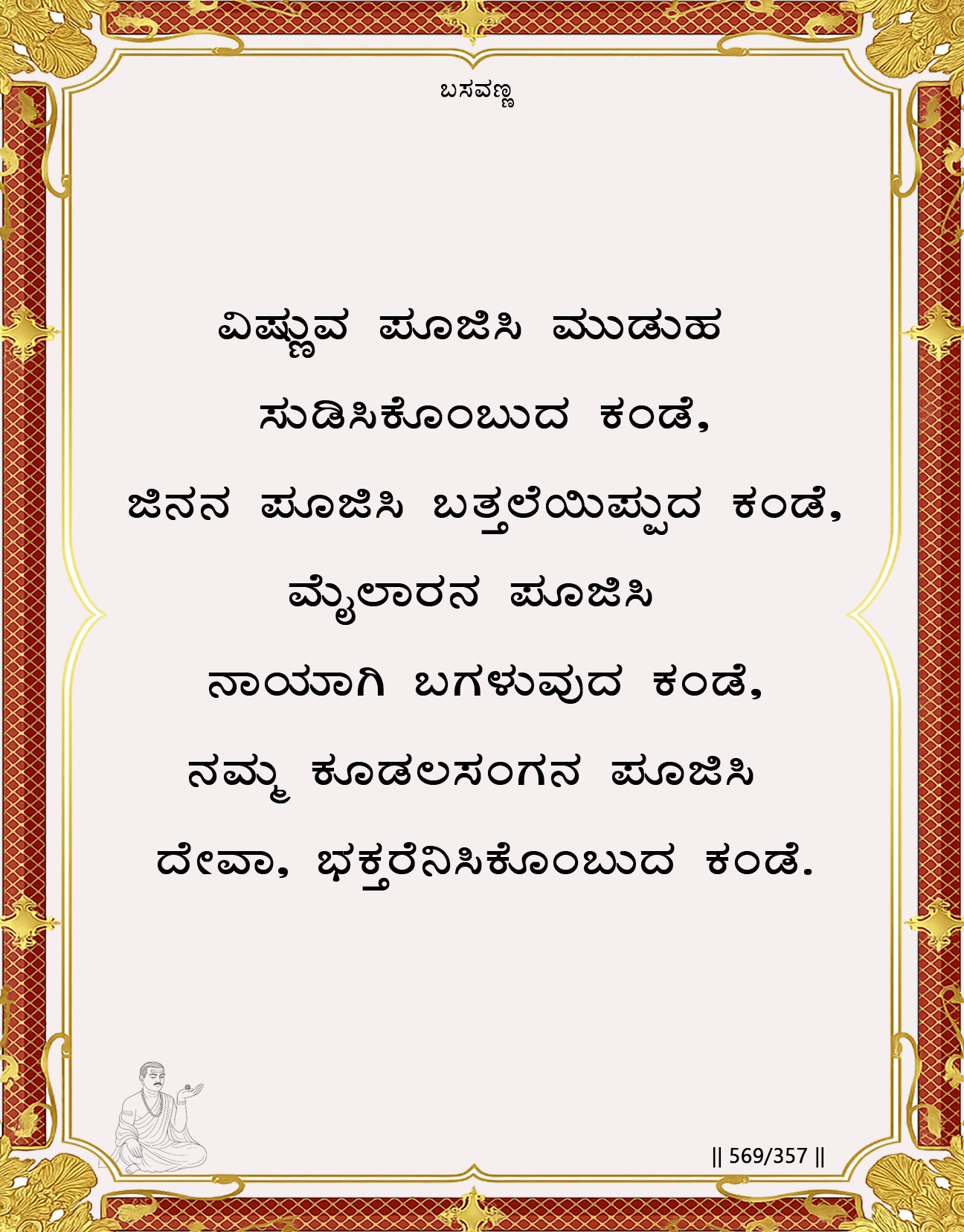
I have seen them, O Lord
the worshippers of Vishnu,
casting themselves into ritual fire.
I have seen them,
the followers of Jina,
starving their bodies into silence.
I have seen them,
the devotees of Mailara,
howling like beasts in madness.
But those who worship You,
O Kudalasangama,
stand serene
their devotion a flame that burns without smoke,
their hearts, quiet sanctuaries of truth.
“When the fire of wisdom burns, it gives warmth to the world, not ashes.” This vachana presents Basavanna’s profound critique of spiritual extremism and ritual excess. Through keen observation of contemporary religious practices, he distinguishes between outer spectacle and inner transformation. The teaching establishes that authentic devotion is not measured by physical austerity or emotional frenzy but by the quality of consciousness cultivated. True worship manifests as serene awareness that integrates rather than fragments human experience.
Spiritual Context
Core Spiritual Principle: Integration Over Extremism. The true measure of spirituality is not the intensity of external practice but the depth of inner serenity and integrated awareness. Authentic devotion harmonizes the human and the divine without violence to the body or agitation of the mind.
Cosmic Reality Perspective (non-dual, Shiva-Shakti dynamics): The cosmos is a balanced play of Shiva (stillness) and Shakti (dynamic expression). Extreme practices represent an imbalance: excessive Shakti (frenzy, fire) without Shiva’s stillness, or excessive negation of Shakti (starvation) without honoring Shiva’s immanence in the body. The serene flame symbolizes the perfect equilibrium Shakti’s energy perfectly aligned with and expressive of Shiva’s peaceful essence.
Historical Reality (Anubhava Mantapa context): In 12th-century Karnataka, Basavanna witnessed various sects engaging in dramatic austerities and ecstatic practices. This vachana served as a foundational critique within the Anubhava Mantapa, defining the Lingayoga path as one of Sthitaprajna (steady wisdom). It rejected performative religiosity and established that true social revolution (Kayakave Kailasa) must be grounded in individuals who are inwardly calm and clear, not physically depleted or emotionally volatile.
Interpretation
1.The Fire of Ritual Suicide: The Vaishnava practice of casting into fire symbolizes Atma-hanana (soul-negation) through misplaced identification with the physical body as the sacrificial offering. Metaphysically, fire (Agni) should inwardly burn the Vasanas (latent tendencies), not the Deha (body). This misdirection confuses the symbol for the substance.
2.The Silence of Starvation: The Jaina practice of fasting to death (Sallekhana) represents the attempt to achieve Kaivalya (isolation) through negation of the physical. However, if the mind remains attached to the idea of austerity, it reinforces Dvandva (duality of body vs. soul). True silence (Mauna) is the stillness of the mind, not the weakness of the body.
3.The Frenzy of Possession: The Mailara (a form of Shiva) devotees’ howling represents Avesha (possession) mistaken for Samadhi (absorption). While divine ecstasy exists, it must lead to integration, not disintegration. Uncontrolled emotion scatters consciousness rather than uniting it.
4.The Serene Flame of Lingayoga: The “flame that burns without smoke” is the Jnana Agni (fire of wisdom). Smoke represents impurities (Mala)ego, attachment, aversion. A smokeless flame indicates complete combustion: the fuel of ignorance is fully transformed into the light of awareness, with no residual pollution.
Practical Implications: Spiritual practice must be evaluated by its fruit: does it increase serenity, clarity, and compassionate engagement? If it leads to physical harm, mental agitation, or social isolation, it is not aligned with integrative wisdom.
The Cosmic Reality
Anga (Human Dimension): The human propensity to seek transcendence through violence against one’s own nature whether through self-harm, severe denial, or emotional abandon. The ego often mistakes these extremes for spiritual prowess.
Linga (Divine Principle): The divine as Santa-Sakara (peaceful form) and Shanta-rasa (peaceful essence). Kudalasangama is the unity that embraces all of life peacefully; worship thus becomes an act of aligning with this inherent peace.
Jangama (Dynamic Interaction): The process of Samyama (balanced restraint)neither suppressing nor indulging the senses and emotions, but channeling them into a steady flow of conscious worship. It is the dynamic calibration that maintains the serene flame.
Shata Sthala
Primary Sthala: Sharana (Total Surrender). The state of serenity emerges from surrendering the ego’s agenda to control spiritual outcomes through extreme effort. The Sharana trusts the Linga completely, allowing devotion to become a natural, steady state.
Supporting Sthala: Prasadi (Grace-Receptivity). The smokeless flame is a gift of grace. To sustain it, the practitioner must cultivate a receptive, clean vessel free from the “smoke” of egoistic striving which is the work of the Prasadi stage.
Practical Integration
Arivu (Awareness Practices): Practice “Flame Observation.” In meditation, visualize a steady, smokeless flame at the heart center. Whenever you notice yourself engaging in spiritual “extremes” (over-exertion in practice, harsh self-judgment, emotional fervor), return to this image as a metaphor for balanced awareness.
Achara (Personal Discipline): Adopt the Madhyama Marga (Middle Path) in all disciplines. Let your dietary, ritual, and meditative practices be sustainable and nourishing, avoiding both indulgence and deprivation. The discipline is to maintain equipoise.
Kayaka (Sacred Action): Let your work be an expression of serene focus. Avoid the extremes of workaholism and laziness. Perform each task with full attention and a calm mind, making the action itself a “smokeless flame” of offering.
Dasoha (Communal Offering): Offer the community the atmosphere of serenity. In gatherings, be a calming presence. Gently steer collective spiritual discussions away from debates over extreme practices and toward the cultivation of inner peace and practical goodness.
Modern Application
Spiritual Exhibitionism and Burnout. In the age of social media and wellness culture, spirituality is often performative characterized by extreme diets, marathon meditation sessions, and public displays of ecstatic practice, all seeking validation. Conversely, many experience “spiritual burnout” from striving too hard, leading to disillusionment.
Cultivating the Sustainable Inner Flame. Use this vachana as a check against spiritual performativity. Ask: “Is my practice creating inner serenity or just external spectacle?” Embrace a spirituality of Sustainable Integration: regular, moderate practices that weave seamlessly into daily life, prioritizing inner peace over dramatic experiences. This builds a resilient spirituality that can withstand life’s pressures without needing to resort to extremes.
Essence
Others offer flesh to fire,
or silence to the starving bone,
or voice to howling wind.
But You, O Stillness at the confluence,
ask only for this heart to hold
a flame that needs no fuel but truth,
that warms the world with light alone.
This vachana illustrates the metaphysical principle of harmonic resonance versus dissonant vibration. Extreme practices are high-amplitude, dissonant vibrations that create noise (smoke) and eventually dissipate energy chaotically. The serene flame is a harmonic of the fundamental frequency of the cosmos a clean, coherent vibration that resonates with the substrate of reality (Shiva-Shakti in equilibrium). In multidimensional terms, the serene devotee’s consciousness exists in a state of aligned phase across all layers of being, whereas extreme practices create phase distortions that manifest as physical or emotional turbulence.
Think of tuning a musical instrument. Extreme practices are like tightening the string so much it might snap (asceticism) or plucking it wildly with no rhythm (frenzy). Both produce discordant sounds. Serene devotion is tuning the instrument perfectly and playing it with a steady, skilled hand producing music that is harmonious, sustaining, and beautiful without strain or noise.
We often believe that to reach the divine, we must go to extremes to prove our commitment through great suffering or intensity. This stems from a deep-seated feeling of unworthiness, that we must earn love or enlightenment. This vachana reveals the liberating truth: the divine is not reached through violence to our being, but through peaceful acceptance and integration. The serene flame represents the peace that comes when we stop warring with ourselves and allow our innate divinity to shine unimpeded. Our deepest longing is not for dramatic transformation but for homecoming to be at peace with who we already are, in the presence of the divine that is already here.

Views: 0