Poetic Rendering
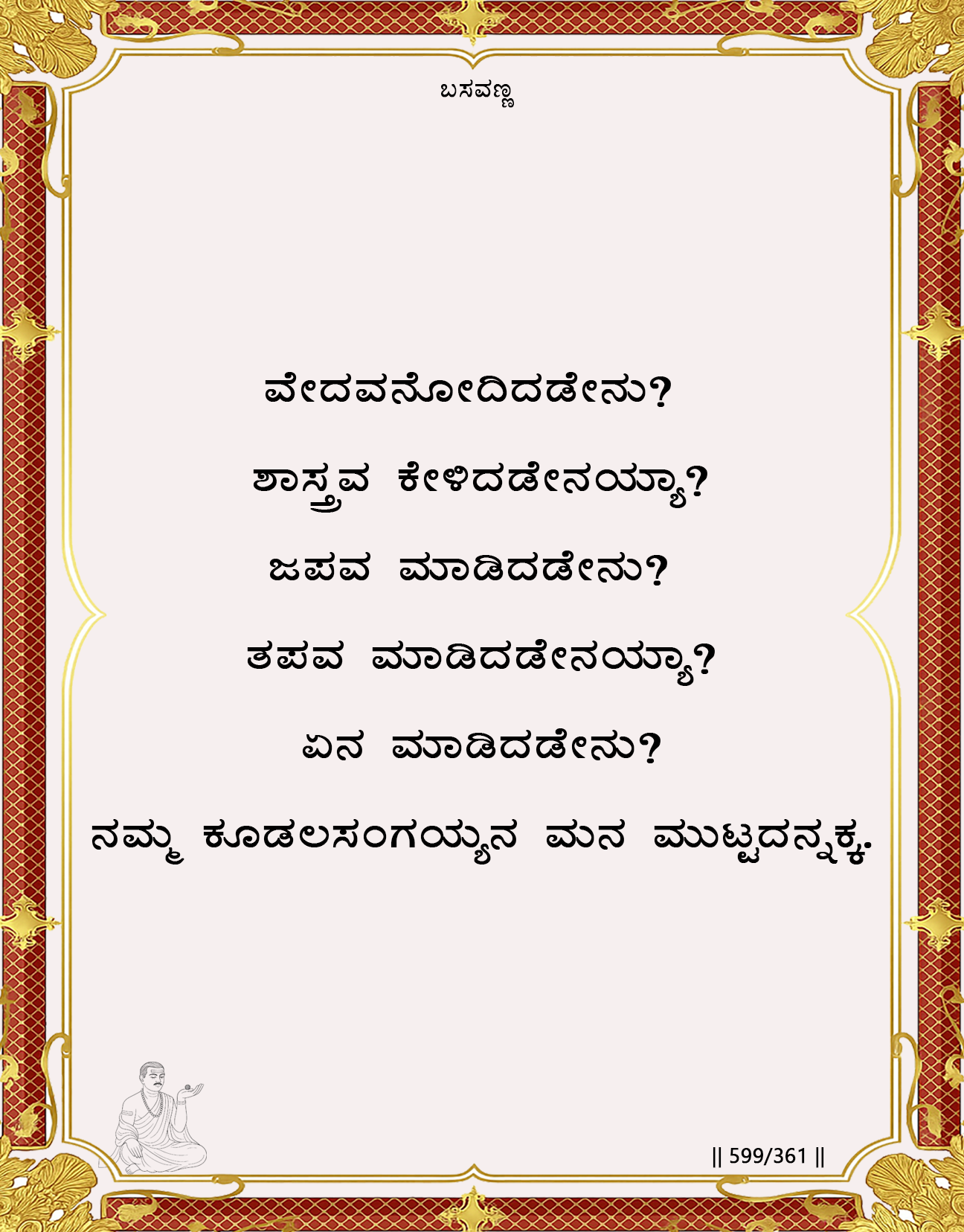
What worth in chanting the Vedas?
What gain in hearing the Shastras?
What fruit in endless penance and chants?
All fade into dust
if they do not touch
the heart of Kudalasangama.
Basavanna’s timeless message for a world drowning in noise and forgetting sincerity This vachana delivers Basavanna’s most essential criterion for spiritual practice: the primacy of heartfelt sincerity over mechanical observance. He confronts the universal tendency toward empty ritualism, asserting that even the most revered spiritual practices Vedic chanting, scriptural study, and ascetic disciplines become spiritually worthless if they fail to generate genuine connection with the Divine. This represents the core teaching that spirituality is qualitative rather than quantitative, measured by depth of heart-connection rather than external performance.
Spiritual Context
Core Spiritual Principle: Sincerity as the Catalyst. The transformative power of any spiritual practice is activated not by its form, duration, or traditional prestige, but by the quality of heartfelt sincerity with which it is performed. The practice is the vessel; sincerity is the content that makes it potent.
Cosmic Reality Perspective (non-dual, Shiva-Shakti dynamics): Shakti is the dynamic power of divine consciousness. In spiritual practice, the human effort is an expression of individual Shakti. For this effort to merge with cosmic Shakti (the “heart of Kudalasangama”), it must carry the resonant frequency of sincerity (Satya). Mechanical practice produces dissonant vibrations that cannot harmonize with the divine frequency, no matter how elaborate its pattern.
Historical Reality (Anubhava Mantapa context): This vachana was a direct challenge to the Brahminical orthodoxy of Basavanna’s time, which equated spiritual merit with the exact performance of Vedic rituals and recitations, often in a language (Sanskrit) inaccessible to the common people. It democratized spirituality by asserting that a single heartfelt moment of a Sharana was more spiritually valuable than a lifetime of perfect but disengaged priestly ritual.
Interpretation
1.Chanting the Vedas: The Vedas are considered Apaurusheya (not of human origin)the cosmic sound itself. However, chanting them without Bhava (feeling) or Artha-Bodha (understanding of meaning) reduces them to mere phonetics. This severs the connection between Shabda (sound) and Artha (meaning), and ultimately Brahman (the reality they signify).
2.Hearing the Shastras: Hearing (Shravana) is the first step in traditional knowledge acquisition. But if it is passive accumulation (Jnana-Sanchaya) without active reflection (Manana) and integration (Nididhyasana), it becomes spiritual data-hoarding, adding to the burden of the mind (Manas) rather than illuminating the consciousness (Chit).
3.Endless Penance and Chants: Penance (Tapas) is meant to burn impurities (Mala). Chants (Japa) are meant to concentrate the mind. When done endlessly as a quantitative exercise (counting beads, measuring days), they can reinforce the ego of the practitioner (“I have done so much tapas”). This perverts the means into an obstacle.
4.”Touch the heart of Kudalasangama”: This is the qualitative benchmark. To “touch” (Sparsha) implies intimacy, direct contact, and affective impact. The “heart” (Hridaya) is the core of being. The criterion is therefore whether the practice facilitates an intimate, feeling-based communion with the divine center of one’s own existence.
Practical Implications: It necessitates a regular “heart-check” in one’s spiritual life. One must be willing to abandon or modify even sacred, established practices if they have become dry, routine, or disconnected from living devotion. The map (practice) must always lead to the destination (heart-connection); if it doesn’t, the map must be re-examined.
The Cosmic Reality
Anga (Human Dimension): The ritual-performing ego. This Anga can become attached to the performance itself, mistaking the sophistication of the ritual for spiritual progress. It is the part of us that can hide in spirituality.
Linga (Divine Principle): The ever-present, ever-available divine reality that responds only to authenticity. It cannot be bribed, impressed, or manipulated by ceremonial complexity. It responds to the call of the genuine heart as iron responds to a magnet.
Jangama (Dynamic Interaction): The alchemy of sincerity. It is the process where the raw material of ritual action is transmuted into the gold of divine communion through the catalyst of a sincere heart. This is the true Sangama (confluence).
Shata Sthala
Primary Sthala: Bhakta (Devotion). The vachana’s central question validates the Bhakta stage as foundational. Before one becomes a knower (Jnani) or a master (Maheshwara), one must first be a lover (Bhakta). All practices are in service of cultivating this loving connection.
Supporting Sthala: Prasadi (Grace-Receptivity). The “touching” of the heart is an event of grace. Sincerity is the precondition that makes the heart receptive to this grace. Thus, the practice of sincerity is the core Sadhana of the Prasadi stage.
Practical Integration
Arivu (Awareness Practices): Before any spiritual practice, pause for a moment of “Heart-Centering.” Set a clear intention: “May this action be an offering from my heart to Yours.” After the practice, reflect briefly: “Did I feel a connection? Or was my mind elsewhere?” This builds conscious engagement.
Achara (Personal Discipline): Discipline yourself to prioritize quality. It is better to chant one name with full feeling than to chant a thousand names while planning your day. Simplify your routine to practices that consistently foster a sense of inner connection and warmth.
Kayaka (Sacred Action): Let your work be your most sincere prayer. Pour heartfelt care into your tasks. The integrity and love you bring to your labor is a direct “touching” of the divine in the field of action, often more potent than formal rituals performed without attention.
Dasoha (Communal Offering): In community worship or study, foster an atmosphere of heartfelt presence. Discourage performative expertise. Encourage sharing from personal experience (Anubhava) rather than scholarly exposition. Make the collective aim to “touch the heart” together.
Modern Application
Spiritual Distraction and Checklist Spirituality. In the modern wellness and mindfulness industry, practices are often reduced to checklist items10 minutes of meditation, 20 minutes of yoga tracked by apps. This can create a detached, goal-oriented mentality that mirrors the very mechanical ritualism Basavanna critiques. We chase experiences and certifications but lose the simple thread of sincere connection.
Cultivating the Sincerity Audit. Use this vachana to institute a regular “Sincerity Audit” of your spiritual or mindfulness practice. Ask: “Am I doing this to check a box, to improve myself, or to genuinely connect with something greater?” Dare to sometimes skip a formal practice to simply sit quietly and feel. Choose depth over duration. This protects your spiritual life from becoming another domain of achievement anxiety and keeps it rooted in the authentic, seeking heart.
Essence
All the sacred sounds, if the heart makes no sound in return,
are just noise.
All the holy words, if they don’t kindle the fire within,
are just ink.
All the austerities, if they don’t soften the soul,
are just violence.
O Heart of All,
unless my practice ends in You,
it has not even begun.
This vachana operationalizes the metaphysical principle of intentionality as a fundamental force. In many wisdom traditions, the intention behind an action determines its subtle effect. Basavanna elevates this to the supreme principle. The ritual is the wave; sincerity is the amplitude. A high-amplitude wave (deeply sincere simple prayer) carries more energy and reaches further (touches the heart) than a complex, low-amplitude wave (elaborate but mechanical ritual). The “heart of Kudalasangama” is the resonant field that only responds to waves of sufficient amplitude (sincerity), regardless of their pattern (type of ritual).
Imagine two people sending you a message. One sends a long, beautifully typed letter copied from a famous poet, but their mind is on their grocery list. The other sends a simple, clumsily written note that says “I’m thinking of you,” and they mean it entirely. Which one truly touches your heart? Basavanna says God is like that. The elaborate Vedic chant is the beautiful letter; the sincere sigh of a weary seeker is the heartfelt note. Only the latter reaches its destination.
We often hide from the vulnerability of sincerity behind the armor of ritual and expertise. It feels safer to “do spirituality correctly” than to open our hearts authentically, which risks exposure, disappointment, or the pain of genuine longing. This vachana calls us out of hiding. It affirms that our deepest longing to be in real relationship with the Divine is answered not by perfect performance, but by the courage to offer our imperfect but genuine selves. Our spiritual poverty is not a lack of knowledge or discipline, but a lack of courage to be sincerely, vulnerably present before the great mystery.

Views: 0