Poetic Rendering
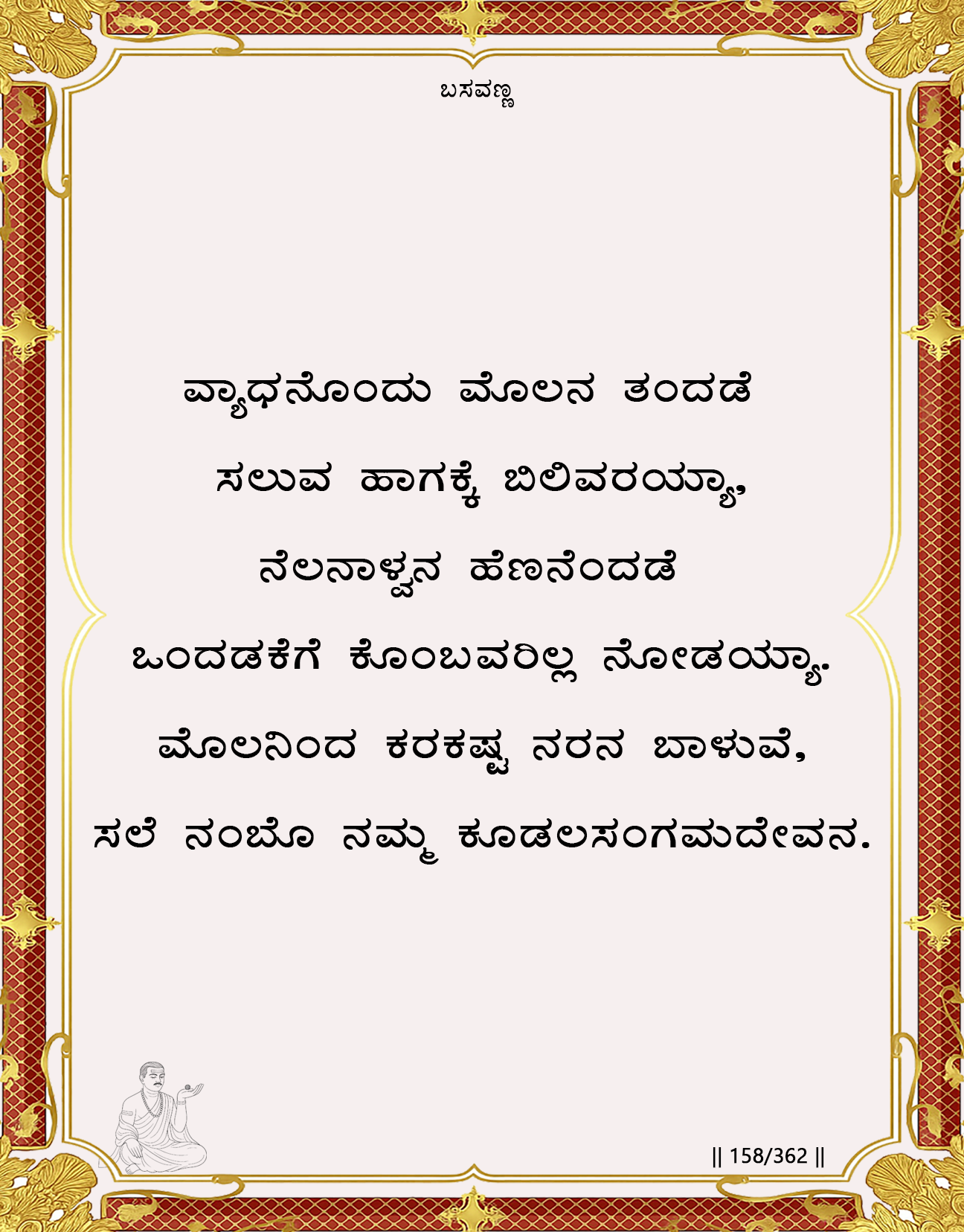
When a hunter returns with a hare,
the whole village rushes forth
hands outstretched, coins clinking,
each eager for a share of the tiny feast.
But when a king lies dead,
no one steps forward,
no one offers a price
for the silent splend our of his fallen body.
His palaces, his guards, his gold
all stand still,
unable to purchase even a single breath.
Such is the measure of worldly worth
a hare draws more life toward it
than a lifeless king.
So place your trust, my friend,
not in this flickering world,
but in Kudalasangama,
the One who does not perish.
In this vachana, Basavanna uses a striking contrast to reveal the illusion of worldly prestige: A simple hare brings the entire village running. A dead king, despite all his wealth and power, draws no one near. Through this irony, Basavanna shows that worldly worth is shallow, temporary, and dependent on utility, not dignity. Human pride collapses the moment breath leaves the body. The vachana points to a deeper truth: Only the eternal Kudalasanga made serves trust. All else fades, loses meaning, and becomes empty spectacle.
Spiritual Context
Core Spiritual Principle: The Inversion of Valuation. Spiritual awakening requires recognizing that the world’s system of value based on utility, status, and possession is not only transient but fundamentally inverted. What is most sought after (kingly power) is ultimately worthless; what provides true refuge (the divine) is often ignored until one sees through the illusion.
Cosmic Reality Perspective (non-dual, Shiva-Shakti dynamics): The play of Shakti manifests as the ever-changing drama of coming and going, attraction and repulsion (the hare and the king). Shiva is the silent, unchanging witness to this entire play. To place trust in the manifestations (Shakti) rather than the ground (Shiva) is to be caught in Maya. Basavanna’s metaphor reveals Shakti’s ultimate powerlessness without Shiva’s animating presence (the dead king).
Historical Reality (Anubhava Mantapa context): In a feudal society obsessed with royal patronage, caste hierarchy, and material wealth, this vachana was a profound leveler. It reminded both the powerful and the commoners that before the ultimate truth of impermanence, a king’s authority and a peasant’s pursuit of a meal share the same fate. It fortified the Sharanas to seek a dignity and security not granted by social rank but found in divine union.
Interpretation
1.The Hunter’s Hare: The hare represents Kshudra Vishayasmall, immediate objects of desire. The village’s rush symbolizes Trishna (craving) and Sangha (herd mentality). The “coins clinking” show the transactional nature of worldly life: everything has a price based on immediate utility. This is Pravritti Marga (the path of engagement) at its most basic level.
2.The Dead King: The king represents the pinnacle of worldly achievementRaja-Satta (royal power), Aishwarya (prosperity), and Kirti (fame). His death reveals the truth of Anitya (impermanence). That “no one offers a price” demonstrates that when the ego (Ahamkara) that wielded power is gone, the external trappings lose all value. The palace and gold, symbols of Bhoga (enjoyment) and Sampatti (wealth), cannot buy Prana (life force).
3.The Measure of Worldly Worth: This conclusion performs Tattva-Jnana (knowledge of reality). It measures the world by its own standard of “drawing life toward it” and finds it bankrupt. The lively hare (small utility) outweighs the dead king (maximum status), proving that without the animating principle of life/consciousness, all worldly value is zero.
4.Place Your Trust in Kudalasangama: This is the liberative turn to Nivritti Marga (the path of renunciation/disengagement). “Trust” (Vishvas or Shraddha) is the fundamental investment of the heart. The teaching redirects this investment from the perishable market of samsara to the eternal bank of the divine.
Practical Implications: One must cultivate the habit of “seeing the dead king in the living one.” This means interacting with worldly successes, status, and possessions while inwardly recognizing their ultimate fragility. It is not about rejecting the world but about investing one’s essential trust correctly, thereby engaging with the world from a place of freedom, not dependency.
The Cosmic Reality
Anga (Human Dimension): The consciousness that is fascinated by the “hare” and intimidated by the “king.” It lives in a constant calculus of gain and loss, fear and desire, based on a flawed valuation system that ignores the dimension of eternity.
Linga (Divine Principle): The timeless, deathless reality that is the source of all value. It is the only “currency” that never inflates or deflates, the only “possession” that cannot be lost. Kudalasangama is the secure ground that remains when the drama of hares and kings ends.
Jangama (Dynamic Interaction): The insightful comparison itself the act of holding the two images side-by-side until the mind grasps their teaching. This is the Jangama as wisdom-in-motion, dynamically deconstructing illusion and reorienting the soul’s compass toward the true north of the eternal.
Shata Sthala
Primary Sthala: Bhakta (Devotion). The final injunction” place your trust… in Kudalasangama” is the defining act of the Bhakta. The entire vachana serves to dismantle competing objects of devotion (wealth, status) so that devotion can flow purely toward the Divine.
Supporting Sthala: Prasadi (Grace-Receptivity). The realization of the hare/king paradox is a form of illuminating grace. It prepares the mind by stripping away false valuations, creating the empty, clarified space (Shunya) necessary to receive the higher grace of divine connection.
Practical Integration
Arivu (Awareness Practices): Practice “Valuation Awareness.” Throughout the day, notice what you are “rushing toward” (the hare) and what you are “revering or fearing” (the king). Ask: “If this were stripped of its utility or status, what would remain? Where is my trust actually placed in this situation?”
Achara (Personal Discipline): Discipline your investment of attention and hope. Consciously withdraw mental and emotional “trust-funds” from volatile worldly investments (e.g., needing approval, clinging to plans) and redeposit them in the steady state of presence/faith. This might mean reducing consumption of “village gossip” (media, social comparisons).
Kayaka (Sacred Action): Perform your duties without being motivated by the “hare” of reward or the “kingdom” of recognition. Let your work be an offering to the eternal, finding its value in the quality of presence you bring, not in the transactional outcome.
Dasoha (Communal Offering): Share the insight of true value. In community, gently point out the “hare-chasing” in collective behavior. Create spaces where people are valued for their being and inner integrity, not for their utility, status, or what they can provide. Be a refuge that honors the eternal in each person.
Modern Application
The Attention Economy and Status Anxiety. Our digital world is engineered around “hares” countless trivial stimuli (notifications, likes, viral trends) that trigger our collective “village rush.” Simultaneously, we worship “kings” celebrities, influencers, billionaires investing them with illusory permanence and power. This leads to fragmented attention, deep existential insecurity, and a life spent chasing or envying what ultimately cannot satisfy or last.
Conscious De-valuation and Re-valuation. Use this vachana to perform a Personal Value Audit. List where you spend your most vital resources (time, attention, emotional energy). Categorize them: Is this a “hare” (trivial distraction), a “king” (status pursuit), or an investment in the “eternal” (consciousness, relationships, service)? Systematically divest from the first two. Practice Digital Sabbaths to break the “village rush” cycle. This cultivates a profound inner stability and redirects your life toward what is truly substantive.
Essence
The world flocks to what can be used,
and flees from what has ceased to serve.
See this, and understand the market of mortality.
Then take your heart,
that eager, coin-clutching villager,
and lead it home
to the One whose gates never close,
whose treasure never spoils,
whose feast has no end.
This vachana demonstrates the metaphysical principle of entropy in valuation systems. In any closed system of worldly value (samsara), entropy always increases value dissipates, meanings corrupt, and what was once prized becomes worthless (the king). The hare represents a temporary, local reversal of entropy (a small spike of order/value), but it too is subject to the same law. The only way to escape this entropic decay of meaning and worth is to connect to the perennial source of value itself (Kudalasangama), which exists outside the closed system and is negentropic by nature.
Imagine your life energy as currency. The world is a marketplace selling two types of goods: “Hares” (cheap, fast consumables) and “Kingdoms” (expensive, prestigious assets). Basavanna reveals that both shops are owned by the same bankrupt merchant named “Death.” Everything you buy there will eventually be repossessed. He points to a different market entirely, run by “Eternity,” where you trade not in coins but in trust, and what you receive can never be taken away. Stop shopping in the wrong market.
We are wired for survival and social standing, which makes us naturally attentive to utility (the hare) and hierarchy (the king). Our anxiety stems from knowing, deep down, that these are fragile. We try to manage this anxiety by acquiring more hares or climbing higher in the kingdom, which only reinforces the cycle. This vachana names the cycle and offers the way out: to transfer our fundamental sense of security from the fragile external world to the unshakable internal ground of being. It addresses our deepest fear of worthlessness and oblivion by showing that our true worth is inherent and eternal, not dependent on the fickle valuations of the village or the court. In an age obsessed with consumption, fame, and endless connectivity, Basava’s words urge us to pause and ask: “Who gathers for truth anymore?” He reminds us that the value of life is not in its applause, but in the depth of its awareness. Where Basavanna’s rustic wisdom blooms into universal truthrevealing the eternal through the ordinary, the infinite through the fleeting.

Views: 0