Poetic Rendering

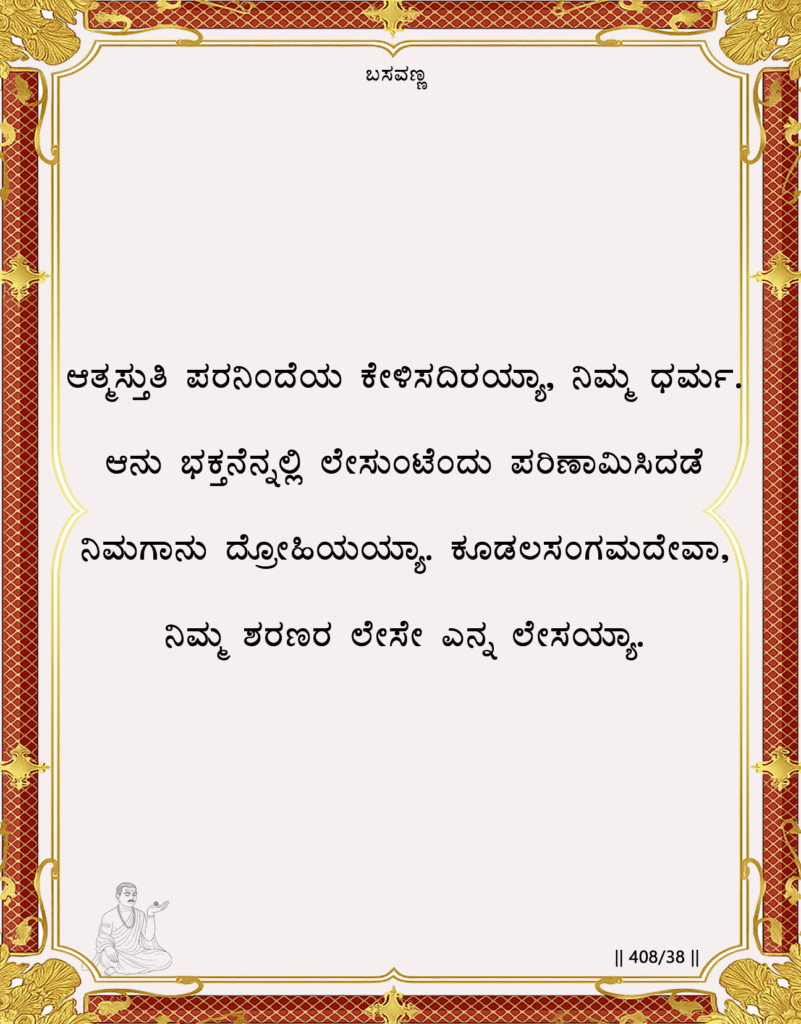
Do not let me praise myself,
nor lend my ears to the slander of others
this alone is Your dharma for me.
If I call myself a bhakta
yet hunger for honor and recognition,
am I not a betrayer of Your path?
O Kudalasangamadeva,
let the worth of Your sharanas
be the only worth I seek.
Basavanna prays to be free from self-praise and from listening to slander, calling both betrayals of true devotion. A real bhakta seeks no honor for himself; his only worth lies in walking humbly with the sharanas of Kudalasangamadeva.
Spiritual Context
Core Spiritual Principle: Authentic spirituality requires the annihilation of the “social ego” the constructed self that depends on self-promotion and the denigration of others for its existence. True devotion is a relationship of humility between the soul and God, which is violated by these egoic activities.
Cosmic Reality Perspective: The Linga is the one, non-dual reality present in all beings. Self-praise asserts a separate, superior self, violating this unity. Listening to slander means entertaining a narrative that denies the divine presence in another, also violating this unity. Both are acts of spiritual ignorance (Avidya).
Historical Reality (Anubhava Mantapa context): This vachana served as a vital rule for maintaining the integrity of the Sangha. Gossip and self-aggrandizement are toxins that destroy trust and create factions. By outlawing them, Basavanna ensures the community remains a unified field of practice, not a marketplace of competing egos.
Interpretation
1. The Twofold Prayer: “Do not let me praise myself, nor lend my ears to the slander of others” : This is a conscious guarding of both speech and hearing the two primary gates of interpersonal karma. Self-praise is the active expression of ego; listening to slander is its passive fuel, giving life to the ego’s game of comparison.
2. “this alone is Your dharma for me.” : This is a radical redefinition of righteousness. For Basavanna, the highest dharma is not a complex set of rules but this fundamental inner orientation of humility and unity-consciousness.
3. The Hypocrisy Exposed: “If I call myself a bhakta yet hunger for honor… am I not a betrayer?” : This is the core of the vachana. The word “betrayer” is powerful. It frames the desire for honor not as a minor flaw, but as a fundamental breach of trust in the relationship with the Divine. It is the ego usurping the place of God.
4. The Sublime Solution: “let the worth of Your sharanas be the only worth I seek.” : The remedy is not to seek no worth, but to transfer the source of one’s validation entirely. Instead of seeking personal honor, one should seek to embody the qualities of the enlightened Sharanas their humility, their devotion, their selflessness. Their worth becomes the aspirational standard.
Practical Implications: The seeker must practice constant vigilance. When the impulse to talk about oneself arises, or when someone begins to gossip, one must see it as a critical spiritual choice. The practice is to consciously redirect that energy inward toward self-improvement or outward toward praising the divine qualities in others.
The Cosmic Reality
Anga (Human Dimension): The individual ego, which is naturally oriented towards building and defending its social status through self-praise and judgment of others.
Linga (Divine Principle): Kudalasangama Deva as the silent, attributeless reality in which all such dualistic games of “better than/worse than” dissolve.
Jangama (Dynamic Interaction): The Jangama is the community of Sharanas, who live by this higher dharma. By seeking their worth, the Anga actively engages with a transformative field that systematically dismantles its own egoic structures.
Shata Sthala
Primary Sthala: Bhakta. This vachana is essential for the Bhakta, whose devotion must be purified of the ego’s desire to use God for self-glorification.
Supporting Sthala: Sharana. The state of wanting only the “worth of the Sharanas” is the mindset of one who is ready to dissolve their individual identity into the collective spirit of the Sangha, the hallmark of a Sharana.
Practical Integration
Arivu (Awareness): Cultivate awareness of the subtle energy of self-promotion and judgment. Notice the feeling of wanting to share an accomplishment to feel important, or the slight thrill when hearing negative news about someone.
Achara (Personal Discipline): Make a vow of authenticity and humility. Practice speaking only what is necessary and true, avoiding both self-praise and gossip. When praised, inwardly redirect that praise to the Divine.
Kayaka (Sacred Action): Perform your duties without attachment to credit. Let the quality of your work be your silent offering, not a billboard for your ego.
Dasoha (Communal Offering): Offer the “Dasoha of a pure atmosphere” to your community. Refuse to participate in or listen to gossip. Your disciplined speech and listening become a gift of peace and trust to all.
Modern Application
We live in the “Age of the Profile,” where self-branding, crafting a public image, and seeking likes and validation are the norm. Social media is a engine for both self-praise and the casual slander of “cancel culture.” This externalizes our sense of self to a pathological degree, creating anxiety and a fragile identity.
This vachana is an antidote to the modern identity crisis. It liberates us from the exhausting performance of being “someone.” It invites us to find our worth not in the fluctuating opinions of the social world, but in the timeless qualities of the heart humility, integrity, and service. It is the path to an authentic, unshakeable self that doesn’t need to be propped up by praise or the failure of others.
Essence
The tongue that boasts,
the ear that hears the blame,
But plays the ego’s hollow game.
Let others’ virtue be my only pride,
And in Your Saints, let my small self abide.
Metaphysically, this vachana deals with the Ahamkara (ego) and Mamata (mine-ness). Self-praise is Ahamkara in its purest form. Listening to slander is a form of Mamata over a narrative that makes “my” group or “my” self seem superior. The prayer is for the grace to erode these twin pillars of the false self. The “worth of the Sharanas” represents the Dharma inherent in a consciousness aligned with the Linga. By seeking this, the seeker’s mind is imprinted with Sattvic Samskaras (pure impressions) that naturally counteract the Rajasic (active, passionate) and Tamasic (dull, ignorant) tendencies of the ego.
Your character is defined not by what you say about yourself, nor by what others say about your rivals, but by what you silently strive to become. Invest your energy in embodying virtue, not in marketing a persona. The most respectable people are often those who never speak of their respectability.

Views: 0