Poetic Rendering
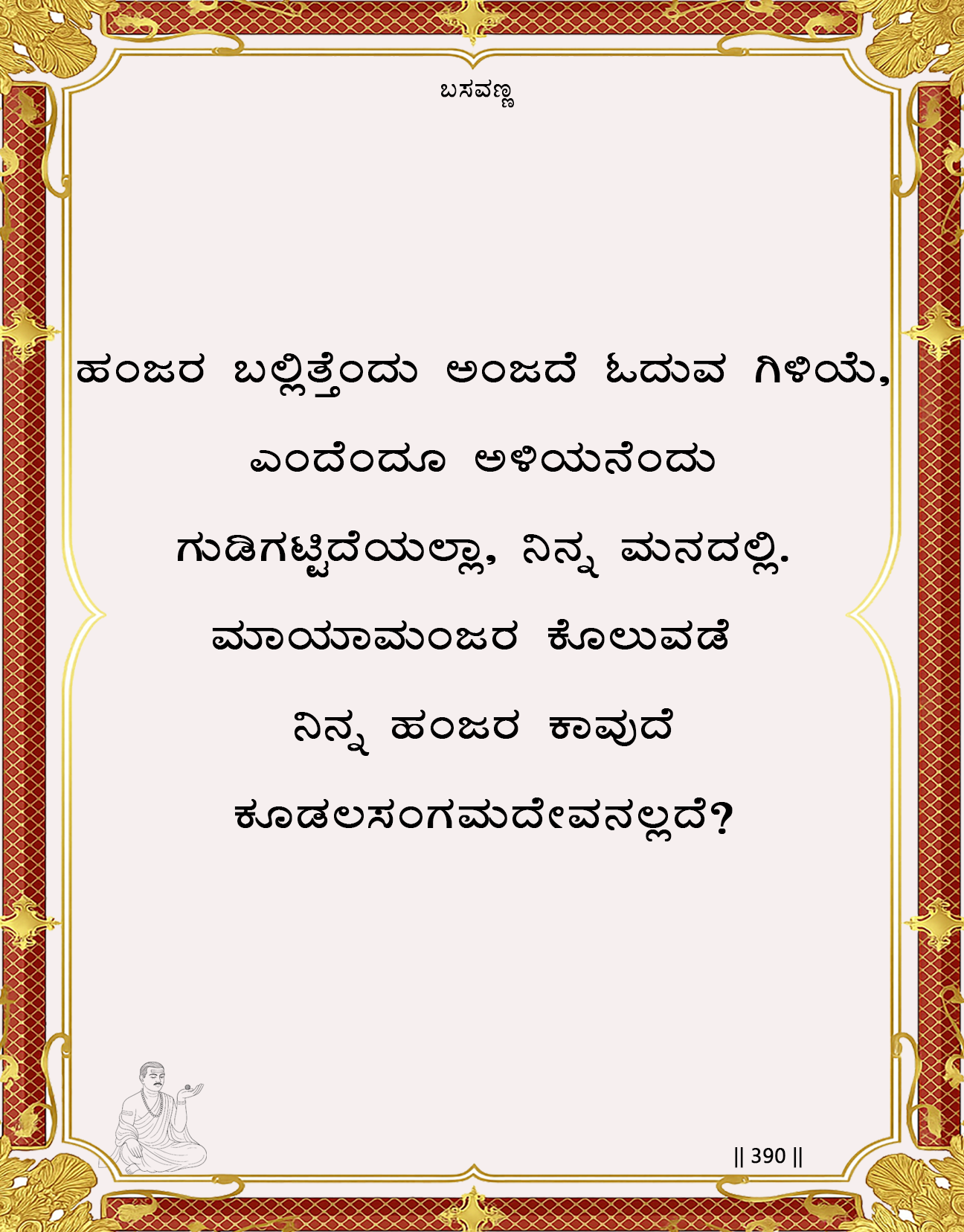
Like a parrot in a cage,
uttering borrowed words without knowing
so your mind repeats its chants,
trapped within the bars
of the very habits it has forged.
You have raised a fortress of ritual in your own mind,
stone upon stone of empty repetition.
But when the winds of truth break through
and your illusioned temple crumbles
to whom will you turn
if not to Kudalasangama?
In this vachana, Basavanna exposes the futility of mechanical spirituality. The Parrot: A Symbol of Mechanical Repetition A parrot can recite words, but cannot understand meaning. Likewise, a mind trapped in habitual chanting mistakes repetition for realization. Basavanna warns: mere utterance is not devotion. Meaning without embodiment is empty. The True Refuge When all illusions break, only the living presence of Kudalasangama the inner divine awareness remains as the real shelter. Core Insight A parrot’s voice may be loud, but only a heart awake can realize the Divine. Basavanna calls us from borrowed repetition to living experience, from ritual habit to fearless inner truth. The Cage: The Mind’s Self-Made Prison The cage is built not by others but by one’s own conditioned patterns: rote ritual inherited dogma spiritual mimicry unquestioned habit This “stone temple” in the mind feels secure, but it is an illusion of stability. The Collapse of Illusion When life shakes the foundations through suffering, crisis, or deep self-inquiry the false temple crumbles. Mechanical faith provides no refuge because it was never alive to begin with.
Spiritual Context
Core Spiritual Principle: Consciousness Precedes Form. The efficacy of any spiritual practice is nullified if performed without the animating presence of aware consciousness (Arivu). Ritual without understanding is spiritual automation; it reinforces the cage of the ego rather than liberating from it. True practice begins when form serves to awaken consciousness, not when it replaces it.
Cosmic Reality Perspective (non-dual, Shiva-Shakti dynamics): The parrot’s words are Shakti as raw, unassimilated sound energy. The cage is Shakti frozen into rigid, repetitive patterns (samskara). The silent understanding (the Linga/Shiva) is absent. For Shakti to be liberating, it must be consciously yoked to Shivathe sound of the mantra must be infused with the awareness of its source. The “storm” is a fierce, disruptive form of Shakti that destroys stagnant structures so that a new, conscious alignment (Shiva-Shakti as union) can emerge.
Historical Reality (Anubhava Mantapa context): This was a direct attack on the priestly orthodoxy of 12th-century Karnataka, which maintained religious authority through the exclusive, ritualized recitation of Sanskrit texts (inaccessible to the masses). The Lingayoga movement, by contrast, conducted its discourse in the vernacular and emphasized personal experience (Anubhava). This vachana empowered the common devotee: it declared that heartfelt understanding in one’s own language was superior to flawless but mindless recitation in a sacred tongue. It championed the living voice of experience over the dead letter of tradition.
Interpretation
1.”Like a parrot in a cage, uttering borrowed words without knowing…”: “Borrowed words” signifies second-hand spirituality beliefs, prayers, and doctrines adopted from others without personal verification. “Without knowing” highlights the absence of jnana (direct knowing) or arivu (awareness). The practice is alienated from the practitioner.
2.”…so your mind repeats its chants, trapped within the bars of the very habits it has forged.”: This reveals the self-perpetuating nature of the cage. The habit of mindless repetition forges the bars (neural and psychological pathways) that then trap the mind into further repetition. It is a closed loop of spiritual sleep.
3.”You have raised a fortress of ritual in your own mind, stone upon stone of empty repetition.”: The “fortress” is a more grandiose illusion than the cage. It represents the pride and perceived security found in ritual proficiency and religious identity. Yet, it is built with “empty” material actions devoid of transformative substance.
4.”But when the winds of truth break through and your illumined temple crumbles to whom will you turn…?”: The “winds of truth” are the unavoidable realities of life: death, loss, failure, or the simple, piercing doubt that asks, “Is this all there is?” These forces test the structural integrity of one’s spiritual life. The rhetorical question forces the seeker to confront the insufficiency of their current refuge.
The Cosmic Reality
Anga (Human Dimension): The Anga as a recording device. It can play back beautiful, pre-recorded spiritual programs (parrot), but it lacks the live microphone of direct experience that connects it to the present source (the Linga).
Linga (Divine Principle): The Linga is the silent broadcast studio from which all true sound originates. The parrot’s cage is a receiver tuned to a recording, not to the live broadcast. The Linga’s truth is the live signal that can only be received by a consciousness awake in the present.
Jangama (Dynamic Interaction): The Jangama is the act of switching from “playback” mode to “live reception” mode. It is the storm that smashes the recording device, forcing a direct, unmediated search for the signal itself.
Shata Sthala
Primary Sthala: Bhakta. The portrait is of a Bhakta who has misconceived devotion as external performance. Their practice lacks the inner dimension of viveka (discernment) and arivu (awareness), which are necessary to evolve beyond this stage.
Supporting Sthala: Prasadi. The crumbling of the self-built fortress is the classic entry point for Prasadi. When one’s own efforts (building the fortress) are revealed as futile, the heart opens in helplessness to receive the grace that is the only true shelter.
Practical Integration
Arivu (Awareness Practices): Transform repetition into inquiry. If you chant a mantra, pause after each cycle. Rest in the silence that follows. Ask: “Who chanted? What is aware of this silence?” Use the chant not as an end, but as a tool to reveal the chanter.
Achara (Personal Discipline): Audit your spiritual routines. Identify one practice that has become purely habitual. For one week, perform it with total, slow, questioning attention. If you cannot bring awareness to it, consider stopping it to create space for something more conscious.
Kayaka (Sacred Action): Let your work be a practice of breaking the “parrot” pattern. Instead of doing your job by rote, bring fresh, creative attention to each task. Let your labor be a live expression of your present capacity, not a repetition of yesterday’s motions.
Dasoha (Communal Offering): In your spiritual community, encourage sharing of authentic struggle and questioning, not just perfected insights. Create a space where the “crumbling of the temple” can be shared without shame, met with support that points toward the true refuge (Kudalasangama), not just toward pat answers.
Modern Application
“The Algorithmic Parrot and the Digital Cage.” Our modern “cages” are the echo chambers of social media, the mindless scrolling of algorithmic feeds, and the consumption of endless spiritual content (podcasts, videos) without dedicated, silent practice. We parrot opinions and trends, building fortresses of online identity that are shattered by real-world intimacy or crisis.
This vachana prescribes a digital and cognitive detox. It urges us to replace passive consumption with active inquiry, to choose depth of practice over breadth of knowledge. It suggests that during times of personal crisis, we must log off and turn inward, allowing the storm to clear the clutter of borrowed ideas so we can hear our own inner truth, which is the voice of Kudalasangama.
Essence
A parrot in a gilded cage may speak a holy name,
But knows not of the sky from which the sacred came.
You build with practiced rite a wall both deep and wide,
To keep the fearful storm of living truth outside.
But when that wall is breached by grief you can’t control,
And rote and ritual fail to comfort your deep soul,
You’ll find the borrowed words you traded like a coin
Are hollow, and your crafted temple’s joints are loaned.
Then turn not to a phrase, a habit, or a book
But to the Living Source, the one true, steady Hook.
This vachana illustrates the psychological principle of functional fixedness applied to spirituality. The mind becomes fixated on the instrumental function of a practice (e.g., chanting to gain merit or peace) and loses sight of its ultimate purpose (liberation, self-knowledge). The practice itself becomes the cage. The “storm” creates a Eureka effecta sudden cognitive restructuring where the seeker sees the cage as a cage and the tool as a trap, forcing a search for the true goal beyond the fixated-upon instrument.
Imagine someone diligently polishing a key every day, believing the polishing itself is the goal. They live in a locked room but never think to use the key to open the door. The “storm” is someone shouting that the house is on fire. In their panic, they drop the polishing cloth and finally see the key as a key. Basavanna says: your rituals are the polishing. Liberation is the open door. Don’t wait for the fire to realize the difference.
We crave the comfort of routine and the certainty of known paths. Spirituality often becomes our most cherished routine. This vachana compassionately warns that this very comfort can become our prison, and that true grace often comes dressed as disruption. It teaches that the purpose of spiritual practice is not to build a better, more impressive cage, but to develop the awareness that we were never truly caged only hypnotized by the bars we built ourselves. The laughter of Vachana 388 and the storm of Vachana 390 are the same divine compassion, working to startle us awake.

Views: 0