Poetic Rendering
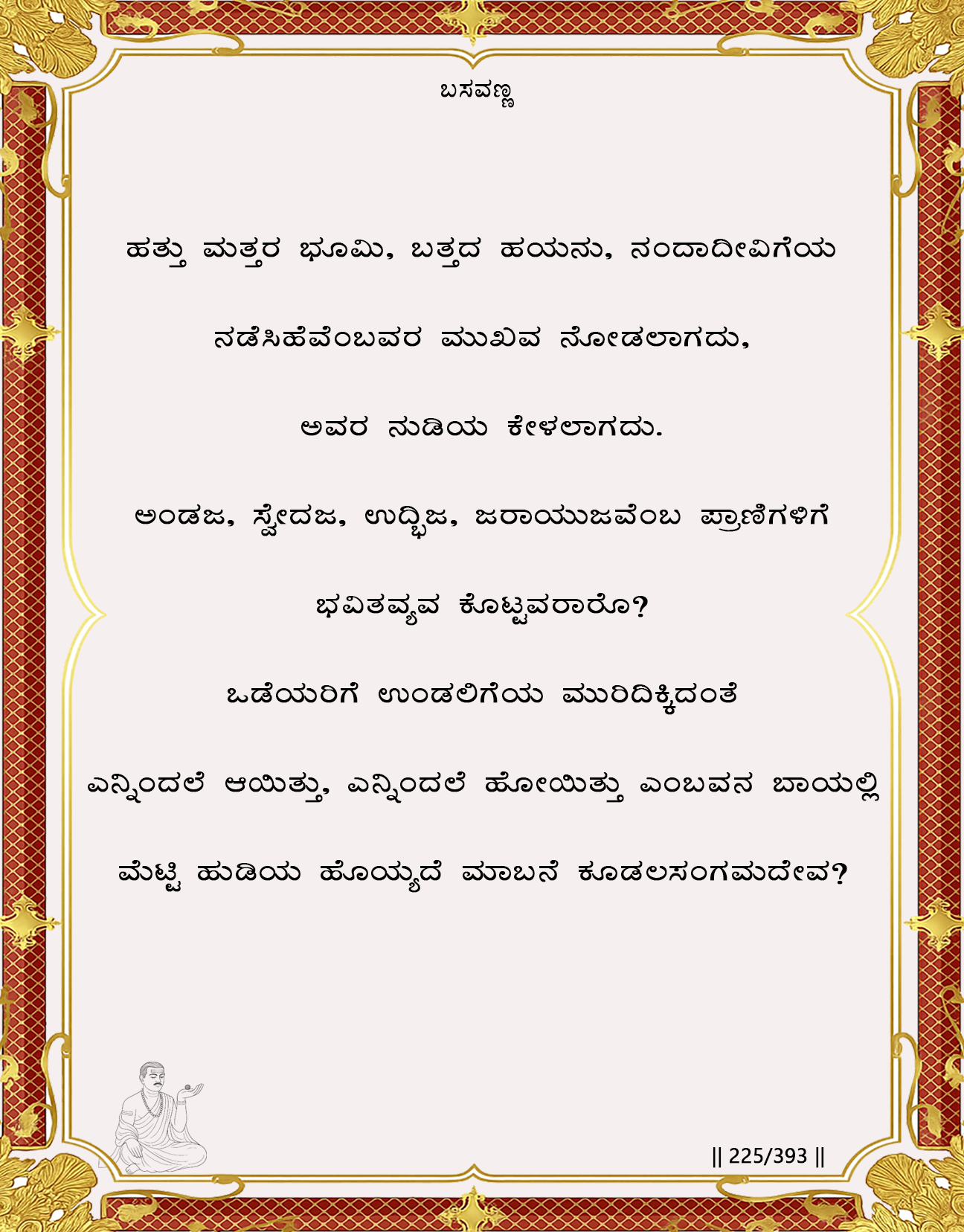
You claim: “These fifty acres,
these fields of grain,
these wealth-giving lands
all prosper only because of my sacred lamp,
my rituals, my offerings.”
We cannot bear to hear such words.
Life that is born of the womb,
life that emerges from the egg,
life that rises from sweat and damp earth
tell me, who sustains all these?
Who provides their food, their breath,
their unending flow of life?
It is like a tenant offering
a chipped lump of jaggery
to the landlord
yet boasting as though
he himself owns the estate.
And so the wealthy strut,
like the rooster that crows at dawn,
believing that his cry makes the sun rise.
In this arrogance
“I did this, I created this,
I sustain this”
their pot of prosperity
cracks and falls apart.
Is this not so,
O Kudalasangama?
In this vachana, Basavanna dismantles one of the deepest spiritual illusions: the belief that human beings are the true owners and creators of anything. The Vachana’s Core Message Basavanna reveals a profound truth of the Sharana path:• We are not owners; we are tenants. • We are not creators; we are participants.• Life, wealth, and opportunity are gifts held in trust, not trophies of the ego. To forget this is to live in delusion; to remember it is to walk in grace. The Boast of Ownership Basavanna mocks the arrogance of those who say their rituals, wealth, or power are what sustain the land, crops, and prosperity. He calls this claim unbearable, because: • No ritual creates life. • No human controls its origins. Life emerges from womb, egg, sweat, soil without asking anyone’s permission. 2. The Tenant Who Believes He Owns the Land Basavanna gives a sharp analogy: A tenant offers a broken piece of jaggery to the landlord, yet struts around as though he owns the entire estate.
This mirrors human behavior: We offer tiny gestures to God, yet claim credit for vast blessings that are not of our making. The Rooster Who Thinks His Crowing Brings the Dawn The most devastating image: The wealthy strut like roosters, believing the sun rises because they crow. This is the pinnacle of ego-delusion: confusing participation with authorship, thinking one’s small actions control the cosmos. 4. The Pot of Prosperity Shatters Basavanna warns that this arrogance “I did this, I built this, I sustain this” creates fractures in the foundation of one’s life. The “pot of prosperity” breaks from within. True prosperity comes only through humility and alignment with the Divine, never through egoic self-claim.
Spiritual Context
Core Spiritual Principle: True spiritual progress begins with the dissolution of ahamkara (ego-sense) as the perceived doer and owner. Prosperity is a flow of grace, not a product of personal effort. Claiming authorship severs one from that flow, while humility restores it.
Cosmic Reality Perspective: In the non-dual Shivayoga view, all action (kriya) is the play of Shakti, and all agency (kartrtva) belongs to Shiva. The arrogant individual mis-identifies with a fragment of this cosmic energy, claiming “I am the doer.” This is a fundamental forgetfulness (avidya) that creates a sense of separation and leads to karmic entanglement.
Historical Reality (Anubhava Mantapa Context): This vachana directly targets the ritualistic priesthood and landed aristocracy of 12th-century Kalyana, who claimed that their Vedic rites and managerial control were the sole cause of societal prosperity. Basavanna, from his position as treasurer, exposes this as a delusion that justifies hierarchy and exploitation. The Anubhava Mantapa countered by teaching that sustenance comes from divine grace manifesting as communal labor (Kayaka) and sharing (Dasoha), not from ritualistic claims.
Interpretation
1.The Boast: “These fifty acres prosper only because of my sacred lamp…” This is the ego’s inflation through identification with its role, rituals, and assets. It mistakes a temporary, contingent function for its core identity and claims creative power.
2.The Question: “Life that is born of the womb… who sustains all these?” This shifts focus from human artifice to autonomous life force (prana). It points to the mysterious, divine sustenance operating seamlessly in all forms of life, utterly independent of human claims.
3.The Tenant Analogy: The tenant offering a “chipped lump of jaggery” symbolizes the meagerness and imperfection of the human offering (ritual, effort). Strutting as the “owner” symbolizes the gross inflation of the ego. The self is always a tenant in the body, on the land, within the cosmos.
4.The Rooster Analogy: The rooster’s crow and the sunrise represent the classic confusion of correlation with causation. The ego, observing its action (kriya) alongside a cosmic event, arrogates causality (karana) to itself. This is the pinnacle of epistemological error.
5.The Shattering Pot: The “pot of prosperity” cracks from the internal pressure of arrogance. Metaphysically, when the limited ego claims infinite agency, it creates a structural flaw in its own being. The container of grace cannot hold when it believes it is the source.
Practical Implications: One must cultivate the constant inner refrain: “I am not the doer” (na ham kartā). This is not passivity but an attitude of offering all action and its results to the Linga. Success should trigger gratitude, not pride; failure should trigger surrender, not shame.
The Cosmic Reality
Anga (Human Dimension): The human as the mistaken owner/doer the tenant, the rooster. This is the contracted identity living in the delusion of control, whose speech is filled with “I,” “my,” and “mine.”
Linga (Divine Principle): Koodalasangamadeva as the fundamental reality the true Owner, the Sun, the silent Sustainer of all life processes. The Linga is the uncaused cause, the silent background against which the ego’s noisy claims are rendered absurd.
Jangama (Dynamic Interaction): The process of reality itself humbling the ego. It is the dynamic where life’s events both prosperity and loss serve to expose the ego’s claims as false. The Jangama is the corrective movement from arrogance to humility, facilitated by the grace that flows when claims of ownership cease.
Shata Sthala
Primary Sthala: BHAKTA. This vachana is a crucial teaching for the Bhakta, who is often entangled in ritualistic piety and the pride of being a “devotee.” The Bhakta must learn that true devotion is not a transaction (“my ritual for your reward”) but a surrender that negates the “my.” The warning against arrogance is essential to prevent stagnation at this stage.
Supporting Sthala: MAHESHWARA. The Maheshwara stage involves the fiery purification of all inner defilements. The primary defilement addressed here is dambha (hypocrisy/ostentation) and ahanikara (egoism). The vachana provides the discernment needed for this purification: scrutinize every thought and claim for the hidden tenant’s arrogance.
Practical Integration
Arivu (Awareness Practices): Practice “source awareness.” With every breath, meal, or accomplishment, consciously trace it back: “This breath is given, this food is grown by the earth and sun, this success is built on the work of countless others.” Mentally offer the credit upstream.
Achara (Personal Discipline): Adopt a discipline of humble speech. Minimize the use of “I” in boasts. Develop a practice of silent gratitude before enjoying any possession or achievement. Acknowledge contributors openly.
Kayaka (Sacred Action): Perform your duty as an instrument. Before work, dedicate the action to the Linga; after work, offer the results. See your role not as that of an owner-builder, but as a caretaker-gardener in a vast estate that is not yours.
Dasoha (Communal Offering): Give in a manner that erases the giver. Anonymous giving, or giving where thanks is directed to the community or the divine principle, helps shatter the ego’s claim of being the benefactor.
Modern Application
The “self-made” myth in entrepreneurship, the cult of celebrity, and the personal branding paradigm are all manifestations of the tenant’s arrogance. “Influencer” culture is the ultimate rooster’s crow. In spirituality, it appears as teachers claiming special powers or lineages claiming exclusive truth.
Foster systems and cultures of acknowledgment academia (citation), business (recognizing teams), and art (honoring inspiration). Practice “ego-ecology”: reduce the mental footprint of the self-claim. Find liberation in the relief of not having to be the source of everything, embracing interdependence and receiving life as a participatory gift.
Essence
The crow that claims to summon sun,
The boast that work was mine alone,
Are cracks that spread till vessels break.
True wealth is held in trust, awake
A humble cup, for grace to fill,
When silent we abide, and still.
This vachana describes the metaphysics of misattributed causation. In the multidimensional self, the surface-level ego-mind (Anga) is a receiver-processor of data and energy from deeper layers (Linga). It mistakes its processing activity for generative activity. Like a computer’s user interface believing it creates the calculation happening in the CPU, the ego experiences correlated events and claims causality. The “cracking pot” is the system error that occurs when this misattribution creates a feedback loop of inflation, overloading the local processor and severing its connection to the core source code.
Imagine a child holding a magnet under a table, moving iron filings on top. The filings move because of the magnet, but the child shouts, “Look, I’m making them dance!” The adult (aware of the magnet) smiles. Basavanna points to the hidden magnet (Linga) and warns the child that boasting will not make the filings dance better; it might make him drop the magnet altogether.
We are hardwired to seek agency and control to mitigate existential anxiety. This vachana confronts us with the terrifying, liberating truth that our deepest need for security cannot be met by amplifying the fiction of our control, but only by surrendering to the reality of a sustaining source greater than ourselves. The tension is between the ego’s desperate autobiography and the soul’s true biography written by grace. Peace is found when we stop claiming authorship and become joyful readers of that grander story.

Views: 0