Poetic Rendering
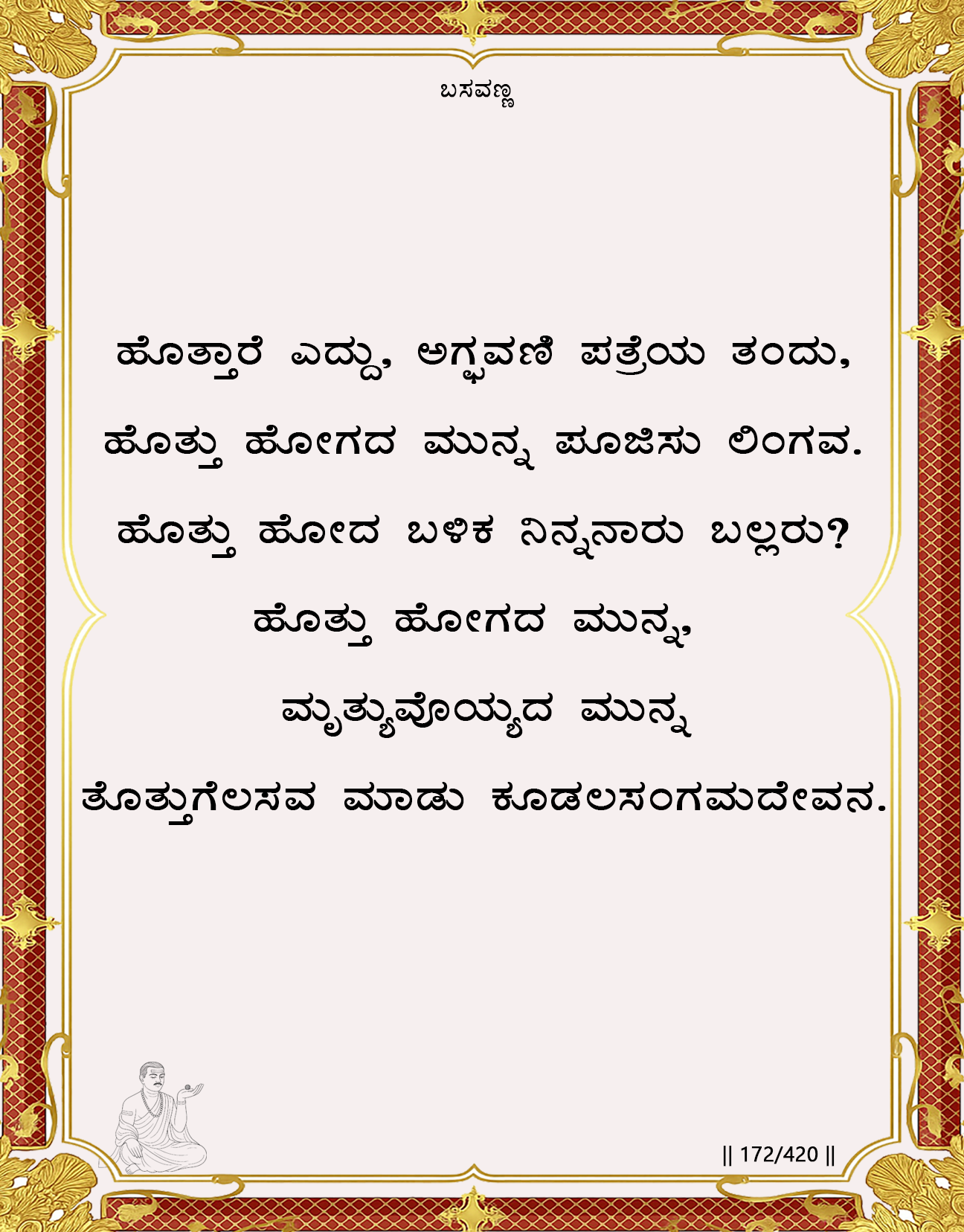
Wake at dawn;
offer fresh leaves that fade
even as you touch them
your own body fades the same.
Before death spreads its shadow
and no one remembers your name,
do your worship now,
Kudalasangamadeva.
Basavanna urges the seeker to abandon delay and recognize the fleeting nature of the body. Like the fresh leaves that begin to wither the moment they’re plucked, life is already moving toward its end. Therefore, devotion cannot be postponed. There is no “later,” no guaranteed tomorrow. The present moment is the only altar on which true spiritual practice can be offered.
Spiritual Context
Core Spiritual Principle: Kshanika Sadhana – The Principle of Instantaneous Practice. Realization is not a distant achievement but a quality of attention applied in the immediate present. Since both the worshipper and the offering are in constant decay, the only spiritually valid time is now; delay is a form of self-deception rooted in ignoring death (mrityu-ajñana).
Cosmic Reality Perspective: From the non-dual view, Shiva (the eternal) and Shakti (the power of time and manifestation) are inseparable. To deny the pressing urgency of Shakti’s flow (decay, death) is to deny a fundamental aspect of the Divine itself. True worship is aligning with the eternal within the transient, not using the transient as an excuse to avoid the eternal.
Historical Reality (Anubhava Mantapa Context): This vachana counteracts priestly and ritual complacency that could schedule spirituality for later. For Basavanna’s revolutionary community, enlightenment was an urgent, personal necessity. It fueled the ethos of kayaka seeing every moment of labor as an immediate offering and created a community of practitioners, not procrastinators.
Interpretation
“Wake at dawn” is not merely a daily instruction but a metaphor for spiritual awakening to the truth of impermanence. The “fresh leaves” represent not just ritual offerings but all of one’s faculties senses, mind, energy which are vibrant yet decaying with each passing second. Offering them “that fade even as you touch them” means consecrating life as it is vanishing, making the act of disappearance itself the sacred gesture. “Before death spreads its shadow…” confronts the ultimate motivator: the impending erasure of the individual ego-mind (“no one remembers your name”).
Practical Implications: Every moment of awareness must be treated as the final moment available for sincere offering. Procrastination in spiritual practice is exposed as a fatal error. This creates a gentle but immense pressure to simplify, to prioritize, and to drop all pretense and delay in one’s approach to the Divine.
The Cosmic Reality
Anga (Human Dimension): The body-mind in its undeniable process of decay. It is not a stable entity but an event of dissolution. Its defining characteristic is its “fading” nature, making it the perfect, urgent raw material for offering.
Linga (Divine Principle): Koodalasangamadeva as the ever-present, timeless “now” that underlies the flow of time. It is the only stable reference point, the background against which the fading of the leaves becomes vividly clear and spiritually significant.
Jangama (Dynamic Interaction): The Jangama is the conscious pivot from passive observation of decay to active offering of that decay. It is the movement where the dying leaf (the Anga) is placed in the fire of the present moment (the Linga). This interaction is worship not as a routine, but as a life-and-death necessity.
Shata Sthala
Primary Sthala: Bhakta. This is the core discipline of the Bhakta: transforming devotion from a sentimental or planned future activity into a relentless, present-tense engagement. The Bhakta’s love is tested by their willingness to act on it immediately, without guarantee of a tomorrow.
Supporting Sthala: Sharana. To act with this urgency is to take total refuge (Sharana). One surrenders the fantasy of a long, self-directed future and places one’s entire being at the disposal of the Divine in this breath, this moment. It is the practical enactment of refuge.
Practical Integration
Arivu (Awareness Practices): Practice moment-to-moment awareness of decay: the end of a breath, the passing of a thought, the aging of your face in the mirror. Use this not for morbidity but as the “dawn” that wakes you up. Ask: “If this were my last conscious moment, how would I offer it?”
Achara (Personal Discipline): Let your primary discipline be immediacy. When a call to pray, meditate, or study arises, do not schedule it honor it as immediately as possible. Simplify rituals to their essence so they can be performed anywhere, anytime, with the “fresh leaves” at hand.
Kayaka (Sacred Action): Perform each task as if it were the last time you could perform it. Infuse it with the care and completeness of a final offering. See the “fading” of the task’s completion as part of its beauty.
Dasoha (Communal Offering): Remind your community of this precious impermanence with kindness. Create gatherings and spaces that feel immediate and vital, not routine. Help others wake from the slumber of “someday.”
Modern Application
We live in the culture of “later.” Spiritual practice is deferred for after career goals, after retirement, after the kids leave. Life is spent in a state of perpetual preparation, numbed by digital distraction, while the “leaves” of our health, relationships, and vitality wither unnoticed in our hands.
This vachana liberates by injecting the profound urgency of death into daily life, not as a threat, but as the ultimate organizer of priorities. It frees you from the tyranny of a hypothetical future. It declares: Your spiritual life is not a project for retirement; it is the quality of your attention right now. The anxiety about not having enough time is solved by fully inhabiting the time you have.
Essence
The leaf is plucked, the curl has begun,
The race is over ere it’s run.
Why build an altar for tomorrow’s stone?
The fading leaf, the breath, the bone
This is the shrine, and this alone.
Now. Before the shadow finds its throne.
This vachana describes the metaphysics of the space-time interval. In spiritual relativity, the contracted ego lives in a dilated, imaginary future (“someday”). Basavanna collapses this time-like interval into a light-like or space-like interval where the world line of the seeker must intersect directly with the world line of the Divine in the present event. The decaying body is the clock measuring proper time until that intersection; delay increases the interval to the point of never intersecting. Worship now is achieving that convergence event.
You are a candle already burning down. You can spend your wax reading about light, planning a grand ceremony to ignite a bigger candle later, or you can use the flame you have right now to light up the room. The wisdom is in knowing the candle is lit at both ends.
We avoid the present moment because it contains the undeniable reality of our limitation and our end. We hide in the fantasy of an unlimited future. This vachana reveals that the very thing we avoid our fragility and finitude is the sacred fuel. The present moment is not ordinary; it is the razor’s edge where eternity meets decay, and where you get to choose which one you serve.

Views: 0