
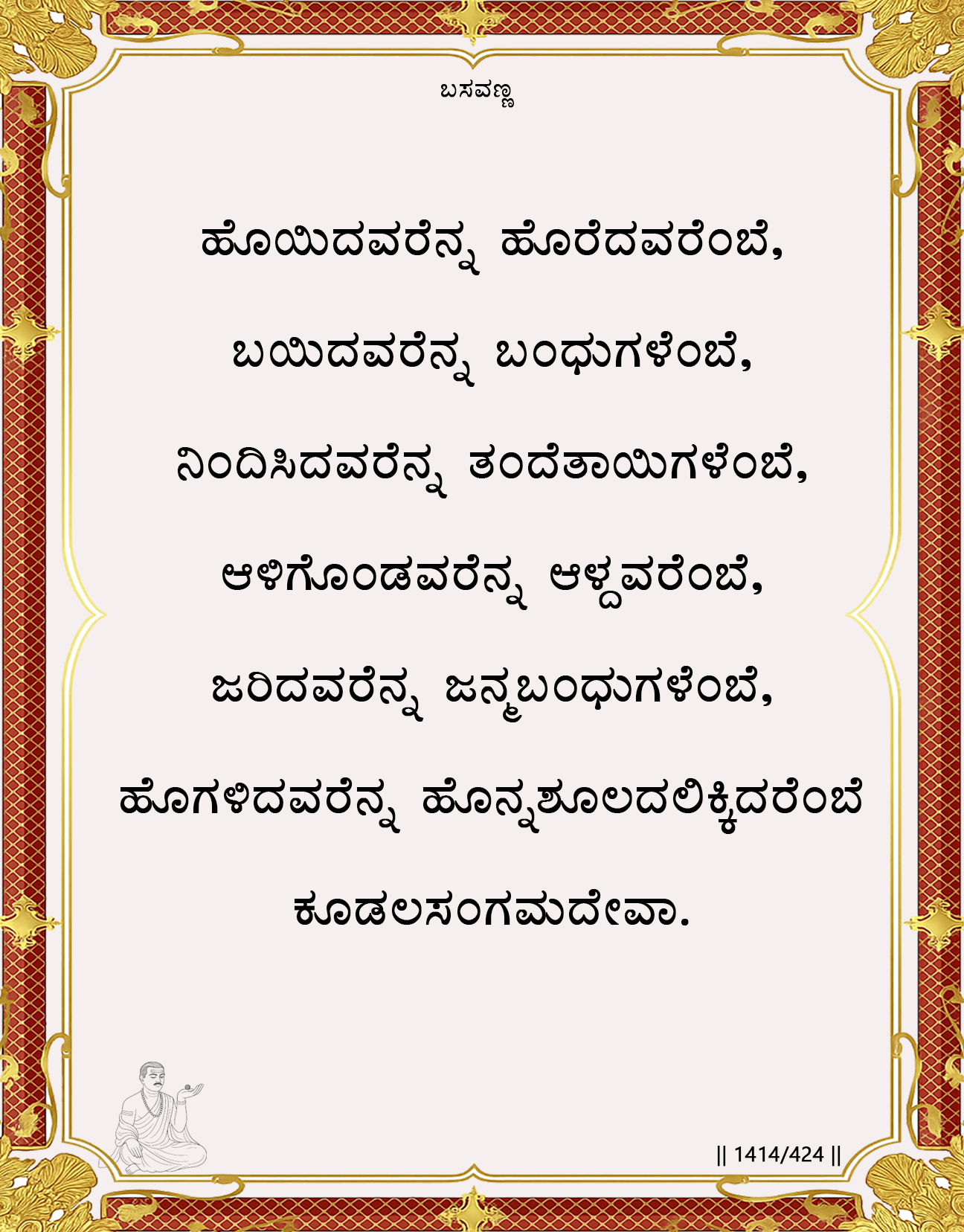
Poetic Rendering

Those who praise me, I call strangers.
Those who do not scold me, I call mere acquaintances.
Those who scold me, I call my parents.
Those who rule over me, I call my lords.
Those who trouble me, I call my true guides.
Those who appreciate me without knowing my inner truth,
are a golden noose at my throat.
So speaks the wisdom of Koodalasangama.
The Inversion of Worldly Values. This vachana is a radical manifesto on spiritual discernment, systematically inverting all conventional social and emotional relationships. In the world, praise is sought, comfort is desired, and trouble is avoided. For the Śharaṇa on the path, these values are a dangerous trap that reinforces the ego (Aṅga) and its illusions. Basavanna redefines every human interaction based on a single criterion: Does this act as a mirror, revealing my faults and burning my ego, or does it act as a painting, covering my imperfections and decorating my self-image? True kinship is redefined not by blood or affection, but by a person’s capacity to serve as an instrument of the Divine (Jangama) for the seeker’s liberation.
Spiritual Context
Core Spiritual Principle: Viparīta-Bhāva Sādhana – The Practice of Inverted Perception. Spiritual growth requires consciously inverting the ego’s natural preferences. What the conditioned self flees (criticism, trouble) is to be embraced as grace; what it seeks (praise, comfort) is to be rejected as poison. This is active alchemy of perception.
Cosmic Reality Perspective: This reflects the non-dual play of Shiva-Shakti where everything serves liberation. The fierce, dissolving aspect of Shakti (raudra-shakti) is as divine as the gentle, nourishing aspect. To reject the fierce forms it takes (in critics, troubles) is to reject a fundamental expression of the Divine meant for your dissolution into Shiva.
Historical Reality (Anubhava Mantapa Context): This was the operational manual for interpersonal ethics in the spiritual commune. It transformed the community into a “soul-forge” where flattery was treason and loving, fierce criticism was the highest form of dasoha (communal offering). It ensured the community’s collective power was directed toward liberation, not mutual comfort.
Interpretation
Each couplet is a precise surgical strike on a specific egoic attachment. “Strangers” (praisers) relate to your mask, not your core. “Acquaintances” (non-scolders) enable spiritual stagnation through polite complicity. “Parents” (scolders) perform tapas (austerity) on your behalf by risking relational comfort to correct you. “Lords” (rulers) break the tyranny of self-will, the root of the ego. “True Guides” (troublers) are the most potent Jangamas, using friction to generate the heat necessary for transformation. The “golden noose” is the most insidious: appreciation based on your false image is a beautiful, gilded spiritual death.
Practical Implications: One must actively re-educate emotional reactions. The sting of criticism should trigger gratitude; the flush of praise should trigger vigilant self-inquiry. Your social circle must be evaluated not by how it makes you feel, but by how truthfully it reflects you.
The Cosmic Reality
Anga (Human Dimension): The reactive psyche that organizes the world into “for me” (pleasant) and “against me” (unpleasant). Its entire framework of judgment is revealed as backwards, requiring a 180-degree turn in its fundamental interpretive mechanism.
Linga (Divine Principle): Koodalasangamadeva as pure, uncompromising Sat (Truth). It is the ultimate “Parent” and “Lord” whose only aim is the revelation of this truth within the Anga, a process indifferent to the Anga’s temporal comfort.
Jangama (Dynamic Interaction): The Jangama is the Divine in motion, using the entire field of relationships as its medium. Every person becomes a potential Jangamaa wandering, dynamic expression of grace based solely on how their interaction impacts your consciousness. The critic is a Jangama delivering the grace of clarity.
Shata Sthala
Primary Sthala: Bhakta. This vachana is the advanced manual for the Bhakta. True devotion (bhakti) is not sentimental love for God, but the fierce love of Truth that welcomes every experience that burns away illusion, even when it comes disguised as human opposition.
Supporting Sthala: Maheshwara. The stage of Maheshwara involves righteous duty and submission to order. Here, accepting the “rule” of just authority and the “scolding” of a true guide is the achara (discipline) that shapes the raw Bhakta into a refined instrument for higher stages.
Practical Integration
Arivu (Awareness Practices): Practice “emotional inversion” meditation. When hurt by criticism, immediately ask: “What truth is being shown to me?” When pleased by praise, ask: “What falsehood is being reinforced?” Become a detective of your own reactions.
Achara (Personal Discipline): Seek out and cherish relationships with “true guides” those who will tell you the hard truth. Make it a discipline to thank those who trouble you. Consciously minimize time spent with “strangers” who only flatter.
Kayaka (Sacred Action): In your work, welcome constructive feedback as the most valuable payment. See difficult colleagues or clients as your most important spiritual trainers, assigned to burn away your professional pride and impatience.
Dasoha (Communal Offering): Offer the gift of truthful, compassionate mirroring to others. Have the courage to be a “parent” or “guide” to fellow seekers when you see their blind spots, and do so with the pure intent of service, not judgment.
Modern Application
We live in a “praise economy” (likes, positive reviews, curated identities) and actively avoid “negative” interactions. Therapy and self-care can be misused to seek perpetual comfort, silencing the necessary voices that challenge our growth. We are surrounded by “golden nooses” of validation that strangulate authentic selfhood.
This vachana liberates you from the exhausting game of seeking approval and avoiding conflict. It reframes your entire social world as a benevolent, if severe, training ground. Your “enemy” becomes your greatest benefactor. It solves relational anxiety by giving you a tool to metabolize all feed back positive and negative as fuel for awakening. Conflict becomes grace.
Essence
The friend who flatters builds a cage,
The foe who faults turns the page.
The comfort that you clutch so tight
Is but the prolonging of the night.
Embrace the blow that breaks the shell,
For in that crack, the truth can dwell.
Your family are the ones who tell.
This vachana describes the spiritual immune system. Praise and comfort are antigens that the egoic immune system readily accepts, leading to autoimmune disease (self-inflation, stagnation). Criticism and trouble are perceived as foreign pathogens, but they are in fact vaccines or therapeutic viruses that trigger the production of “truth antibodies.” By willingly exposing itself to these “pathogens,” the consciousness builds resilience and wisdom, ultimately becoming immune to the false self.
If your mind is a garden, flatterers are weeds that look like flowers, choking your true growth. Critics are the gardeners who prune you, and troublemakers are the storms that test your roots. Fire the landscapers who only plant weeds; thank the pruners and the weather.
We are wired to seek belonging and avoid rejection. This vachana reveals that true belonging is found not in the crowd that cheers your persona, but in the fierce embrace of those who care enough to see through you. Our deepest fear is being truly seen and found wanting; this vachana says that only through that terrifying exposure can we be found, and freed.

Views: 0