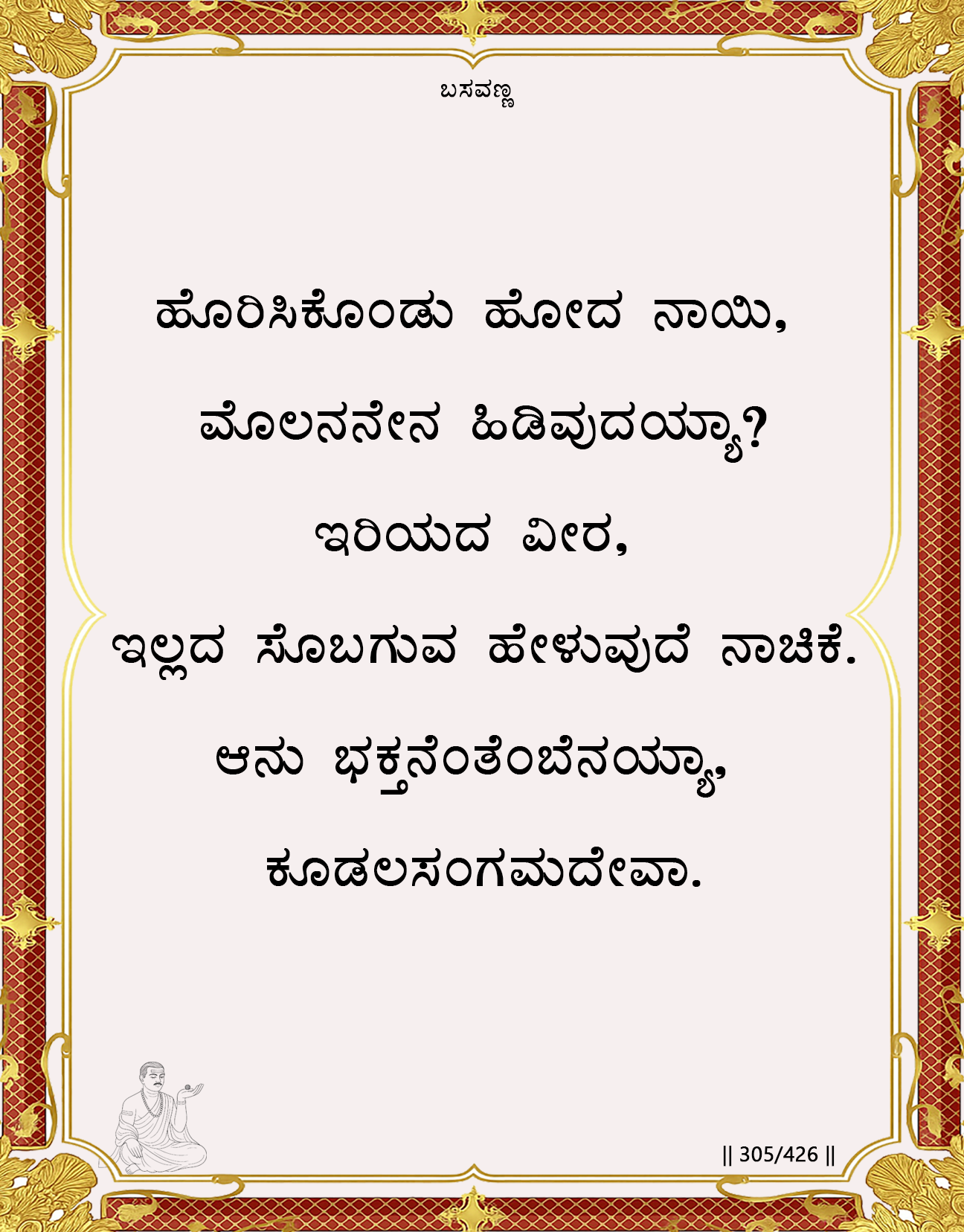
Poetic Rendering
A dog in a palanquin
will it ever learn to hunt?
Carried by borrowed pride,
it only barks in delusion.
How can such a one be called a bhakta?
O Kudalasangama,
make me free of this false dignity.
Basavanna exposes the emptiness of borrowed spirituality through the striking image of a dog carried in a palanquin. Just as the dog gains no real skill or dignity from being lifted up, a seeker who relies on status, lineage, or external religious display gains no true spiritual worth. Without inner discipline, humility, and personal experience of the Divine, devotion becomes hollow. The vachana calls for the dissolution of ego, pretense, and second-hand spirituality, urging the seeker to return to authentic practice rooted in humility before Kudalasangama.
Spiritual Context
Core Spiritual Principle: Sva-Anubhava Adhikara – The Principle of Personal Experiential Authority. Spiritual authority and the title of bhakta are conferred solely by direct, personal experience (anubhava), never by proxy, inheritance, or scholarly acquisition. The path demands the full, vulnerable engagement of the individual consciousness; any buffer (the palanquin) that separates the seeker from the raw ground of experience is an obstacle.
Cosmic Reality Perspective: In Shiva-Shakti dynamics, Shakti is the active, seeking power of consciousness. To place this power in a “palanquin” a contrived, elevated identity is to distort its natural function of movement and engagement. It creates a static, isolated node that interrupts the flowing circuit of consciousness seeking its source (Shiva). The “bark” is the dissonant energy emitted by this disconnected node.
Historical Reality (Anubhava Mantapa Context): This was a targeted critique of the Brahminical monopoly on spiritual authority, which was based on birth (jati) and mastery of texts (shastra), not personal realization. It democratized spirituality by asserting that the “dog” (any human being) who actively “hunts” (engages in sincere sadhana) is infinitely superior to the one carried by priestly or scholarly palanquins. It protected the community from internal hierarchies based on empty prestige.
Interpretation
The “dog” represents the primal, undecorated human consciousness, which possesses the innate instinct (samarthya) for spiritual pursuit. The “palanquin” is the entire superstructure of ego: social status, religious title, intellectual pedigree, or even a polished spiritual persona. The two are fundamentally incompatible; the palanquin’s luxury destroys the dog’s functional capacity. “Borrowed pride” is the specific poison a sense of worth derived from association rather than attainment. The final plea (“make me free of this false dignity”) is the crucial turning point: the recognition that the palanquin is not a benefit but a prison, and freedom lies in leaping out of it to touch the earth.
Practical Implications: One must vigilantly identify one’s own “palanquins” the credentials, identities, and comforts that allow one to avoid the humble, gritty work of authentic self-confrontation and seeking. Spiritual practice begins with the voluntary abandonment of these false supports.
The Cosmic Reality
Anga (Human Dimension): The consciousness that has consented to be “carried.” It has traded its agency and its functional integrity for the comfort and illusion of elevation. It is in a state of profound disconnection from its own ground and purpose.
Linga (Divine Principle): Koodalasangamadeva as the wilderness, the terrain of the “hunt.” It is the reality that can only be known through direct, unmediated encounter. It does not recognize palanquins; it responds only to the genuine seeker moving on their own feet.
Jangama (Dynamic Interaction): The Jangama is the “hunt” the dynamic, often arduous process of seeking, stumbling, and tracking. In this metaphor, the Jangama is completely absent, replaced by the static, artificial conveyance. The vachana is a call to restore the Jangama by destroying the palanquin.
Shata Sthala
Primary Sthala: Bhakta. This vachana is a litmus test for the Bhakta. It asks: Is your devotion an active, personal seeking, or are you enjoying the comforts and recognition that come with playing the role of a devotee? The true Bhakta is the hunter, not the passenger.
Supporting Sthala: Maheshwara. The stage of Maheshwara involves duty and station. This vachana warns that if one’s station (as a teacher, leader, or learned person) becomes a palanquin that separates one from the raw experience of seeking, it is a corruption of that stage. Right duty must keep the seeker grounded.
Practical Integration
Arivu (Awareness Practices): Practice identifying the “palanquin” in moments of pride. When you feel spiritually superior, knowledgeable, or respected, ask: “Is this feeling based on my own direct encounter with truth, or on a borrowed, conceptual identity?” Use this awareness to deflate false dignity.
Achara (Personal Discipline): Choose disciplines that ground you, that make you a beginner again. If you are a teacher, become a student in another area. Simplify your spiritual practice to its core elements, stripping away any performative aspects that feel like a “palanquin.”
Kayaka (Sacred Action): Engage in work that is humble, manual, or challenging in a way that your usual credentials don’t help. Let this work reconnect you with the dignity of direct effort, restoring the “hunting” instinct through concrete engagement.
Dasoha (Communal Offering): In community, offer the gift of humility. Defer to those with less status but more sincerity. Create spaces where people are valued for the authenticity of their seeking, not for their titles or knowledge. Challenge borrowed pride gently in yourself and others.
Modern Application
We live in an age of spiritual and intellectual palanquins: social media followings, branded guru lineages, academic degrees, and the constant curation of a “wise” or “enlightened” personal brand. We are encouraged to build palanquins (platforms) and then get trapped in them, barking opinions while our innate capacity for humble, direct learning atrophies.
This vachana liberates by giving you permission to step down. You don’t need to maintain an image of having it all figured out. The path to truth is found in admitting “I don’t know” and setting out to hunt for yourself. It frees you from the exhausting performance of spirituality and restores the joyful, gritty adventure of personal discovery. Your authority comes from your seeking, not your seat.
Essence
A throne built high to view the sky
Will never teach your feet to fly.
The borrowed crown, the cushioned seat,
Are just the ways you know defeat.
Leap down into the dust and dirt,
Where every scratch becomes a hurt
That teaches more than praise can say
And walk the hunter’s humble way.
This vachana describes a failure in spiritual quantum tunneling. The “hunt” (realization) requires the particle (seeker) to possess enough wave-like potential (sincere, undirected seeking energy) to tunnel through the barrier of ignorance. The “palanquin” collapses the seeker into a definite, classical “object” (a titled person, a knower) with too much localized mass (ego). This destroys the quantum uncertainty and potential needed for the tunnel effect, trapping the seeker forever on the near side of the barrier, able only to emit classical “barks” of noise.
You can’t learn to swim by being carried across the pool in a litter. The palanquin keeps you dry, but you never touch the water. To know water, you must get wet. To know God, you must get humble, engaged, and real. Jump in.
We crave the safety and esteem of the palanquin because the ground looks dirty, difficult, and full of predators. This vachana reveals that the palanquin itself is the trap that denies us our true nature and our ultimate fulfillment. Our nobility is not in being carried, but in the courage and integrity of our own search. The most dignified posture on the path is not sitting tall, but walking forward, nose to the trail.

Views: 1