Poetic Rendering
The Path That Transforms Identity
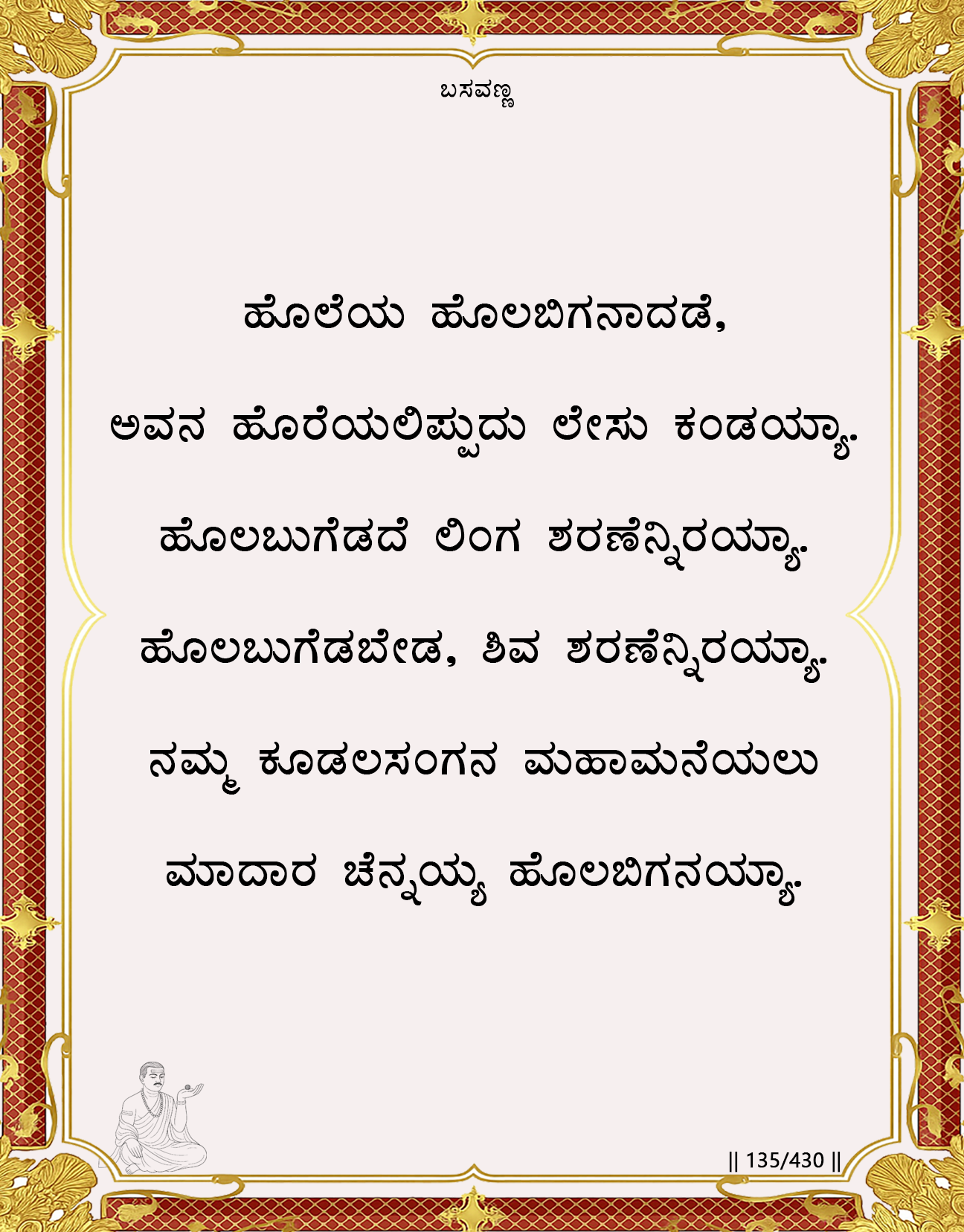
If one called “low-born” bows to the Linga,
then that is the company I choose.
Even the man the world despises
if his heart leans toward You,
call him Sharana.
For in the great house of Koodalasangama,
is not Madara Chennayya
the humble cobbler
shining among the highest?
This vachana proclaims the radical spiritual equality at the heart of Basavanna’s teaching: Birth does not define a person’s worth; devotion does. One considered “low” by social standards becomes spiritually exalted the moment his heart turns toward the Linga. Such a person is not merely accepted he is preferred over those who rely only on social status. Basavanna cites Madara Chennayya, a cobbler by birth but revered as one of the foremost Sharanas, as living proof that Divine grace dissolves all hierarchy. The true identity of a person is not their caste, but their alignment with the Divine. In the House of God, Sharana is the only title that matters.
Spiritual Context
Core Spiritual Principle: Nama-Rupa Parivartana – The Transformation of Name and Form. The Linga possesses the power to alter the very “name” (social identity, nama) and “form” (perceived nature, rupa) of the devotee. The act of surrender is not just psychological; it catalyzes a metaphysical re-identification where the devotee’s primary “name” becomes Sharana and their “form” reflects divine attributes.
Cosmic Reality Perspective: In Shiva-Shakti non-duality, all names and forms are transient expressions (shakti) of the one Consciousness (shiva). Caste identity is a frozen, illusory form. Devotion is the application of conscious heat (tapas) that melts this frozen structure, allowing the individual shakti to flow back into and recognize itself as part of the universal Shiva. The Sharana is one in whom this melting is complete.
Historical Reality (Anubhava Mantapa Context): This vachana functioned as both a rule of association and a declaration of sanctity for the Basava yoga community. It instructed members to actively prefer the company of the devout “low-born” over the irreligious elite. By naming Madara Chennayya, it canonized a living saint from an oppressed community, providing an irrefutable archetype that legally and spiritually invalidated caste-based exclusion within the Anubhava Mantapa.
Interpretation
“Bows to the Linga” is the key action a symbolic and actual surrender of the ego’s primary identity at the feet of a higher principle. This bowing is the sankalpa (intention) that initiates alchemy. “The company I choose” represents conscious satsanga; community is built on recognized spiritual essence, not social convenience. “Even the man the world despises if his heart leans toward You, call him Sharana” is an operational definition: the title Sharana is conferred by internal orientation, not external validation. The mention of Chennayya “shining among the highest” is the triumphant result the transformed identity is not just accepted but radiates as a guiding light.
Practical Implications: Spiritual practice requires actively dismantling internal caste/class prejudice in one’s choice of teachers, friends, and community. It demands that we recognize and honor spiritual authority based on the evidence of transformation, not on titles or lineage. We must learn to “see” the Sharana in unlikely forms.
The Cosmic Reality
Anga (Human Dimension): The “low-born” label is a karmic and social imposition, a heavy garment worn by the soul. It represents the most entrenched form of dualistic identity (high/low, pure/impure). This garment is not the wearer.
Linga (Divine Principle): Koodalasangamadeva as the supreme solvent and re-identifier. It is the power that can dissolve the dye of that social garment and re-clothe the individual in the “saffron robe” of divine consciousness. Its “great house” is the domain where only these transformed identities dwell.
Jangama (Dynamic Interaction): The Jangama is the catalytic process of transformation itself. It is the “bowing,” the “leaning of the heart,” and the resulting luminous state of being a Sharana. Chennayya is not just an example; he is Jangama made permanenta fixed point of proof that this transformation is real and achievable.
Shata Sthala
Primary Sthala: Bhakta. This vachana defines the entry into true Bhakti. It is the stage where the seeker’s devotion becomes so central that it actively begins to dissolve their prior, worldly identity. The choice of divine company over social company is the hallmark of this stage.
Supporting Sthala: Aikya. The vision of Chennayya “shining among the highest” in the divine house is a vision of Aikya. In union, all are equally sublime manifestations of the one light; distinctions of high and low are not merely ignored but are seen to have never existed in the essence.
Practical Integration
Arivu (Awareness Practices): Practice seeing the Linga within every person, especially those you have been conditioned to overlook or disregard. Meditate on your own most ingrained social identities and consciously offer them to the Linga in surrender, asking to be identified only as a devotee.
Achara (Personal Discipline): Make your spiritual discipline the conscious cultivation of humility and the active seeking of satsanga with those whose devotion is pure, regardless of their worldly status. Let your respect be guided by the criterion in this vachana.
Kayaka (Sacred Action): Perform your work as an act of bowing to the Linga, dedicating its fruits to the dissolution of false hierarchies. Support and elevate colleagues based on their integrity and dedication, not their pedigree.
Dasoha (Communal Offering): Build and fiercely protect spiritual communities that operationalize this vachana. Ensure leadership, honor, and voice are given to those who embody sincere devotion and realized wisdom, creating a living sanctuary where transformed identity is the norm.
Modern Application
We live in a world of pervasive, often invisible, caste systems: corporate hierarchies, academic pedigrees, social media influence, and systemic -isms (racism, classism). Our identities are still largely shaped by these markers, and our communities often reflect social stratification rather than spiritual cohesion.
This vachana liberates by offering a path to completely reinvent yourself based on your deepest values, not your past or your social resume. It empowers you to build a “chosen family” of fellow seekers based on shared sincerity. It provides a tool to critique any community, spiritual or otherwise, that values status over substance. Your true identity is not what you were born into, but what you bow to.
Essence
The name they gave you is a cage,
A footnote on a brittle page.
But bow the head, and feel the seal
That names you real.
The heart that turns, the knee that bends,
Is where the borrowed persona ends.
In that submission, fiercely kind,
The self you seek, you finally find.
This vachana describes spiritual quantum tunneling of identity. The socially imposed “low-born” identity is a deep potential well, a classically trapped state. Devotion (“bowing to the Linga”) provides the quantum coherence and energy (bhakti-shakti) that allows the consciousness to tunnel through the seemingly insurmountable barrier of social karma and re-emerge in a new state: the “Sharana” identity, which exists in a higher, liberated potential field (the “great house”).
Imagine your social identity as a heavy, ill-fitting suit of armor. You can spend your life complaining it’s uncomfortable, or trying to polish it. Basavanna says: kneel before the divine forge. That act itself will cause the armor to heat up, melt away, and be recast into a perfect, luminous ornament that reflects your true form. The kneeling is the key.
We are terrified of being defined by our lowest social perception. This vachana reveals that we have the agency to be redefined by our highest spiritual aspiration. The world’s contempt is powerless against a heart that has chosen its true object of reverence. Your dignity is not granted by society; it is claimed by your surrender to the sacred. The most radical act of self-creation is chosen devotion.

Views: 0