Poetic Rendering

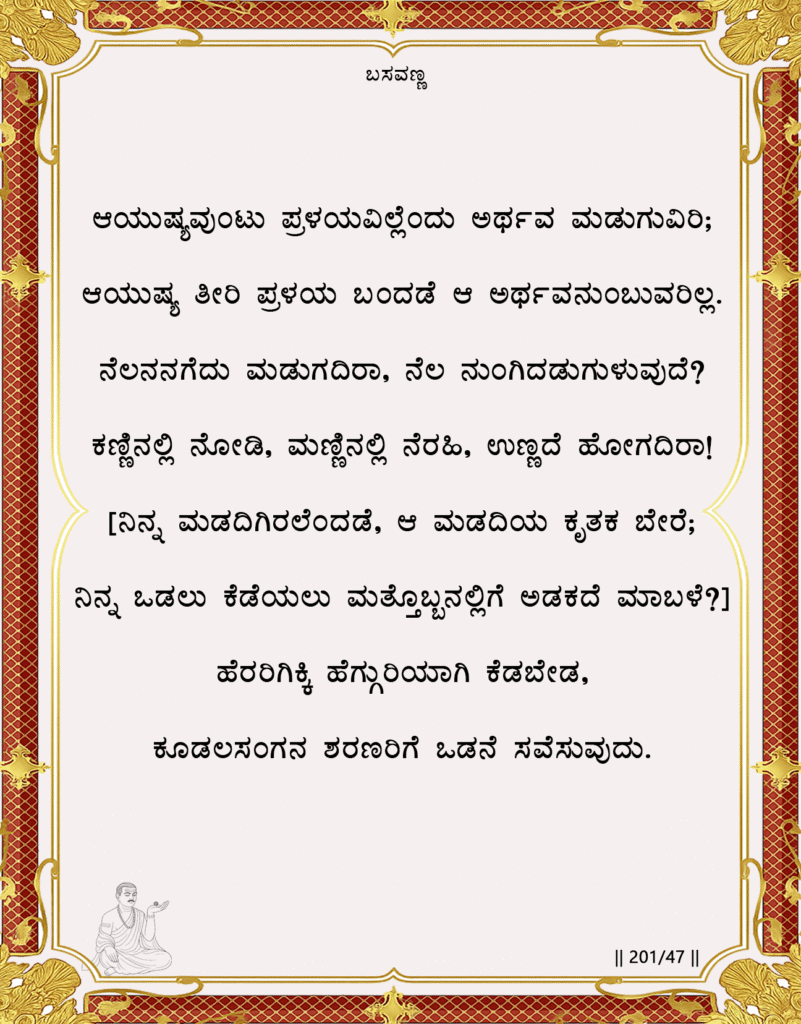
You think life is yours forever,
speaking of permanence as
if death were a myth.
But when death comes and life slips away,
will your proud words go with you?
When a body is buried,
does the earth mourn?
It only takes it in
as quietly as always.
And when your strength fades,
even your own wife will turn away,
each bound to their own path of fate.
So why cling to life with foolish pride?
Offer your very being in service
to the sharanas of Kudalasangamadeva
for that alone endures
when death claims all else.
Basavanna exposes the illusion of permanence: death is certain, and nothingreasoning, possessions, even close relationshipsfollows the soul. Since all worldly ties dissolve, only selfless service to the sharanas holds lasting value. True wealth is what death cannot take: devotion expressed through giving and humility.
Spiritual Context
Core Spiritual Principle: Dasoha as the Logic of Impermanence. When everything is seen as fleeting, the only intelligent action is to give it away before it is taken. Dasoha is not charity but spiritual economicsinvesting the currency of a temporary life in the eternal bank of divine consciousness, with the sharanas as its trustees.
Cosmic Reality Perspective: From the non-dual view, the phenomenal world (Prakriti) is Shiva’s dynamic, ever-changing dance. Clinging to any snapshot of this dance (a relationship, a possession, a thought) is to suffer. Realization is to join the dance as the dancer (Shiva), not as a clinging spectator. Service to the sharanas is participating in the divine dance consciously, using one’s temporary form for the eternal play.
Historical Reality (Anubhava Mantapa Context): This was a radical redefinition of social duty (dharma). It stripped the Brahminical emphasis on rituals for the afterlife and replaced it with ethical action (kayaka) and communal sharing (dasoha) in the here and now as the true preparation for death. It empowered the community to create a shared economy of grace, undermining the material and ritual monopolies of the priesthood.
Interpretation
“Will your proud words go with you?” Attacks the vanity of the intellectual ego (buddhi). Philosophy and reason, the pride of the learned, are mere secretions of the perishable brain.
“Even your own wife will turn away…” Severs attachment at the deepest emotional level. It illustrates that all relational identities (husband, wife) are temporary roles in life’s drama, not the essence of the soul.
“Offer your very being in service…” This is the culmination. When body, mind, and relationships are seen as loaned instruments, the only sane act is to play them in service to the Owner. The sharanas are the conduits through which this offering reaches the Divine.
Practical Implications: The contemplation of death (marananussati) becomes the central spiritual practice. It is the whetstone that sharpens discernment, cutting through all trivial pursuits and clarifying the one necessary action: selfless offering.
The Cosmic Reality
Anga (Human Dimension): The Anga is the “burning candle.” Its purpose is not self-preservation but to provide light (service) before it is extinguished.
Linga (Divine Principle): The Linga is the eternal flame, the source of all light. Service to the sharanas is using your candle to connect with and honor that source.
Jangama (Dynamic Interaction): Jangama is the act of lighting one candle from anotherthe community of sharanas passing on and sustaining the light of consciousness through the practical, physical act of receiving and giving service.
Shata Sthala
Primary Sthala: Sharana. The entire vachana is an argument for becoming a Sharana. The realization of impermanence leads directly to the act of taking refuge (sharanagati), which is physically and socially enacted through service to the existing community of sharanas. This is the foundational step.
Supporting Sthala: Prasadi. The profound, transformative understanding that “everything is impermanent” is a shocking grace. The one who receives this understanding and acts upon it is a Prasadia recipient of the grace of wisdom. Their subsequent life of dasoha is an expression of gratitude for this liberating insight.
Practical Integration
Arivu (Awareness Practices): Daily “Death Meditation.” Vividly contemplate the dissolution of your body, your thoughts, your relationships. From that space of stark clarity, ask: “What, then, shall I do today?”
Achara (Personal Discipline): Practice “non-ownership.” Begin each day by mentally offering your body, energy, and possessions to Koodalasangamadeva. Throughout the day, act as a steward, not an owner.
Kayaka (Sacred Action): Perform your work as a direct offering to the spiritual community (sangha). See your labor as building and sustaining the “bridge” (Jangama) that helps others cross the river of impermanence.
Dasoha (Communal Offering): Actively seek to serve the awakened and the sincere seekers in your community. Offer time, skill, and resources. See this not as helping “them,” but as honoring the Linga within them, which is the only enduring reality.
Modern Application
A culture built on hoarding wealth, curating a perfect digital identity, and seeking permanent security in careers and relationships, leading to deep existential dread when these inevitably shift or fail.
This vachana is the cure for status anxiety and the fear of missing out. It reframes life as an opportunity for conscious divestment. It teaches that security is found not in what you have, but in what you can joyfully give away. It turns the terror of death into the motivation for a life of profound meaning and connection.
Essence
The earth receives the corpse, unmoved and still.
The wife turns to her path, by fate’s own will.
All reason, pride, and strength by death are shorn.
Why cling to melting wax? Be light, not mourn.
Invest your fleeting breath, your borrowed clay,
In serving those who walk the Eternal Way.
Major Premise (Observed Reality): All composite things are impermanent (Body, mind, relationships). Minor Premise (Spiritual Inquiry): I am composed of these impermanent things. Conclusion (Liberative Action): Therefore, I must dedicate my impermanent components to that which is permanent (The Linga, via service to its embodiments, the sharanas). This is the only action that resolves the existential contradiction of being a conscious entity in a perishable form.
In Simple Terms: You are a tourist in a foreign city (the world). You have a limited amount of local currency (your life, energy, possessions). The wise tourist doesn’t try to smuggle the currency home (impossibledeath). They spend it all on gaining the one thing that can be taken home: the experience, the wisdom, the connections that change them forever. For Basavanna, that “souvenir” is divine consciousness, purchased through the currency of selfless service. The Human Truth:
This addresses the core human tragedy: we fall in love with the temporary. We build sandcastles knowing the tide will come. Basavanna doesn’t tell us to stop building; he tells us to build for the joy of building and then offer the castle to the sea with a bow before it is swept away. In that offering, we are no longer the anxious builder, but the joyful, liberated participant in the cosmic rhythm of creation and dissolution. The fear of death is the fear of losing everything you have. But if you give everything you are before you die, you have nothing left to lose, and in that divine poverty, you discover the one thing that can never be taken: your freedom.

Views: 0