Poetic Rendering

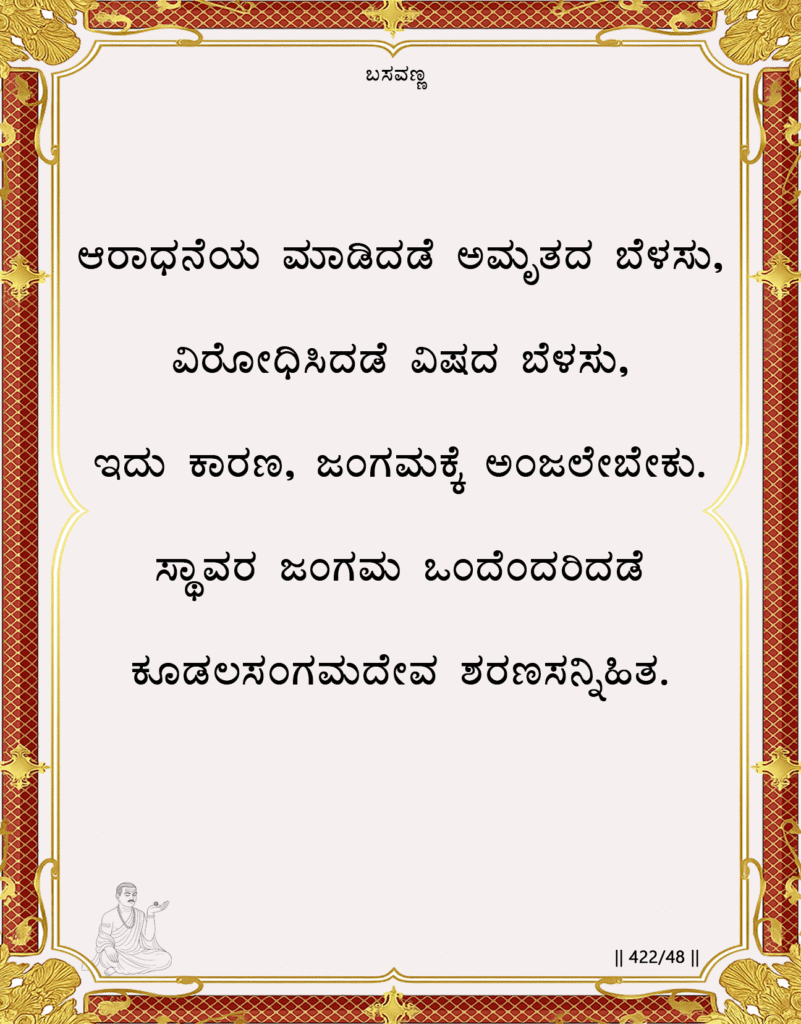
Where devotion flows, there arises nectar;
where resistance stands, bitterness takes root.
Knowing this truth, how can one fail
to honour the jangama?
The Linga may rest still, the jangama may walk
yet the same radiance dwells in both.
And when this secret awakens within me,
O Kudalasangamadeva,
the sharana before me
is none other than You Yourself.
Basavanna teaches that reverence opens the door to divine grace, while resistance breeds inner poison. Understanding that the same Divine dwells both in the immovable Linga and the living jangama, the seeker must honour the sharana. This recognition of the One in all is the essence of becoming a true sharana.
Spiritual Context
Core Spiritual Principle: Reverence is not a social courtesy but a spiritual technology that transforms consciousness, attracting divine grace (amrita) and dissolving the egoic resistance (poison) that separates the seeker from the Divine.
Cosmic Reality Perspective: The One Non-Dual Reality (Brahman) consciously manifests as both the static, foundational principle (Linga) and the dynamic, moving expression (Jangama). To privilege one over the other is a failure of perception. True vision (divya drishti) sees the same Cosmic Reality pulsating in the stone icon and the walking saint.
Historical Reality (Anubhava Mantapa Context): This Vachana is a cornerstone of the Lingayat revolution. It dismantles the priestly monopoly on the divine by declaring that the moving, human Jangama is as sacred as the installed Linga. It institutionalizes the radical egalitarianism of the Anubhava Mantapa, where the highest spiritual practice is to see and honor God in one’s fellow human being, especially the enlightened Sharana.
Interpretation
1. “Where devotion flows, there arises nectar; / where resistance stands, bitterness takes root.” The Vachana begins with an immutable law of consciousness. “Devotion” (bhakti) here is the inner posture of openness, humility, and love. This attitude itself becomes the alchemical vessel that transforms ordinary perception into a source of bliss (amrita). “Resistance” (dvesha/aversion) is the ego’s contraction, which metabolizes experience into the “poison” of separation, jealousy, and anger.
2. “Knowing this truth, how can one fail to honour the jangama?” This is a logical and existential imperative. If one truly understands the cause-and-effect relationship between attitude and inner state, the only intelligent choice is to cultivate reverence. To not honor the Jangama is to consciously choose spiritual poison for oneself.
3. “The Linga may rest still, the jangama may walk/ yet the same radiance dwells in both.” This is the theological and metaphysical revelation that justifies the practice. The apparent differences (static/dynamic) are mere modes of appearance (upadhis). The essential substance, the “radiance” or Consciousness, is one and the same.
4. “And when this secret awakens within me… the sharana before me is none other than You Yourself.” This is the culminationthe anubhava (experience) of non-duality. The “secret” is not an intellectual concept but a lived reality that “awakens.” When it does, the subject-object dichotomy between the devotee and the Sharana collapses. The act of seeing God in the other becomes seeing God as the other, which is ultimately seeing God as one’s own Self.
Practical Implications: The seeker is guided to: Consciously practice seeing the divine presence in every person, especially spiritual companions. Approach all interactions with an attitude of reverence and service, understanding this as a direct means to inner joy. Use moments of irritation or judgment as alarms, signaling the arising of the “bitterness” of egoic resistance.
The Cosmic Reality
Anga (Human Dimension): The Anga is the seeker whose perception is being purified. Their role is to actively cultivate the “devotion” that allows them to perceive the unity of Linga and Jangama. The Anga’s mind becomes the crucible where the “secret awakens.”
Linga (Divine Principle): The Linga is the “same radiance”the immutable, conscious, divine principle that is the ground of all being. It is the essential nature shared by both the static symbol and the moving human.
Jangama (Dynamic Interaction): The Jangama is the human embodiment of the divine radiance, the “walking Linga.” The Jangama is also the very act of recognizing this unity. The dynamic interaction is the sacred gaze that meets the gaze of the Sharana and sees Kudalasangamadeva, thereby dissolving the separation between worshipper and worshipped.
Shata Sthala
Primary Sthala: Prasadi Sthala. The entire Vachana describes the state of grace. The inflow of amrita (nectar) is the direct experience of grace. The ability to see the divine in all is a fruit of grace, not an achievement of effort.
Supporting Sthala: Sharana Sthala. The final realization “the sharana before me is none other than You Yourself” is the definitive mark of the Sharana. One becomes a true Sharana by recognizing the Sharana-principle in everything and everyone. This Vachana is both a description of and a path to that ultimate stage.
Practical Integration
Arivu (Awareness Practices): Meditative Seeing: Sit with a symbol of the divine (Linga) and then transfer that same gaze to a person (in life or imagination). Practice holding the same feeling of reverence and sacredness for both.
Mindfulness of Judgment: Throughout the day, notice when a feeling of aversion or judgment arises toward someone. Pause and silently affirm: “The same radiance dwells here. My resistance is my poison.”
Achara (Personal Discipline): Make it a daily discipline to offer respecta bow, a kind word, a gesture of serviceto those around you, consciously seeing them as vessels of the one Divine.
Kayaka (Sacred Action): Perform your work as an offering to the divine presence within your colleagues, clients, and everyone you interact with.
Dasoha (Communal Offering): The highest Dasoha is to offer reverence itself. Serve the community by holding this unifying vision, thereby strengthening the collective awareness of the divine in all.
Modern Application
The Modern Malady: The “Crisis of Dehumanization.” In a hyper-critical, divisive, and digitally-mediated world, we constantly objectify and judge others. We reduce people to their opinions, their utility, or their social status. This leads to loneliness, social fragmentation, and an inner state of chronic irritation and cynicism.
The Liberative Application: This Vachana offers a profound antidote to modern alienation. It teaches us to re-sanctify our relationships. By practicing seeing the “same radiance” in a political opponent, a difficult family member, or a stranger, we free ourselves from the poison of judgment and connect with a deeper, unifying reality. It transforms social interaction from a battlefield of egos into a sacred communion, fostering true community and inner peace.
Essence
A heart open, a sweetness pours.
A heart clenched, a venom seeps.
This is the law.
Why then choose the thorn over the flower?
The Mountain-God, the Wandering-Saint
one Light in two lamps.
When my eyes learned this,
O Kudalasangama,
every face became Your face,
every place, Your resting place.
This Vachana presents a complete metaphysics of perception. It posits that the world experienced is a direct reflection of the inner posture of the perceiver. Its multidimensional genius lies in fusing epistemology (how we know) with theology (what we worship) and psychology (what we experience). It reveals the Jangama as the ultimate test and fulfillment of non-dual vision: if the Divine is not perceived in the moving, breathing human other, then the realization of oneness is incomplete.
The quality of your life is determined by the quality of your gaze. When you look upon the world with reverence, you find a world worthy of reverence. The divine is not hidden; it is everywhere, waiting to be recognized by a humble and devoted heart. The greatest secret is that God is in plain sight, wearing a human face.

Views: 0