Poetic Rendering

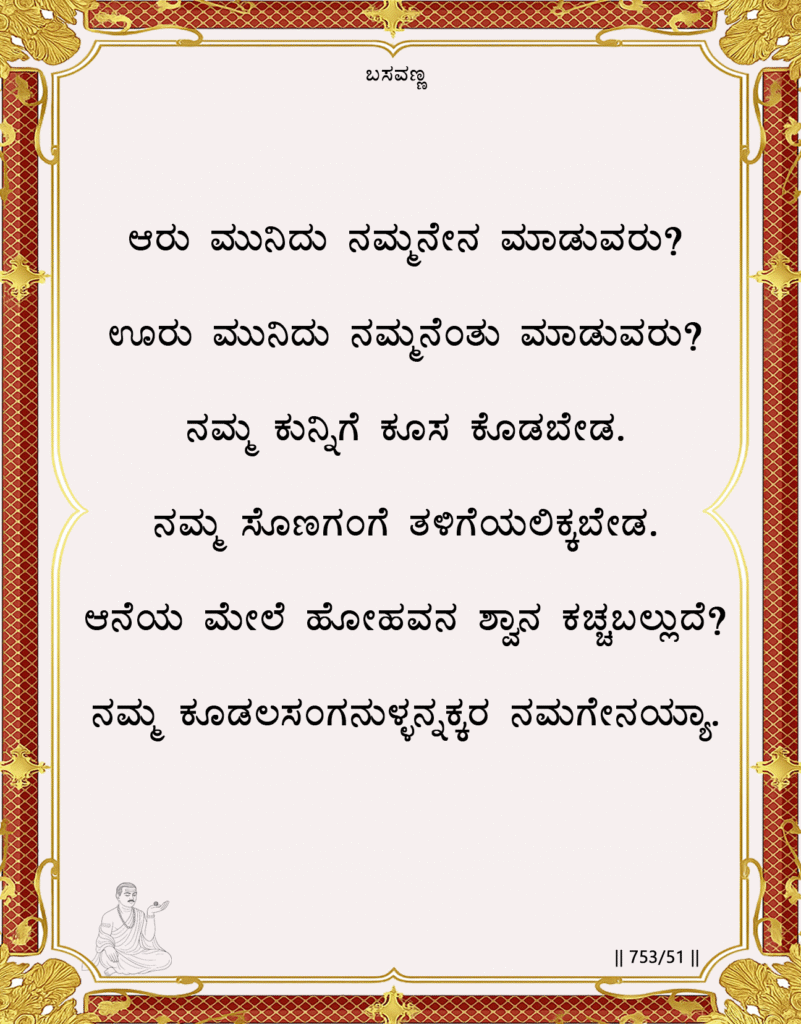
When the senses surge and rebel,
can they shake the one anchored in You?
When the world storms with anger,
can its clamor break the spine of truth?
Would anyone place a tender child
in the den of jackals?
Or seek sweet milk
from a barren cow?
Do the yelps of street dogs
disturb the calm stride
of the great mountain elephant?
So tell me,
O Kudalasangamadeva
how can slander or blame
ever cling to the one
who stands firm in You,
steady as the sky,
unmoving as the ground
beneath all things?
Basavanna teaches that nothing external neither the senses nor the world’s hostility can disturb one who is firmly rooted in the Divine. Just as weak forces cannot sway the strong, the noise of criticism cannot touch a devotee established in truth. The vachana affirms that spiritual steadiness arises not from effort, but from abiding in the unshakable presence of Kudalasangamadeva.
Spiritual Context
Core Spiritual Principle: True spiritual attainment is not the absence of challenges, but the establishment of an inner stability so profound that external turbulence and internal agitations cannot disturb the core of one’s being.
Cosmic Reality Perspective: The non dual reality is like the sky unchanging, unaffected, and all encompassing. The storms of sensory input, emotional reactions, and social opinions are like weather patterns that arise and dissolve within it. To be established in the Linga is to have one’s identity shifted from the weather (the mind body complex) to the sky itself (Pure Consciousness).
Historical Reality (Anubhava Mantapa Context): As a revolutionary leader, Basavanna faced immense slander and political hostility from orthodox establishments. This Vachana is a fearless declaration of the inner sovereignty cultivated by the Sharanas. It asserts that their power came not from social standing but from an unassailable spiritual foundation, making them immune to the very tools shame, blame, and threat used by the prevailing powers to control society.
Interpretation
1. “When the senses surge and rebel… When the world storms with anger…” Basavanna first identifies the two fronts of battle: the internal rebellion of the senses (indriyas) and the external storm of the world’s anger and slander. He posits that for the grounded seeker, both are equally powerless.
2. “Would anyone place a tender child in the den of jackals? Or seek sweet milk from a barren cow?” These are metaphors of futility and misplaced expectation. The “tender child” is the unanchored self, which would be devoured by the “jackals” of worldly chaos. The “barren cow” is the external world, from which one foolishly expects to draw true nourishment (peace, validation). The enlightened one does not make this error.
3. “Do the yelps of street dogs disturb the calm stride of the great mountain elephant?” This is the central metaphor of inherent stability. The “mountain elephant” is the seeker established in the Divine. Its size, strength, and purpose are of such a different order of magnitude that the “yelps” of criticism are not even a minor irritation; they are irrelevant noise. The elephant’s calm is innate, not a reaction.
4. “How can slander or blame ever cling to the one who stands firm in You…” The final conclusion is one of non stickiness. For blame to “cling,” there must be a surface of ego identity for it to adhere to. For one whose identity is merged with the “steady sky” and “unmoving ground” of the Divine, there is no such surface. Insults find no purchase and fall away.
Practical Implications: The seeker is guided to: Shift the focus from controlling external circumstances to deepening the internal anchor in the Divine. When faced with sensory temptation or criticism, recall the image of the mountain elephant and consciously access the inner stillness that is its nature. understand that reactivity is a sign of a weak anchor; stability is a sign of grace.
The Cosmic Reality
Anga (Human Dimension): The Anga is the “mountain elephant” the individual who has stabilized their consciousness. The body may be in the world, but the mind is unwavering. The senses are perceived as external phenomena that no longer command the inner self.
Linga (Divine Principle): Kudalasangamadeva is the “unmoving ground” and the “steady sky.” It is the principle of absolute, immutable stability and spacious consciousness in which all phenomena occur.
Jangama (Dynamic Interaction): The Jangama is the dynamic state of “standing firm” in the Linga. It is the continuous, lived relationship of refuge not a one time event, but a constant abiding. It is the process by which the Anga consciously draws its stability from the Linga, moment by moment.
Shata Sthala
Primary Sthala: Prasadi Sthala. This unwavering stability and freedom from disturbance is the very definition of the state of Grace. It is not achieved through personal effort but is the natural consequence of the soul being suffused with divine presence.
Supporting Sthala: Aikya Sthala. The state described where the individual’s steadiness is synonymous with the steadiness of the Divine ground is a foretaste of full union. The distinction between the anchor and the anchored dissolves; the seeker becomes the stability itself.
Practical Integration
Arivu (Awareness Practices):Anchor Meditation: Sit in silence and feel the body as the “unmoving ground” and the awareness as the “steady sky.” Let thoughts, sounds, and sensations (the “yelping dogs”) arise and pass without disturbing this foundational stillness.
Mindful Equanimity: Throughout the day, when faced with praise or blame, internally affirm: “This is like the yelp of a dog. I am the mountain elephant, steady on my path.”
Achara (Personal Discipline): Cultivate a practice of not immediately reacting to provocation. Pause, return to the inner anchor, and then act from that centered space.
Kayaka (Sacred Action): Perform your work with the steadiness of the mountain elephant, undisturbed by the petty politics or criticisms of the workplace. Let the quality of your work be your statement.
Dasoha (Communal Offering): Offer the gift of your stability to your community. Be a calming, steadfast presence in times of collective anxiety or conflict.
Modern Application
Modern life, with its constant notifications, social media outrage, and pressure to respond instantly, cultivates a reactive, fragile psyche. People are perpetually off balance, tossed by the latest trend, criticism, or crisis, leading to burnout and anxiety disorders.
This Vachana is an antidote to the modern crisis of attention and equanimity. It teaches the art of cultivating an “unshakable core.” It allows one to engage with the digital world without being consumed by it, to hear feedback without being derailed by it, and to maintain inner peace amidst outer chaos. It is the foundation for mental resilience and sustainable action in a frenetic world.
Essence
The storm insults the sky, and passes.
The jackal barks at the cliff, and is ignored.
Why would I, whose heart is now that sky,
whose soul is now that stone,
bother to flinch at a passing gust,
or answer every howl with my own?
It demonstrates that disturbance is not a property of an external event but a function of the level of identification of the consciousness perceiving it. Its multidimensional impact is to provide a working model for enlightenment as a state of imperturbable wisdom a state where one remains unwavering in success and failure, praise and blame. It reveals the Jangama as the fully integrated human in whom the dynamic flow of life no longer creates inner turbulence, because it is recognized as a play upon the eternal, static ground of the Linga.
Do not seek a life without storms; build a soul that the storms cannot shake. Your peace is not dependent on the world being peaceful. It is an inner fortress, built from the unassailable materials of truth and spiritual connection, from which you can meet the world with strength and grace, utterly untouched by its noise.

Views: 0