Poetic Rendering

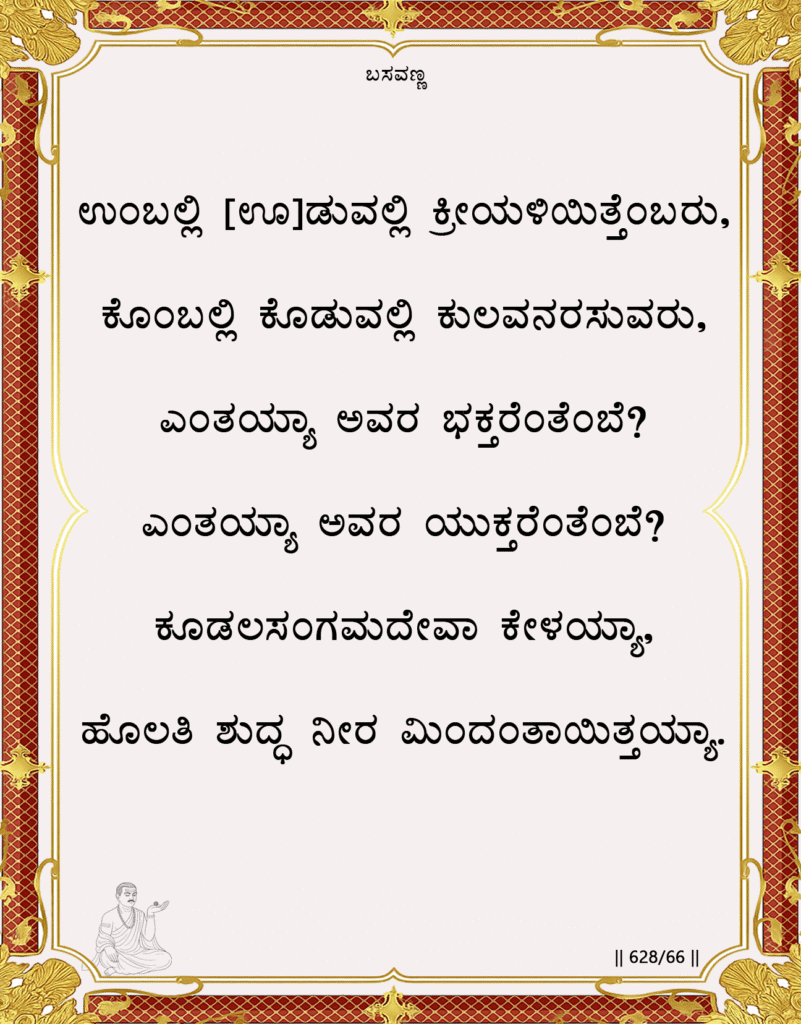
“They shared food with all kinds of people
of every caste, every manner, every way,”
they say,
“and so they lost their religion.”
Tell me, then
can such ones be called bhaktas?
Can they be called yukthas,
steady and discerning?
O Koodalasangamadeva,
to judge them so is like
muddying clear water
by washing the unclean in it.
Basavanna criticizes those who claim that dining with people of different castes corrupts one’s faith. He rejects such narrow mindedness, questioning whether those who hold such views can truly be called devotees or wise ones. Judging inclusivity as impurity, he says, is like contaminating pure water through one’s own misunderstanding.
Spiritual Context
Core Spiritual Principle: True devotion (bhakti) is expressed through radical inclusivity and the transcendence of man made social hierarchies. To see impurity in another human being is to fundamentally misunderstand the nature of the Divine, which pervades all.
Cosmic Reality Perspective: The Linga (Divine Principle) is the singular, all pervading consciousness that animates every being without distinction. The concept of ritual purity and pollution (madi and mailige) based on caste is a human made illusion (maya) that obscures the vision of this underlying unity. To impose such divisions is to project one’s own ignorance onto the flawless canvas of divine creation.
Historical Reality (Anubhava Mantapa Context): This Vachana is a direct and powerful assault on the caste based social order of 12th century Karnataka. The act of inter dining was a revolutionary political and spiritual statement. Basavanna is defending his Sharanas against accusations of heresy from orthodox quarters. He turns the accusation on its head, stating that it is the accusers whose judgmental mindset is the true impurity, “muddying” the pure waters of spiritual truth with their prejudice.
Interpretation
1. “They shared food with all kinds of people… and so they lost their religion.” Basavanna begins by quoting the accusation leveled against his community. “Sharing food” (sahabhojana) symbolizes the deepest level of social acceptance and spiritual equality, as food represents life itself.
2. “Tell me, then can such ones be called bhaktas? Can they be called yukthas, steady and discerning?” He uses sharp, rhetorical questions to challenge the very spiritual credentials of the accusers. A true bhakta (devotee) is one who sees God in all. A yuktha (one who is yoked, discerning) is one who understands the true, non dual nature of reality. Basavanna argues that those who cling to caste distinctions are neither truly devoted nor spiritually discerning.
3. “to judge them so is like muddying clear water by washing the unclean in it.” This is the masterful concluding metaphor. The “clear water” is the pure, inclusive action of the Sharanas, which is an expression of their enlightened vision. The “unclean” thing being washed is the accuser’s own prejudiced mind. The act of judgment itself is the process of “muddying.” Thus, the impurity is not in the shared meal, but in the narrow, divisive consciousness that dares to judge it.
Practical Implications: The seeker is guided to: Actively practice inclusivity and reject all forms of social discrimination as antithetical to spirituality. Understand that true purity is of the heart and mind, not of external social codes. Recognize that judging others is a greater spiritual fault than the actions being judged, as it reinforces the ego’s sense of separation.
The Cosmic Reality
Anga (Human Dimension): The Anga is the individual who has internalized the vision of unity. Their act of sharing food is an outward expression of their inner realization that all are part of the one divine body.
Linga (Divine Principle): The Linga is the universal, all pervading consciousness that knows no caste, creed, or distinction. It is the “clear water” of pure existence.
Jangama (Dynamic Interaction): The Jangama is the sacred act of communal dining and fellowship. It is the dynamic practice that breaks down illusory barriers and embodies the non dual truth. It is also the compassionate engagement with those still trapped in ignorance, attempting to “wash” them clean of their prejudices.
Shata Sthala
Primary Sthala: Bhakta Sthala. This Vachana establishes the essential ethical and spiritual foundation for a devotee. A Bhakta must begin by purifying their heart of all social prejudices and cultivating a vision of equality. Without this, their devotion is hypocritical.
Supporting Sthala: Aikya Sthala. The principle of radical inclusivity is the practical expression of the non dual realization of Aikya Sthala. If one truly sees all as One, discrimination becomes impossible.
Practical Integration
Arivu (Awareness Practices): Contemplation on Unity: Meditate on the truth that the same divine consciousness shines through the eyes of every human being, regardless of their background.
Mindfulness of Judgment: Notice when feelings of superiority or aversion arise based on someone’s social identity. See these thoughts as the “unclean” thing that muddies your own mental clarity.
Achara (Personal Discipline): Make a conscious effort to engage with people from diverse backgrounds. Let your conduct be a living protest against all forms of discrimination.
Kayaka (Sacred Action): Ensure your workplace or professional environment is equitable and inclusive. See your labor as a means to build a more just society.
Dasoha (Communal Offering): The highest Dasoha is to offer the gift of dignity and belonging to all. Actively create and protect communities where everyone, without exception, is welcomed as a Sharana.
Modern Application
“Systemic Prejudice and Virtue Signaling.” While explicit caste systems may be less prevalent in some parts of the world, modern societies are rife with systemic racism, classism, xenophobia, and other forms of “othering.” Furthermore, people often signal virtue without engaging in the difficult, personal work of rooting out their own unconscious biases.
This Vachana is a timeless prescription for social healing. It calls for a spirituality that is actively anti discriminatory. It liberates us from the subtle and overt prejudices we inherit, teaching that true spiritual progress is measured by the expansion of our circle of compassion. It warns against the hypocrisy of holding spiritual beliefs while maintaining discriminatory attitudes, revealing such judgment as the true source of social and spiritual “impurity.”
Essence
You call them polluted for the company they keep,
while your own mind is the well of prejudice, deep.
The food they shared was an offering of love,
your judgment, a stain on the light from above.
The pure see the Divine in every face.
The impure see only caste and place.
This Vachana establishes a spiritual epistemology where the capacity to perceive unity is the true measure of enlightenment, and the propensity to impose division is the mark of ignorance. Its multidimensional impact fuses social ethics with mystical realization, making the fight against discrimination a sacred duty. It positions the Jangama as the embodiment of this inclusive consciousness, whose very existence is a critique of and a catalyst for the dissolution of artificial social hierarchies. The “stain” is not on the one who embraces all, but on the consciousness that creates the category of the “unclean.”
Any religion or spirituality that teaches you to see another human being as inferior, impure, or less sacred is itself impure. The truest test of your faith is not whom you worship, but whom you welcome to your table. Do not confuse the man made stains of prejudice with divine law. The divine sees only itself, reflected in every human face. Cleanse your own vision, and you will see a world of boundless, equal sanctity.

Views: 0