Poetic Rendering

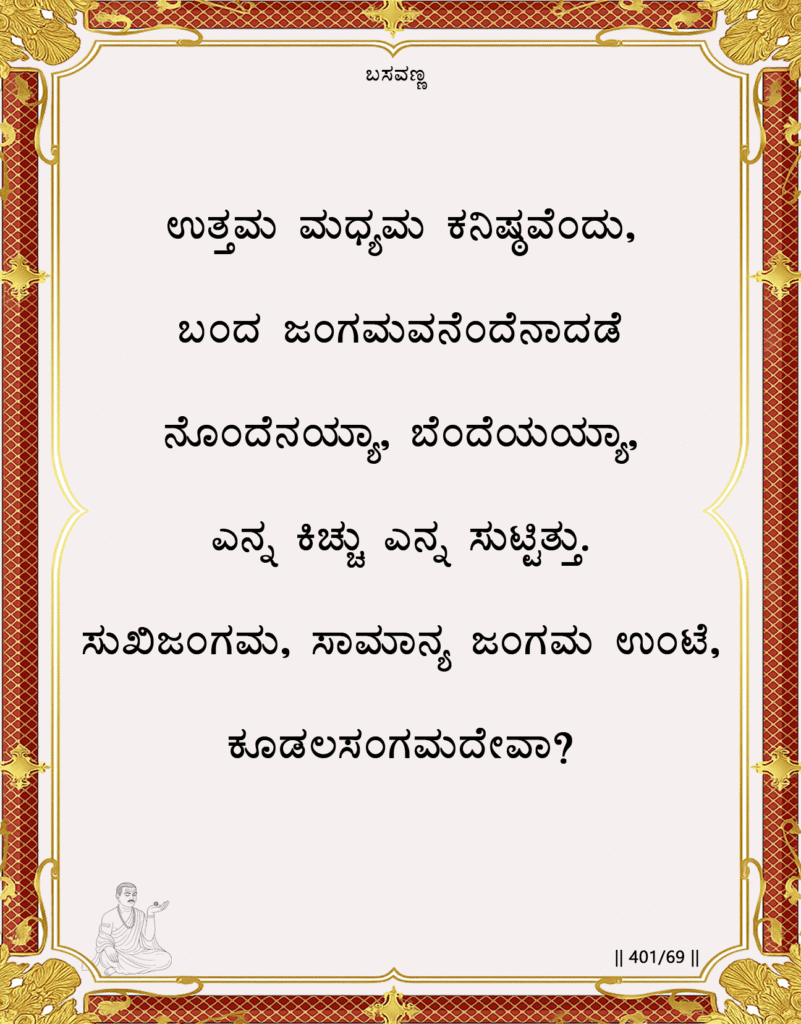
When they declare
“This jangama is superior,
that one mediocre,
this one inferior”
my heart burns with protest,
my spirit flames with outrage.
Can there truly be,
O Koodalasangamadeva,
such a thing as
a fortunate or ordinary jangama?
The Indivisibility of Divine Embodiment. This vachana represents Basavanna’s fiery response to the human tendency to categorize and rank what is inherently beyond classification. He exposes the spiritual violence of imposing worldly hierarchies upon those who have transcended all distinctions. The jangama, as the living embodiment of the Divine, cannot be measured by earthly standards of high and low, for they all participate equally in the same sacred reality. Basavanna’s burning heart demonstrates that true spiritual sensitivity cannot tolerate the fragmentation of what God has made whole.
Spiritual Context
Core Spiritual Principle: The Jangama, as a living manifestation of the Divine, is indivisible and beyond all qualification. To impose hierarchies upon them is a profound act of spiritual ignorance (avidya) that violates the very principle of non duality.
Cosmic Reality Perspective: From the perspective of the Absolute (Linga), all apparent forms are equal manifestations of the one, non dual consciousness. The concepts of “superior” and “inferior” are relational, dualistic constructs that arise only within the realm of maya (illusion). To see a Jangama as anything less than a perfect expression of the Whole is to fail to see the Jangama at all.
Historical Reality (Anubhava Mantapa Context): This Vachana is a fierce defense of the core revolutionary principle of the Lingayat community. Basavanna confronts the insidious tendency, even among seekers, to create new hierarchies judging Jangamas by their perceived level of enlightenment, their austerity, or their popularity. He safeguards the community from internal stratification and reaffirms that in the eyes of Shiva, all realized beings are equally sacred, and all are equally valid conduits of grace.
Interpretation
1. “When they declare ‘This jangama is superior, that one mediocre, this one inferior’ ” Basavanna begins by naming the blasphemy. The act of “declaring” or labeling is the ego’s attempt to control and categorize the infinite, which is an act of violence against the sacred.
2. “my heart burns with protest, my spirit flames with outrage.” This is not a personal, egoic anger, but the spontaneous, righteous fire (tejas) of a heart that perfectly reflects the unity of the Divine. It is the necessary, compassionate fury that arises when Truth is violated. This burning is a sign of deep spiritual integrity.
3. “Can there truly be, O Koodalasangamadeva, such a thing as a fortunate or ordinary jangama?” The question is rhetorical and exposes the absurdity of the premise. “Fortunate” and “ordinary” are worldly attributes. A Jangama, by definition, is one who has realized their identity with the transcendent reality. To call such a one “ordinary” is a contradiction in terms. To call one “fortunate” implies that their state is a circumstantial boon rather than the fruit of divine realization.
Practical Implications: The seeker is guided to: Cultivate a vision that sees all genuine spiritual guides and realized beings as equal manifestations of the one Guru principle. Eradicate the habit of comparing, ranking, or gossiping about spiritual teachers. Understand that devotion (bhakti) is diluted the moment it becomes preferential and exclusive.
The Cosmic Reality
Anga (Human Dimension): The Anga is the devotee whose heart is aligned with non dual truth. Their “burning” is not a flaw but a sign of this alignment. Their role is to protect the sanctity of the Jangama principle by rejecting all false distinctions.
Linga (Divine Principle): The Linga is the undivided, unqualified Absolute. It is the source and substance of every Jangama, making all qualitative distinctions between them utterly illusory.
Jangama (Dynamic Interaction): The Jangama is the sacred, moving presence of the Divine. The dynamic interaction is the devotee’s act of perceiving this presence without distortion seeing the one Linga in all Jangamas, without creating a hierarchy of vessels.
Shata Sthala
Primary Sthala: Bhakta Sthala. This Vachana defines the correct attitude of a devotee towards the Jangama. A true Bhakta offers equal reverence to all embodiments of the Divine, as this reverence is directed at the essence (Linga), not the form.
Supporting Sthala: Aikya Sthala. The vision expressed here the inability to see division where there is only unity is the perfected vision of one in the Stage of Union. This Vachana shows the Bhakta cultivating the very perception that defines the highest stage.
Practical Integration
Arivu (Awareness Practices): Unity Meditation: Meditate on the concept of the Jangama. See beyond the individual personality to the one, radiant consciousness that animates all true teachers. Feel the equality of this essence.
Mindfulness of Judgment: Vigilantly watch for thoughts that compare or rank spiritual figures. When they arise, see them as the “protest” and “outrage” of your own inner ignorance, and consciously dissolve them.
Achara (Personal Discipline): Make it a discipline to speak of all spiritual teachers with equal respect. Refrain from gossip and comparative analysis that diminishes any one of them.
Kayaka (Sacred Action): In your work and social life, practice seeing the inherent, equal worth in everyone, as a training ground for seeing the divine equality in all Jangamas.
Dasoha (Communal Offering): Be a guardian of unity within your spiritual community. Gently but firmly challenge conversations that create hierarchies among teachers or paths, helping to uphold the sacred equality of all.
Modern Application
“The Spiritual Marketplace and Guru Wars.” The modern spiritual scene is often a marketplace where teachers are branded, ranked, and pitted against each other by followers. Social media fuels “guru wars” and cults of personality, where devotees of one teacher feel superior to devotees of another. This completely misses the point of the sacred function of the teacher.
This Vachana is a powerful antidote to sectarianism and spiritual tribalism. It liberates the seeker from the need to have the “best” guru and allows them to receive wisdom from any authentic source without conflict. It fosters a mature, universal spirituality that honors all genuine paths and teachers as rivers leading to the same ocean.
Essence
To rank the rays of the one sun,
to call one wave of the ocean better
this is the arrogance that makes my soul burn.
In the eyes that see Your form in all,
how can there be a “high” or “low” Jangama?
There is only the One, wearing countless names,
and my heart, which refuses to play this foolish game.
This Vachana operates at the level of spiritual epistemology, defining what constitutes a correct perception of the sacred. It asserts that to see hierarchy in the Jangama is a categorical error of perception, a fundamental misapprehension of reality. Its multidimensional impact is to protect the integrity of the devotee’s faith (Bhakti) and the cohesion of the spiritual community (Sangha) by rooting out the divisive seed of comparison. It positions the Jangama not as individual personalities competing for status, but as a unified field of grace, where each is a perfect, non duplicate expression of the same infinite source.
The moment you start ranking spiritual teachers, you have stopped seeing the Divine in them and have started seeing only your own projections and preferences. True devotion is an equal opportunity reverence. It honors the light wherever it shines, in whatever color glass it is housed. Do not let the small mind’s love for comparison desecrate the sacred unity that is the very heart of all authentic spirituality.

Views: 0