Poetic Rendering

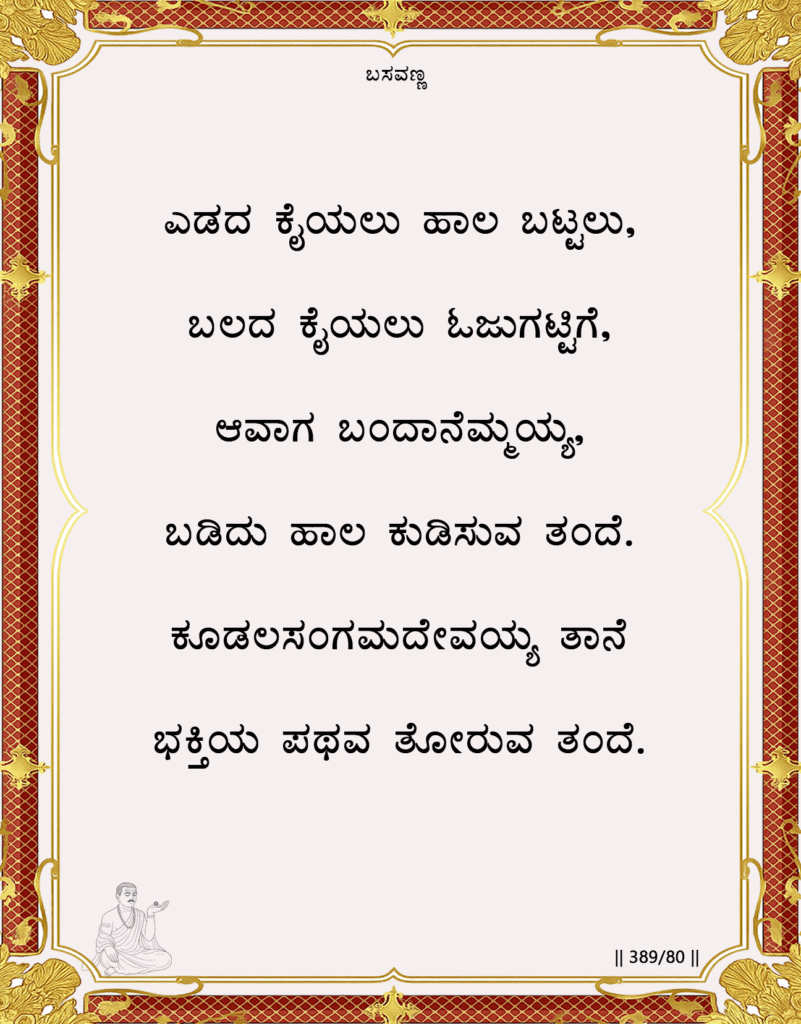
With a bowl of milk in one hand,
and a staff of discipline in the other,
the Jangama comes to me as father
feeding with love,
guiding with firmness.
He is the living shrine of devotion,
he is the revealed path itself.
O Koodalasangamadeva,
through him, You are both nurturer and guide,
the true father of my bhakti.
Basavanna illuminates how divine grace manifests through living teachers the Jangamas who embody both nourishment and discipline. Spiritual transmission is not abstract; it flows through these awakened beings who guide, correct, and inspire. The “bowl of milk” symbolizes care and sustenance, while the “staff” represents firmness and moral guidance. The Vachana emphasizes that the Jangama is simultaneously the shrine (place of devotion) and the path (revealed truth), demonstrating that authentic devotion is nurtured through personal contact with enlightened beings, linking the seeker to the principles of Anga Linga Jangama and the stages of Shatsthala.
Spiritual Context
Core Spiritual Principle: The Guru, or Jangama, is the living embodiment of divine grace, manifesting in a dual role: as the compassionate nurturer who sustains the seeker and as the firm disciplinarian who purifies and guides. This personal, living transmission is indispensable for authentic spiritual growth.
Cosmic Reality Perspective: The formless, transcendent Divine (Linga) descends into form and relationship through the Jangama to care for and guide the individual soul (Anga). The “bowl of milk” represents the sattvic,nourishing aspect of consciousness, while the “staff” represents the unwavering law of Dharma and the discernment needed to follow it. The Jangama makes the abstract, cosmic principles personally accessible.
Historical Reality (Anubhava Mantapa Context): This Vachana institutionalizes the role of the Guru in the Lingayat tradition. In the Anubhava Mantapa, the Jangamas were not just philosophical discussants but active spiritual guides (Gurus). This Vachana defines their function, ensuring that the transmission of Lingayat teachings remains a living, experiential process grounded in a personal teacher disciple relationship, preventing the path from devolving into a mere intellectual or ritualistic exercise.
Interpretation
1. “With a bowl of milk in one hand, and a staff of discipline in the other…” The two symbols define the complete Guru. Bowl of Milk: Represents unconditional love, nourishment, solace, and the sweet, sustaining wisdom (jnana) that feeds the hungry soul. It is the grace that accepts and comforts. Staff of Discipline: Represents the unwavering demand for truth, the strict guidance that corrects error, and the firm boundaries that shape the seeker’s character. It is the grace that challenges and purifies.
2. “…the Jangama comes to me as father feeding with love, guiding with firmness.” The Jangama is explicitly identified with the archetype of the ideal father. This relationship is based on loving provision and authoritative guidance, creating a container of safety and growth for the seeker.
3. “He is the living shrine of devotion, he is the revealed path itself.” This is a profound theological statement. The Jangama is not merely a pointer to the path; he is the path in human form. He is not a building where God is worshipped; he is a “living shrine” where God is visibly present and active. The distinction between the means and the end collapses in the person of the true Guru.
4. “O Koodalasangamadeva, through him, You are both nurturer and guide, the true father of my bhakti.” The Vachana culminates in the realization that the Jangama is a transparent medium for the Divine. The seeker’s devotion (bhakti) is not ultimately for the human teacher but for the Divine Father (Linga) who is acting through him. The Jangama is the functional embodiment of Kudalasangamadeva in the seeker’s life.
Practical Implications: The seeker is guided to: Seek and surrender to a genuine spiritual teacher (Jangama/Guru). Be receptive to both the nurturing comfort and the challenging discipline offered by the Guru, understanding that both are forms of divine love. See the Guru as the living bridge to the Divine, honoring them as the “revealed path.”
The Cosmic Reality
Anga (Human Dimension): The Anga is the seeker in the role of the child, open to receiving both nourishment and discipline from the Jangama.
Linga (Divine Principle): The Linga is the “true father,” the ultimate source of both nurturing love and guiding law.
Jangama (Dynamic Interaction): The Jangama is the human manifestation of the divine father, holding the “bowl” and the “staff.” The dynamic interaction is the Guru disciple relationship itself, through which the grace of the Linga flows to transform the Anga.
Shata Sthala
Primary Sthala: Bhakta Sthala. The initiation into and nurturing within the Bhakta stage is fundamentally dependent on the Jangama, who “fathers” the nascent devotion of the seeker.
Supporting Sthala: The Jangama’s role is crucial at every stage. In Maheshwara Sthala, the “staff” of discipline is central to the process of purification. In Prasadi Sthala, the “bowl of milk” represents the inflow of grace. In Aikya Sthala, the seeker realizes their own identity with the Jangama principle.
Practical Integration
Arivu (Awareness Practices): Contemplation on the Guru: Meditate on the form of your Guru or an ideal Jangama. Visualize them offering you the bowl of milk (wisdom, comfort) and the staff (clarity, discipline). Feel the balance of these energies in your own spiritual life.
Gratitude for Guidance: Cultivate a daily practice of gratitude for both the comforting and the challenging aspects of your spiritual path, seeing both as gifts from the Divine.
Achara (Personal Discipline): The primary discipline is to follow the guidance of the Jangama with trust and sincerity, embracing both the nurturing and the demanding aspects of their teaching.
Kayaka (Sacred Action): Let your work be an offering to your Guru. See your labor as a way to honor the “staff” of discipline by acting with integrity and the “bowl” of milk by being a source of nourishment for others.
Dasoha (Communal Offering): Honor and support the Jangamas and teachers in your community. Contribute to creating an environment where they can fulfill their role of nurturing and guiding all seekers.
Modern Application
“Spiritual Consumerism and the Fear of Authority.” The modern seeker often shops for teachers who offer only comfort and validation, avoiding those who provide necessary challenge and discipline. There is also a deep distrust of any form of spiritual authority, which can leave the seeker adrift without essential guidance.
This Vachana restores the sacred understanding of the Guru disciple relationship. It liberates the seeker from the consumerist approach by showing that a true teacher provides the full spectrum of care, which includes loving firmness. It validates the need for a living guide in an age of abstract information, providing a relational container for authentic, transformative growth.
Essence
One hand holds the sweetness that makes growth possible,
the other, the strength that makes it true.
The Guru is not a person, but a function of God:
the Love that feeds the fragile seed,
the Truth that prunes the wandering weed.
In his presence, the path walks beside you,
and the destination breathes with your own breath.
This Vachana presents the metaphysics of spiritual transmission, revealing the evolutionary arc of a sharana. The journey culminates not in a static state of realization but in the flowering of a new function: that of the Guru. When a sharana’s inner union with the Linga (Aikya) becomes so total that the Linga is perceived not just as their own state but as the universal, structured path (Shatsthala) itself, a transformation occurs. The individual consciousness (Anga) becomes a transparent conduit (Jangama), and the realized Divine (Linga) expresses itself as the “bowl” and the “staff” the dual instruments of grace for other seekers. The Jangama Guru is thus the Linga in dynamic action, the path made flesh, transmitting not a “message” but a living “method” of consciousness through the sacred field of the Guru disciple relationship.
Enlightenment is not an end; it is the beginning of a sacred responsibility. The highest realization flowers into the role of the Guru the spiritual parent who guides others. A true teacher is one in whom the divine path has become their very person. They offer not just comfort, but the challenging and precise guidance needed for transformation. In this sacred relationship, you encounter God not as a distant idea, but as a living, guiding presence that walks with you, nourishes you, and corrects your course with unwavering love.

Views: 0