Poetic Rendering
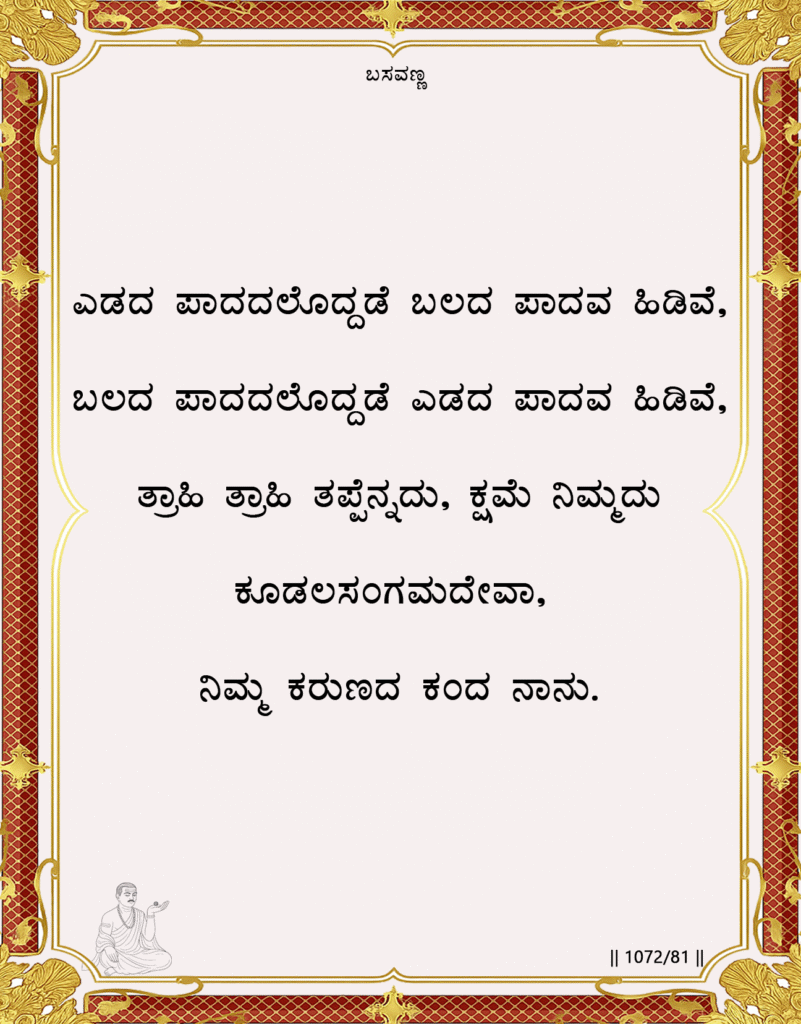
Falling from one foot,
I cling to the other
slipping, trembling, crying out:
“Save me… save me…
forgive my wandering ways.”
Helpless, I turn to You alone.
O Koodalasangamadeva,
I am but a child
cradled in Your boundless mercy.
Basavanna shows the soul as a child who keeps stumbling, unable to stand firm on its own strength. Each fall becomes a cry for divine help, revealing that spiritual growth begins when self reliance ends. True surrender is not weakness but wisdom the recognition that only divine grace can steady the wavering human heart. In this childlike dependence, the devotee discovers the compassionate embrace of Koodalasangamadeva, whose mercy alone becomes refuge and support.
Spiritual Context
Core Spiritual Principle: The culmination of spiritual wisdom is the recognition of one’s own utter helplessness and the total, childlike surrender to divine grace. The ego’s project of self perfection must fail completely for the soul to turn unconditionally towards God.
Cosmic Reality Perspective: The Divine (Linga) is the only absolute, unchanging reality. The individual soul (jiva), by its very nature as a limited entity, is inherently unstable (“slipping, trembling”). To realize this is not a defeat but an alignment with the truth of the cosmos: the part depends wholly on the Whole. The cry for help is the sound of the part seeking to remember its source.
Historical Reality (Anubhava Mantapa Context): This Vachana offers the ultimate solace to every seeker. It democratizes spirituality by making it accessible not to the strong and the perfect, but to the weak and the failing. It assures that the path is not about achieving invulnerability but about embracing one’s vulnerability as the very door through which grace enters. This was a comforting and empowering message for common householders struggling with their imperfections amidst a spiritual revolution.
Interpretation
1. “Falling from one foot, I cling to the other ” This vivid image portrays the inherent instability of the human condition. The “feet” represent the ego’s various strategies for security worldly success, intellectual knowledge, ritual piety. As each one fails (“falling”), the seeker desperately grabs for another, only to find it equally unreliable.
2. “slipping, trembling, crying out: ‘Save me… save me… forgive my wandering ways.'” This is the moment of existential crisis and breakthrough. The “slipping and trembling” is the collapse of self confidence. The cry “Save me” is the birth of true prayer a prayer that is not a transaction but a desperate plea from the depths of the soul. “Forgive my wandering ways” is the admission of guilt and delusion, the final relinquishment of the ego’s justification.
3. “Helpless, I turn to You alone.” This is the pivotal turn, the essence of surrender (sharanagati). The word “alone” is critical; it signifies the end of seeking other refuges. All alternatives have been exhausted.
4. “O Koodalasangamadeva, I am but a child cradled in Your boundless mercy.” The resolution. The seeker’s identity is redefined from a failed adult to a helpless “child.” This is not a regression but an evolution into a higher truth: the soul’s true relationship with the Divine is that of a dependent child to an all powerful, all loving parent. The “boundless mercy” is the new, eternal ground of existence.
Practical Implications: The seeker is guided to: Honestly acknowledge their weaknesses, failures, and instability without shame. Transform moments of failure into conscious prayers of surrender. Cultivate the attitude of a dependent child, trusting completely in the “boundless mercy” of the Divine, rather than in their own limited strength.
The Cosmic Reality
Anga (Human Dimension): The Anga is the “child” the soul that has surrendered its project of egoic autonomy and now exists in a state of conscious dependence.
Linga (Divine Principle): The Linga is the “boundless mercy” the compassionate, parental consciousness that welcomes, forgives, and cradles the surrendered soul.
Jangama (Dynamic Interaction): The Jangama is the cry, “Save me!” It is the dynamic act of surrender itself, the reaching out that forges the sacred bond between the helpless child and the divine parent.
Shata Sthala
Primary Sthala: Bhakta Sthala. This Vachana describes the most fundamental and purified form of devotion (bhakti), which is simple, heartfelt surrender. It is the gateway to all other stages.
Supporting Sthala: Prasadi Sthala. The state of being “cradled in boundless mercy” is the very definition of living in a state of grace (prasada). This entire Vachana is a description of the Prasadi experience from the perspective of the receiving Bhakta.
Practical Integration
Arivu (Awareness Practices): Prayer of Helplessness: Use the words of this Vachana as a daily meditation. Sit quietly, feel your own “slipping and trembling,” and inwardly or outwardly cry out, “Save me, O Kudalasangamadeva.” Feel the relief of surrendering the burden of self reliance.
Contemplation as a Child: Spend time in contemplation, actively imagining yourself as a small child being held and protected by a vast, loving, divine presence.
Achara (Personal Discipline): The primary discipline here is the discipline of surrender to constantly offer up one’s worries, fears, and sense of control to the Divine.
Kayaka (Sacred Action): Perform your work as an offering of the “child,” doing your best but offering the results to the Divine Parent, free from anxiety about success or failure.
Dasoha (Communal Offering): Create a community where vulnerability is safe. Be a compassionate presence for others in their moments of “slipping and trembling,” reminding them of the boundless mercy that holds them.
Modern Application
“The Tyranny of Self Help and Perfectionism.” Modern culture is obsessed with self optimization, resilience, and peak performance. This creates immense pressure and, ultimately, despair when individuals inevitably fail to meet these impossible standards. The narrative is that needing help is a sign of weakness.
The Liberative Application: This Vachana is a radical act of liberation from the cult of self reliance. It reframes “helplessness” not as a failure but as the most mature spiritual understanding. It offers permission to stop the exhausting performance of being in control and to find profound peace and strength in surrendering to a grace that is infinitely more reliable than the ego. It is the cure for burnout and spiritual exhaustion.
Essence
I built my house on my own two feet,
and watched the ground give way.
I have run out of ground, Lord.
I have run out of feet.
All that remains is this falling,
and the certain knowledge
that Your hands are the only ground.
Catch me.
This Vachana presents the metaphysics of surrender. It identifies the ego’s assertion of independence as the primary obstruction to grace. The path to liberation is therefore a path of kenosis an emptying of the ego’s claims to power, until only the cry for help remains. This cry is not a void but a potent, magnetic force that draws the divine response. Its multidimensional impact is to resolve the seeker’s fundamental anxiety by relocating the source of their security from their own fragile self to the indestructible Divine. It positions the Jangama as the principle of this surrendered cry, the ultimate human act that perfectly inverts the ego’s project and establishes the soul in its true, dependent relationship with the Absolute.
Your greatest strength lies in admitting your weakness. Your most powerful act is to surrender control. The peace you seek cannot be built by you; it can only be received by you when you stop building and start trusting. You are not a failed god; you are a beloved child of the Universe. Let go. Fall into the arms of the mercy that has been holding you all along.

Views: 0