Poetic Rendering
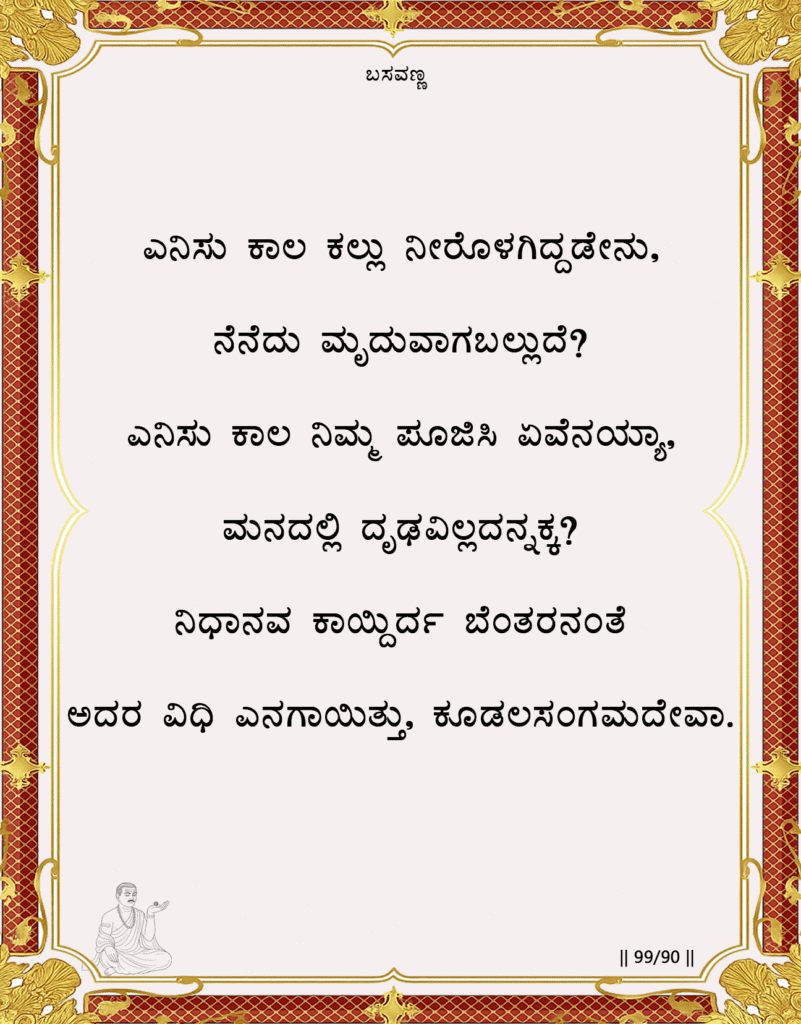
If a stone rests in water for ages,
does it ever soften, Lord?
So too, what use is worship
when the heart remains unchanged?
Like a treasure buried
under the guard of a dark spirit,
so has my own heart remained
untouched, unopened, unmoved.
O Koodalasangamadeva.
Basavanna uses the image of a stone lying in water yet never softening to show that mere outward worship cannot transform a hardened heart. Without inner sincerity, spiritual practices remain fruitless. Like a hidden treasure guarded by a dark force, the heart remains locked and unmelted. He confesses his own condition and prays for true inner transformation from Koodalasangamadeva.
Spiritual Context
Core Spiritual Principle: True spirituality is not a matter of external ritual but of profound internal metamorphosis. The efficacy of practice is measured solely by its power to soften the ego and purify the heart.
Cosmic Reality Perspective: From the non dual (Advaita) view, the individual self (Anga) must become porous and receptive to the pervasive presence of the Divine (Linga). A hardened heart is a manifestation of ignorance (Ajnana) that creates a false sense of separation, “guarding” the innate divine treasure within.
Historical Reality (Anubhava Mantapa Context): This Vachana is a radical critique of empty ritualism and Brahmanical orthodoxy that prioritized external observance over genuine inner experience. It champions the core Veerashaiva value of Antaranga Shuddhi (internal purity) over Bahiranga Kriye (external actions).
Interpretation
1. “If a stone rests in water for ages, does it ever soften, Lord?”: The “stone” is the egoic self, characterized by density, rigidity, and resistance. The “water” symbolizes the external forms of worship, spiritual practices, and even divine grace that surrounds an individual. The metaphor powerfully states that mere proximity to the sacred is insufficient; a fundamental change in the very substance of the self is required.
2. “So too, what use is worship when the heart remains unchanged?”: This is the direct, pragmatic application. Worship (Aradhane) that does not lead to a melting of arrogance, fear, and desire is merely a performance, a spiritual vanity. It questions the very purpose of practice if it leaves the core of one’s being untouched.
3. “Like a treasure buried under the guard of a dark spirit…”: The “treasure” is the divine Self (Atma Linga), the innate potential for enlightenment and bliss that resides within every individual. The “dark spirit” is the ego, the collection of samskaras (mental impressions), and the veil of Maya that guards this treasure through ignorance, creating a sense of lack and separation.
Practical Implications: The seeker is called to constant self vigilance. The primary question is not “Am I performing my rituals correctly?” but “Is my practice truly transforming me? Is my heart becoming more compassionate, humble, and open?”
The Cosmic Reality
Anga (Human Dimension): The Anga here is in a state of failure and confession. It is the unsoftened stone, the hardened heart, the individual whose inner landscape is guarded by the “dark spirit” of the ego. It is the seeker who has engaged in the form of worship but has not allowed its essence to penetrate.
Linga (Divine Principle): The Linga is invoked as “Koodalasangamadeva,” the Lord of the meeting rivers. This symbolizes the confluence of the individual soul with the Divine, the ultimate goal of transformation. The Linga is the transformative power that alone can dissolve the stone like heart and unlock the buried treasure.
Jangama (Dynamic Interaction): The Jangama is the act of sincere, confessional prayer itself. By articulating his state of spiritual stagnation to the Divine, Basavanna initiates the very Jangama relationship that can transform it. The Jangama is the bridge of honest self assessment and yearning that connects the flawed Anga with the redeeming Linga.
Shata Sthala
Primary Sthala: Bhakta Sthala. This Vachana is a masterclass on the essence of this initial stage. It moves beyond the simplistic definition of a Bhakta as one who performs worship, to define a true Bhakta as one whose worship is causing a tangible, internal softening. Basavanna exposes the shadow of the Bhakta stage: the risk of ritualistic complacency.
Supporting Sthala: Maheshwara Sthala. The internal softening and purification sought here are the very prerequisites for entering the Maheshwara stage, where one becomes a purified vessel fit for the indwelling of the Divine. One cannot become a “temple of God” (Maheshwara) with a stone heart.
Practical Integration
Arivu (Awareness Practices): Practice mindfulness during worship. After prayer or meditation, consciously reflect: “Was my mind soft and receptive, or was it hard and distracted? Did any deeply held resistance or negativity surface?” Use the “unsoftened stone” as a koan for self inquiry.
Achara (Personal Discipline): Cultivate practices that actively soften the heart outside of formal worship. This includes consciously practicing forgiveness, embracing humility in daily interactions, and engaging with viewpoints that challenge your own.
Kayaka (Sacred Action): Ensure your daily work is not just a mechanical duty (a “stone” in the water of life) but an act of offering that softens your arrogance and connects you to the community. Let the quality of your work reflect an inner change.
Dasoha (Communal Offering): Share not just material wealth but also your vulnerabilities. The confession in this Vachana is an act of spiritual Dasoha, reminding others that the path requires honesty about one’s failures. Create a community where members can acknowledge their “unsoftened” states without judgment.
Modern Application
Spiritual Consumerism and Performative Wellness. The modern seeker often “consumes” spirituality collecting workshops, apps, and rituals without allowing any to effect deep change. Social media fosters a culture of performative piety, where the appearance of being spiritual is valued over the messy, internal work of transformation. This leads to a “spiritual bypass,” where practices are used to reinforce the ego rather than dissolve it.
The Liberative Application: This Vachana acts as a profound corrective. It calls for an end to spiritual accumulation and a beginning of sincere, inner alchemy. It asks us to audit our spiritual lives not by the number of hours meditated or prayers chanted, but by the measurable increase in empathy, decrease in reactivity, and the genuine melting of our inner rigidity in the face of life’s challenges.
Essence
A lifetime in the river,
yet the core remains dry.
The ritual is a shell,
the heart, a guarded cry.
O Confluence,
not the water, but the stone,
is the lie.
This Vachana metaphysically deconstructs the process of spiritual practice itself. It posits that for the Anga Linga relationship (Jangama) to be authentic, the Anga must possess the fundamental quality of receptivity. A hardened heart is a state of metaphysical insulation; it is an Anga that has not undergone the necessary tapas (austerity) of self surrender to allow the Linga’s grace to permeate its being. The “dark spirit” is not an external entity but the self created, self perpetuating energy of ahamkara (egoity) that occludes the innate divinity.
The central, timeless message is that authentic transformation is an inside out process. No amount of external conditioning, knowledge, or ritual can substitute for the courageous, internal work of making one’s own being vulnerable, open, and receptive to change. It is a call to prioritize the state of one’s heart above all else, for that is the true measure of any spiritual endeavor.
Views: 0