Poetic Rendering
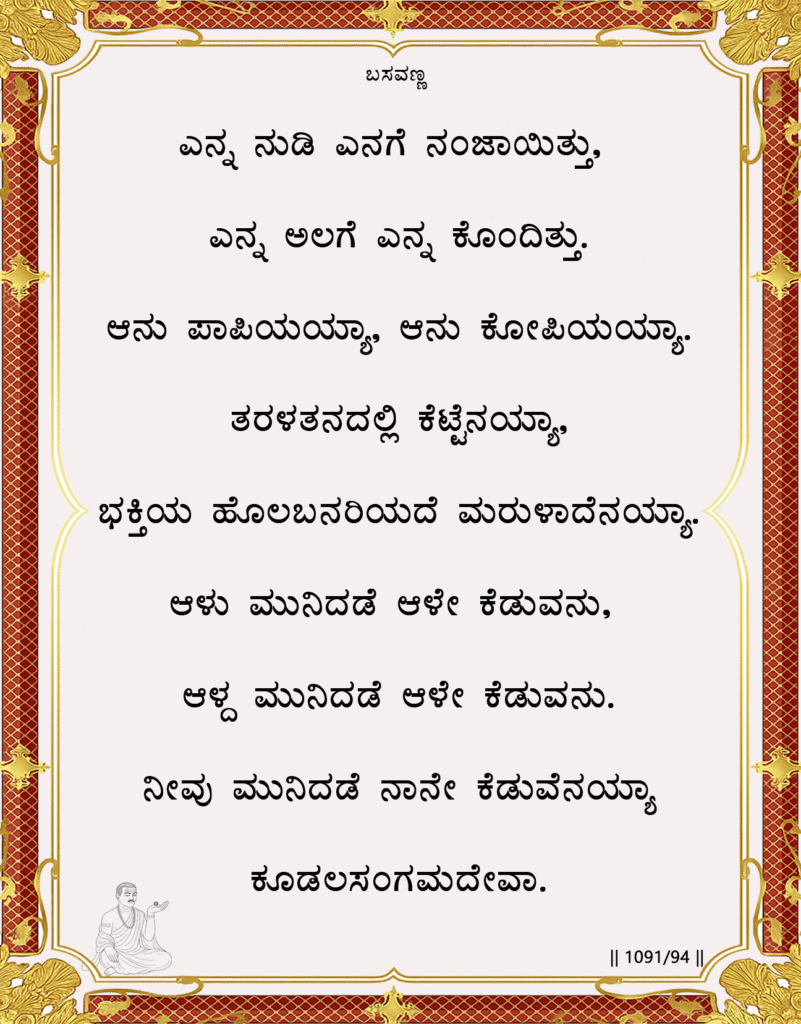
My own words have wounded me,
my own blade has turned against me.
I am the sinner,
the one quick to flare with anger.
In ignorance I wandered,
knowing nothing of the devotee’s path,
nothing of the way a bhakta should walk.
If a master is angered,
only the servant suffers loss
and if You were ever to turn away,
who but I would be destroyed?
Hold me fast in Your mercy,
O Koodalasangamadeva.
In this vachana, Basavanna confesses that his downfall arises not from others but from his own speech, impulses, and immaturity. He recognizes that without understanding the way of devotion, he has repeatedly harmed himself through anger and ignorance. Yet he also affirms a profound truth: when humans falter, only divine compassion can save them. If the Lord were to withdraw even slightly, the loss would be entirely his. Thus he stands before Koodalasangamadeva, seeking not justice but mercy, knowing that the devotee depends wholly on divine grace for transformation.
Spiritual Context
Core Spiritual Principle: The first step toward liberation is profound self-honesty and the recognition that the ego is its own worst enemy. The seeker’s primary obstacle is not external, but the internal ignorance (ajnana) that misuses one’s own faculties, causing self-inflicted suffering.
Cosmic Reality Perspective: From a non-dual standpoint, the “sin” is the misidentification of the true Self (Linga) with the limited, reactive ego (Anga). The anger and harmful speech are symptoms of this fundamental error. The path to correction is to realign the Anga’s dependence entirely on the Linga, its source.
Historical Reality (Anubhava Mantapa Context): This is a continuation of Basavanna’s internal revolution, dismantling the ego with the same fervor he applied to external social hierarchies. It reinforces the community’s ethos that spiritual progress requires brutal self-assessment and the rejection of spiritual hypocrisy.
Interpretation
1. “My own words have wounded me, my own blade has turned against me.”: This identifies the source of suffering as internal. The faculties of action (speech) and perception (the discerning mind as a “blade”) have been turned inward against the self due to ignorance, creating a cycle of self-generated karma (sanchita and agami).
2. “I am the sinner… In ignorance I wandered…”: This is a full acceptance of responsibility without deflection. He names the specific failing (krodha, anger) and its root cause (ajnana, ignorance of the Bhakta’s way). This awareness is itself the dawn of wisdom.
3. “If a master is angered, only the servant suffers loss…”: This analogy establishes the correct metaphysical relationship. The Anga is the servant, utterly dependent. Its well-being is contingent on the grace of the Linga, the Master. The devotee’s plea is based on this understanding of existential dependence.
The Cosmic Reality
Anga (Human Dimension): The Anga is in a state of confessed crisis. It is a self-destructive entity, aware that its own nature, untethered from the Linga, leads to its suffering. This awareness is the Anga’s most evolved state in this contextthe clarity of seeing its own flawed nature.
Linga (Divine Principle): The Linga is Koodalasangamadeva in the role of the compassionate Master. The Linga’s “anger” is not a human emotion but the natural consequence of the law of karma, which the devotee incurs upon themselves. The Linga’s “mercy” is the conscious, gracious intervention that can suspend this law.
Jangama (Dynamic Interaction): The Jangama is the desperate, truthful appeal that bridges the gap between the flawed Anga and the merciful Linga. It is the dynamic of confession and supplication that activates the flow of grace, preventing the Anga’s self-destruction and re-establishing the sacred connection.
Shata Sthala
Primary Sthala: Bhakta Sthala. This Vachana defines the essential crisis of the early seeker. A true Bhakta is not one who is pious, but one who realizes their own impiety and the dire consequences of being disconnected from the Divine. This painful self-awareness is the prerequisite for authentic devotion.
Supporting Sthala: Prasadi Sthala. The entire Vachana is a prayer for the descent of Prasada (Grace). The Bhakta’s realization of their own bankruptcy is the vacuum that draws the grace of the Prasadi stage into their life.
Practical Integration
Arivu (Awareness Practices): Cultivate a witness consciousness toward your own reactive patterns. When anger or harsh speech arises, step back and observe: “This energy is now turning inward to harm me.” Use this awareness not for self-flagellation but as a trigger for the prayer: “Koodalasangamadeva, hold me in Your mercy.”
Achara (Personal Discipline): The primary discipline is mindful speech (vak tapas). Before speaking, especially in anger, pause and remember that words are a blade that can wound the self. The discipline is to consciously offer the impulse to speak to the Divine before expressing it.
Kayaka (Sacred Action): Perform all actions with the attitude of a servant fulfilling a duty for the Master. This reframes action from being a source of personal gain or failure to an offering, reducing the ego’s volatility and the resulting self-harm.
Dasoha (Communal Offering): By openly confessing his own flaws, Basavanna performs a Dasoha of humility. It creates a community where individuals can be authentic about their struggles, fostering an environment of mutual support rather than judgment, and collectively relying on divine grace.
Modern Application
The Self-Help Trap and Projection of Blame. Modern culture often promotes a “self-help” paradigm that can become a subtle form of self-aggression the relentless pressure to “fix” oneself. Conversely, there is a widespread tendency to project blame for one’s suffering onto external factors parents, society, politics avoiding self-responsibility. Both lead to cycles of frustration and powerlessness.
This Vachana offers a way out by combining radical self-responsibility with radical reliance on grace. It liberates one from the exhausting loop of self-improvement and the bitterness of blame. It teaches that we must own our capacity for self-harm, but we need not rely on our own limited power to heal it; that is the role of a grace greater than the ego.
Essence
I forged the blade, I spoke the curse,
My own nature is my universe.
I stand accused by my own hand,
In need of grace I can’t command.
Do not regard what I have earned,
But by the love I have not spurned,
O Confluence, let me be turned.
1. The Karmic Feedback Loop: The “words” and “blade” represent the faculties of Vak (speech) and Buddhi (intellect). When operated under the illusion of a separate self (ahamkara), they generate negative karma (papa) that immediately feedbacks, reinforcing the sense of a suffering, isolated entity. This is a closed system from which the ego cannot extricate itself.
2. The Plea as a System Override: The heartfelt prayer to Koodalasangamadeva is not a mere request; it is a metaphysical act designed to break this karmic feedback loop. By acknowledging the Linga as the sole Master and the self as the servant, the seeker deliberately introduces a new variable into the systemDivine Grace (Shakti-pata). This grace has the power to suspend the laws of karma that the ego is subject to, offering a “soft reset” of the consciousness.
3. The Jangama of Relational Dynamics: The Jangama here is the understanding of the master-servant relationship itself. The devotee’s survival depends on the master’s continued regard. This understanding is the crucial leverage that shifts the seeker’s focus from self-correction (an ego-driven activity) to self-offering (a grace-driven activity). The ultimate realization is that the Anga’s only true “work” is to maintain this receptive, dependent posture, allowing the Linga’s transformative power to do the healing.
The universal message is that our deepest wounds are self-inflicted, and our healing lies not in our own hands, but in surrendering those wounded hands to a merciful higher power. True strength is found not in the assertion of egoic control, but in the humble admission of our lack of control and our profound need for a love and grace that can accept us in our brokenness and begin a transformation we cannot accomplish alone.

Views: 0