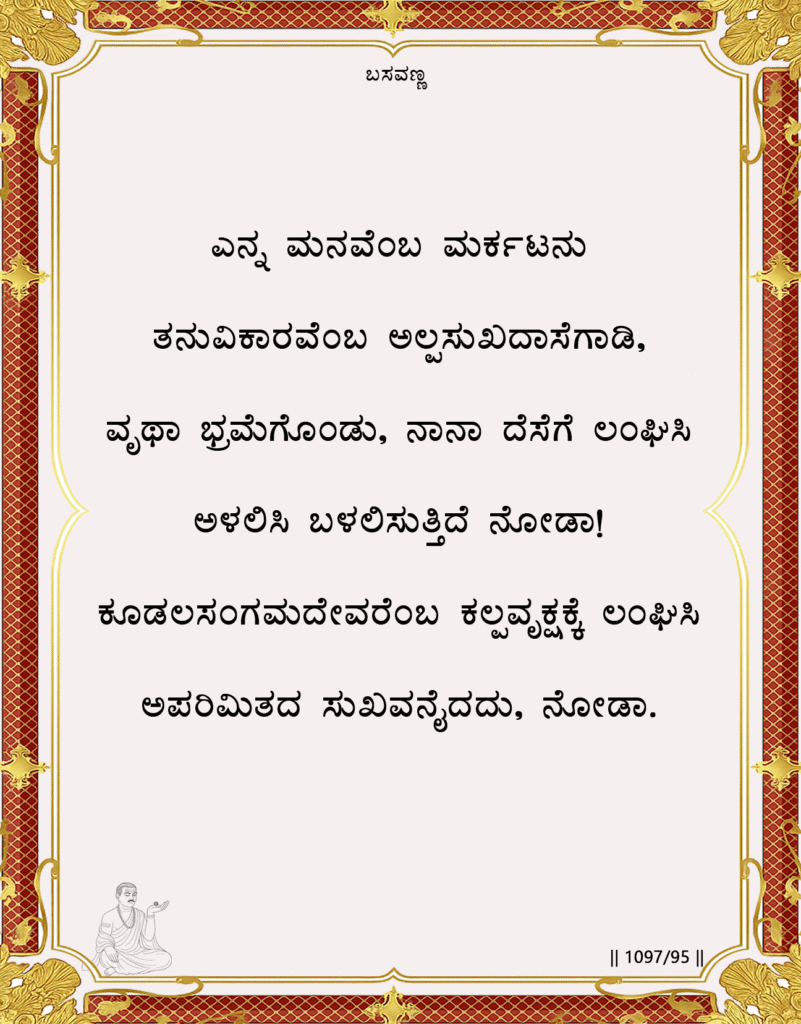
Poetic Rendering
My mind leaps like a restless monkey,
chasing the body’s fleeting pleasures.
Lost in illusions, I wandered
seeking what fades,
grasping what wounds,
and harvesting only sorrow.
To You, O Koodalasangamadeva,
I have clung to what is useless,
gathered what is unworthy,
and now I sit without the peace
my soul longs for.
Basavanna compares his mind to a monkey restless, impulsive, and easily trapped by the temptations of the world. In pursuing temporary pleasures and clinging to illusions, he recognizes that he has filled his life with things that weigh down rather than uplift. This self-awareness leads him to admit that the peace he seeks cannot arise from worldly pursuits. Only by releasing what is unnecessary and turning wholeheartedly toward Koodalasangamadeva does the seeker find true rest. This vachana reveals the essential spiritual transition from outward distraction to inward clarity.
Spiritual Context
Core Spiritual Principle: The fundamental obstacle to peace is the untamed, outwardly-directed mind. Spiritual progress begins not with acquiring divine experiences, but with recognizing and confessing the mind’s inherent restlessness and its futile pursuit of satisfaction in the ephemeral.
Cosmic Reality Perspective: From the non-dual view, the mind (manas) is a tool of consciousness that has become identified with the phenomenal world (Prakriti). This identification creates the “restless monkey.” The Linga represents pure, unchanging Consciousness (Purusha). Peace is found not by calming the monkey, but by re-identifying with the still Awareness that witnesses its restlessness.
Historical Reality (Anubhava Mantapa Context): This Vachana provides a psychological foundation for the Veerashaiva revolt against external ritualism. It implies that a mind obsessed with worldly or religious forms cannot grasp the formless Divine. The first “ritual” is the inner one of mastering one’s own mental chaos.
Interpretation
1. “My mind leaps like a restless monkey…”: The “monkey mind” (manas) is a universal archetype for the undisciplined intellect, hopping from one sense object (vishaya) to another, driven by latent impressions (vasanas). This is the default state of unawakened humanity.
2. “seeking what fades, grasping what wounds, and harvesting only sorrow.”: This is a precise analysis of Samsarathe cycle of birth and death. Pursuing impermanent objects (anitya) leads to attachment, which inevitably causes pain when the object changes or is lost (duhkha). The “harvest” is the accumulation of negative karma.
3. “I have clung to what is useless, gathered what is unworthy…”: This is the moment of Viveka (discernment). The seeker develops the wisdom to distinguish between the precious (sara) and the worthless (asara). Worldly pursuits are “unworthy” not because they are evil, but because they cannot yield the eternal peace (shanti) the soul truly seeks.
4. “…now I sit without the peace my soul longs for.”: This is the culminating point of divine discontent. The suffering of seeking in the wrong place becomes so acute that it forces a fundamental reorientation. This feeling of lack is the space into which grace can flow.
The Cosmic Reality
Anga (Human Dimension): The Anga is the psycho-physical apparatus dominated by the restless mind and demanding senses. It is the seat of desire and the experiencer of the resulting sorrow. Its current state is one of exhaustion and confessed failure.
Linga (Divine Principle): The Linga is Koodalasangamadeva, symbolizing the eternal, peaceful, and fulfilling reality that stands in stark contrast to the fleeting objects of the monkey mind. It is the true object of the soul’s longing.
Jangama (Dynamic Interaction): The Jangama is the conscious act of turning away from the world and toward the Divine. It is the dynamic process of re-channeling the energy of seeking from external, “unworthy” objects to the internal, worthy Lord. The confession itself is the first step in this Jangama.
Shata Sthala
Primary Sthala: Bhakta Sthala. This Vachana captures the very genesis of the Bhakta. A devotee is born the moment one realizes the emptiness of worldly pursuits and feels a genuine longing for a higher, lasting peace. This disillusionment is the fertile ground for devotion.
Supporting Sthala: Maheshwara Sthala. The “peace the soul longs for” is the state of inner purity and stillness that characterizes the Maheshwara, who has become a fit temple for the Divine. The Bhakta’s longing is for the stability of this next stage.
Practical Integration
Arivu (Awareness Practices): Practice mindfulness meditation to simply observe the “monkey mind” without judgment or engagement. Label thoughts as “seeking,” “grasping,” or “sorrow” as they arise. This cultivates the witnessing awareness that is separate from the mind’s chaos.
Achara (Personal Discipline): Implement a discipline of conscious consumption. This includes not just food, but also media, information, and conversation. Ask, “Is this nourishing my soul or merely stimulating my restless mind?” Practice Pratyahara (withdrawal of the senses).
Kayaka (Sacred Action): Engage in work as a form of mindfulness practice. Focus completely on the task at hand, using it as an anchor to tame the monkey mind. Let the work itself be an offering that redirects your energy from distraction to purposeful action.
Dasoha (Communal Offering): Share your journey of disillusionment. By confessing our shared human restlessness, we break the illusion that everyone else has it “figured out.” This creates a supportive community that values inner peace over outer achievement, making it easier for all to turn inward.
Modern Application
The Attention Economy and Digital Distraction. The modern world is engineered to exploit the “monkey mind.” Social media, 24/7 news, and targeted advertising constantly trigger our seeking and grasping instincts, leading to information overload, anxiety, and a profound sense of dissatisfaction despite material abundance.
This Vachana is a powerful diagnosis and cure for the digital age. It calls for a conscious “digital detox” and a radical re-evaluation of what we pay attention to. It liberates us by showing that the peace we seek through endless scrolling and consumption is an illusion. True peace requires consciously withdrawing our attention from the digital “world” and re-investing it in the silent, inner “Lord,” Koodalasangamadeva.
Essence
A monkey-mind, a world of toys,
A chase that harvests only noise.
I gathered dust and called it gold,
A story of a thirst untold.
Now, with empty hands and quiet plea,
I turn from all but You to see.
1. The Observer Effect and the Collapse of Duality: In quantum mechanics, the act of observation collapses a wave of probabilities into a defined particle. The “restless monkey” mind performs this function continuously upon the unified field of consciousness. By fixating on a sensory object or thought (“chasing the body’s pleasures”), the mind’s attention acts as a measurement. This collapses the non-dual awareness (Linga) into a stark subject-object duality: the “seeker” and the “thing sought.” Each grasp is a quantum event that crystallizes the illusion of a separate self, generating the karmic momentum that binds it.
2. The Entropy of Scattered Attention: From an information theory perspective, a scattered mind is a high-entropy system disordered, noisy, and inefficient. The energy of consciousness, when dissipated across countless sense objects, produces no coherent output other than “sorrow.” This is the “harvest” of which Basavanna speaks. The mind, in this state, is a receiver overwhelmed by static, unable to lock onto the singular signal of divine truth.
3. Jangama as a Coherence Engine: The act of turning the entire being toward Koodalasangamadeva is a metaphysical process of inducing coherence. It is the conscious effort to reduce the entropy of the mind. By withdrawing attention from the multitude of “unworthy” targets and focusing it on the singular Linga, the seeker’s consciousness transitions from a state of chaotic probability to a state of ordered, laser-like focus. This realignment does not deny the world but re-contextualizes it; phenomena are no longer measured as separate objects to be acquired, but are perceived as transient modulations within the singular, unbroken field of the Divine. The resulting “peace” is the experiential quality of a low-entropy, coherent consciousness, resonant with its source.
Suffering is not your default state; it is the product of a distracted attention that creates fragmentation. Peace is not something to be found, but something to be uncovered by ceasing the activity that obscures it. By consciously directing your awareness from the many to the One, you shift from being a victim of your reality to being the conscious source of your experience.

Views: 0