

Summary
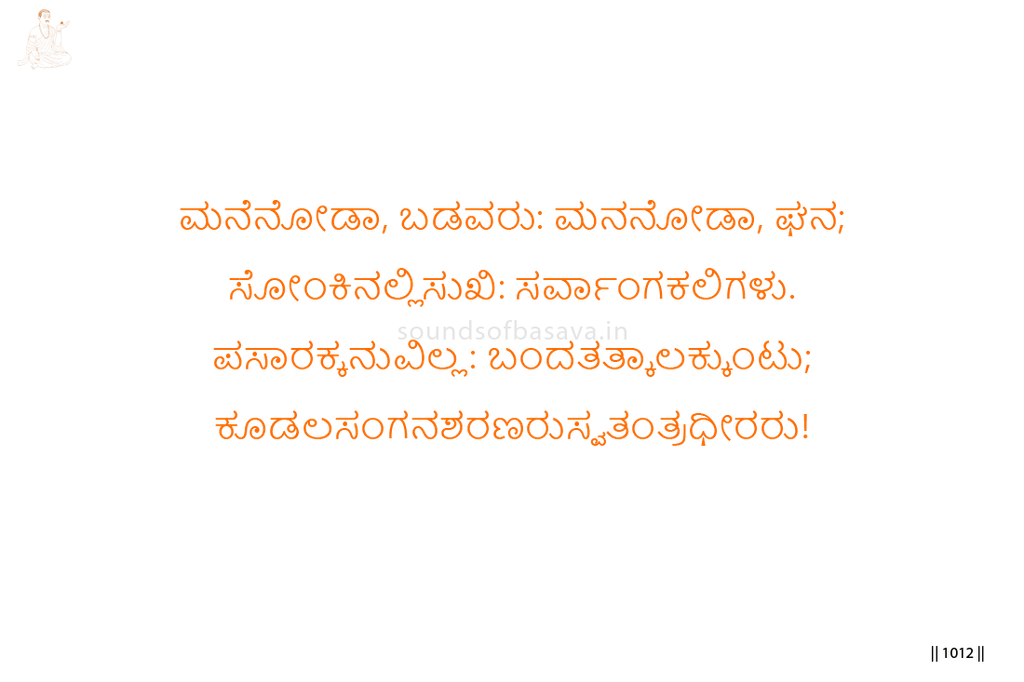
Basavanna contrasts outer poverty with inner greatness. The Sharanas may appear poor when one looks at their house or outward condition, but when one looks at their mind, they are vast.
Their purity is not measured by social status, ornament, wealth, or external refinement. It is shown in touch, conduct, and total bearing. The Aikya source explains that the Sharanas may appear materially poor and outwardly simple, yet inwardly they possess immeasurable richness because they are free from greed, fear, dependence, and possessiveness.
The final line names them as the free and steadfast Sharanas of Kudalasangama. Their true currency is not possession, but inner freedom. They cannot be bought, shaken, or measured by worldly value.
Imagery & Symbolic Relevance
The line “look at the house: they are poor” gives the first image. The house represents outer condition, visible possession, and social measure. If one judges only by the house, the Sharana may appear poor.
The line “look at the mind: it is vast” reverses the first image. Basavanna asks us to shift from outer dwelling to inner dwelling. The mind of the Sharana is not narrow, anxious, or possession-bound. It is expansive because it is not trapped in ownership.
The contrast between house and mind is the heart of the vachana. Outer poverty does not prove inner lack. Inner vastness does not depend on outer possession.
The phrase “pure in touch” gives the next image. Touch here should not be reduced to social ideas of purity and impurity. The Aikya source clarifies that the purity of the Sharanas is not ritual purity, but integrity of consciousness.
The phrase “all limbs are strong” shows that this purity is embodied. The Sharana’s freedom is not only inward thought; it is visible in the whole bearing of life. The body, movement, conduct, and presence carry steadiness.
The phrase “no need for provision” or “no dependence upon stored means” gives another sign of freedom. The Sharana is not governed by anxiety over gain, arrangement, or future security. What comes in the needed moment is enough.
The phrase “when the moment comes, it is there” shows trust in the present. The Sharana does not live by endless calculation. The Aikya source states that the Sharana does not live psychologically divided between desire, regret, fear, ambition, and memory; presence itself becomes spiritual freedom.
The final statement, “Kudalasangama’s Sharanas are independent and steadfast,” completes the vachana. Their independence is not pride or isolation. It is freedom from being ruled by possession, fear, social approval, or bargaining.
Together, the lines show the reversal of worldly value. The house may look poor, but the mind is vast. Outer lack may be visible, but inward freedom is the true wealth. Kudalasangama’s Sharanas stand as those whose value cannot be measured by property, status, or ornament.
Lingayoga
In Lingayoga, this vachana teaches the seeker not to confuse outer condition with spiritual measure. A poor house may contain a vast mind, and a wealthy house may contain fear, greed, or dependence.
The practice-point is direct: examine where value is being placed. If the seeker measures life by possession, provision, and appearance, the inner field remains small. If the seeker stands in truth without bargaining, the mind becomes vast before Kudalasangama Deva.
The Aikya source states that true value lies not in ownership, ornament, caste, ritual status, or public honor, but in inward clarity, fearless truthfulness, and uninterrupted awareness of Kudalasangama Deva.
Editorial Commentary
This vachana should be read as a correction of social and spiritual valuation. Basavanna is not romanticizing poverty by itself. He is showing that outer poverty does not define the Sharana, and outer wealth does not create greatness.
The key contrast is between house and mind. The house may be poor, but the mind is vast. The true measure is the free stature of Kudalasangama’s Sharanas.
Related Vachana
Supporting Vachana
Sharana Sthala Vachana 325 — The Chain of Gems Is Still a Chain
Sharana Vachana 325 supports this Aikya vachana by teaching sufficiency through the hands already given for Bhakti and work. There, Basavanna says the ten fingers are enough for Bhakti, for work, and for supporting the Pramathas, while even a chain made of gems remains a chain before Kudalasangama Deva.
Aikya Vachana 326 carries this forward. In Sharana Vachana 325, ornament is rejected because even beauty can bind. In Aikya Vachana 326, the Sharanas stand beyond such valuation altogether: their house may appear poor, but their mind is vast, their bearing is pure, and their freedom is their true wealth.
Advancing Vachana
Aikya Sthala Vachana 854 — Every Step the Sacred Ground
Aikya Vachana 854 advances this teaching within Aikya Sthala. In Vachana 326, Kudalasangama’s Sharanas are free and steadfast, no longer measured by outer possession. In Vachana 854, that freedom becomes total sacred movement: every step is a sacred place, every step is a divine field, and the Sharana stands free, independent of all.
Thus Vachana 326 shows the inward wealth and independence of the Sharanas, while Vachana 854 shows that such independence has become the very ground of their movement. The poor house and vast mind of Vachana 326 deepen into the state where every step itself is sacred before Kudalasangama Deva.
